Quote Explained: “The obstacle is the way.”
By Ryan Holiday, author of The Obstacle Is the Way and The Daily Stoic
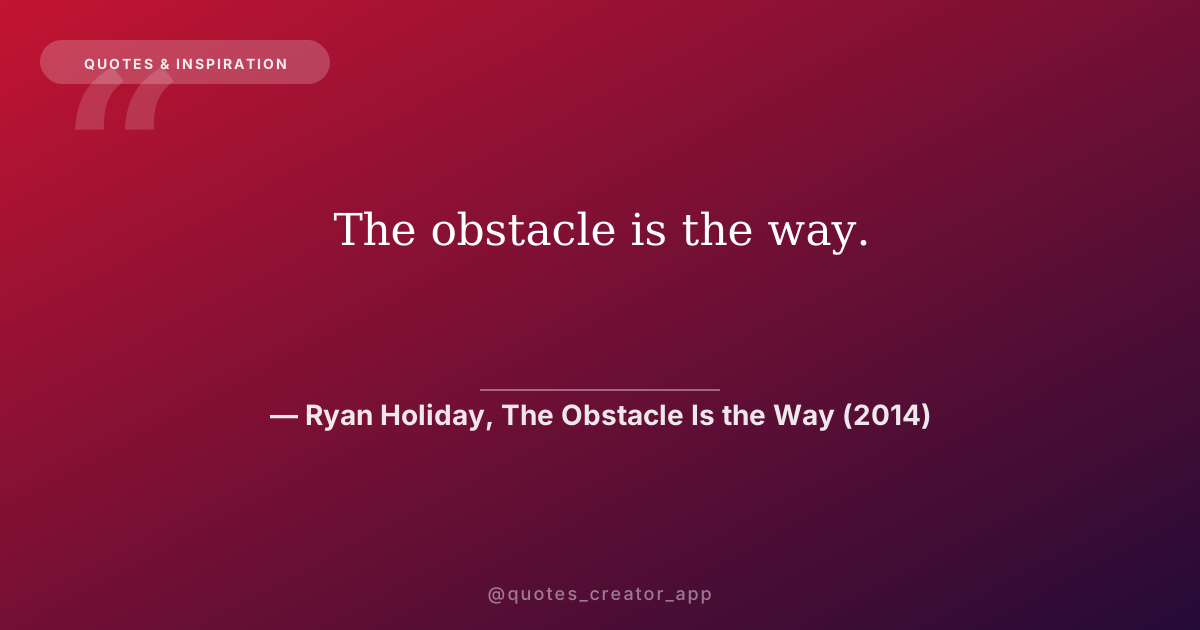
“The obstacle is the way.”
The context
Ryan Holiday did not invent the idea that adversity can be converted into advantage; he resurrected it. The phrase “the obstacle is the way” is his contemporary distillation of a principle that reaches back nearly two millennia, to the private notebooks of the Roman emperor Marcus Aurelius. Writing to himself in the Meditations, a journal never intended for publication, Aurelius observed: “The impediment to action advances action. What stands in the way becomes the way.” It was a radical inversion of common sense — the assertion that the thing blocking your path is not merely to be endured or overcome, but that it is the path, the very material out of which progress is built. For centuries this idea slept in the footnotes of classical scholarship, admired by a handful of philosophers but unknown to the culture at large. It took a college dropout with a talent for connecting ancient wisdom to modern ambition to drag it back into the daylight.
Holiday came to Stoicism not through the academy but through the furnace of early career. He dropped out of the University of California, Riverside at nineteen to apprentice under Robert Greene, the author of The 48 Laws of Power, an experience that immersed him in the ruthless mechanics of strategy and influence. He then became director of marketing at American Apparel, where he weathered public-relations firestorms and boardroom chaos while still in his twenties. The Stoic texts he read during those years — Aurelius, Seneca, Epictetus — stopped being academic curiosities and became survival manuals. He noticed that the people he admired most, from entrepreneurs to athletes, shared a common posture toward failure: they treated setbacks not as interruptions but as raw material. In 2014, he published The Obstacle Is the Way: The Timeless Art of Turning Trials into Triumph, and the book found an unexpected audience — NFL coaches, Navy SEALs, Silicon Valley founders, and ordinary people fighting through illness, debt, and loss. The book’s title, a five-word thesis, became a meme, a mantra, and eventually a movement.
The timing was no accident. Holiday published at a cultural inflection point — the aftermath of the 2008 financial crisis, the rise of an always-on digital economy, and a creeping sense that the old certainties about careers, institutions, and progress were dissolving. Traditional Stoicism, with its reputation for grim resignation, had been misunderstood as passivity: accept your fate, suppress your emotions, endure. Holiday repackaged it as something almost the opposite — a philosophy of agency. His Stoicism was not about tolerating obstacles but about metabolizing them, about recognizing that the events which seem to block us are often the precise mechanism of our growth. That reframing caught fire precisely because it answered a question the modern self-help industry had been fumbling for decades: not “how do I avoid problems?” but “how do I turn the problems I already have into fuel?”
The meaning
The quote’s power lies in its compression. Five words, three of which are utterly ordinary, arranged into a sentence that functions like a key turning in a lock. “The obstacle” is the thing we have spent our lives learning to resent — the rejection, the illness, the competitor, the setback, the person who wronged us. “The way” is the thing we have spent our lives pursuing — the route forward, the path to what we want, the answer to our problem. The genius of the sentence is the verb that joins them: “is.” Not “is on the way,” not “is in the way,” not “is part of the way.” The obstacle and the way are not adjacent, not overlapping, not sequential. They are identical. The sentence collapses the distance between problem and solution into a single point, and in doing so it abolishes the entire mental framework that keeps us stuck — the assumption that the obstacle is a barrier standing between us and the path, when in fact it is the path itself.
To grasp what Holiday means, it helps to see what he is rejecting. The default human response to difficulty is complaint, avoidance, or brute-force denial. We treat obstacles as aberrations, as unfair interruptions of a plan that was supposed to go smoothly. This is the mindset of the victim, and it is seductive precisely because it is comfortable — it relieves us of responsibility while allowing us to feel wronged. Holiday’s aphorism dismantles this posture by changing the question we ask. Instead of asking “why is this happening to me?” — a question that has no actionable answer — the Stoic asks “what is this obstacle teaching me, and what can it become?” The obstacle is not meaningless suffering to be endured until it passes. It is information. It is resistance, and resistance, as every athlete knows, is the only thing that builds strength. A muscle does not grow without tension; a mind does not sharpen without difficulty; a character does not form without friction. Remove the obstacle and you remove the very conditions that produce the person you are trying to become.
There is a deeper layer still, one Holiday inherited directly from Aurelius and the Stoic doctrine of the “dichotomy of control.” The Stoics taught that the world divides neatly into what is up to us — our judgments, our choices, our character — and what is not — the weather, the economy, the behavior of other people, our own eventual death. Suffering, they argued, arises almost entirely from confusing these two categories: from trying to control the uncontrollable and neglecting the one thing we actually command. “The obstacle is the way” is the applied form of this doctrine. Most obstacles — a layoff, a rejection, a market crash, a pandemic — are not up to us. What is up to us is how we perceive them, how we act in response, and whether we let them embitter us or refine us. The obstacle, in other words, is the arena in which our only real power — the power over our own response — becomes visible and consequential. It is not that the obstacle is secretly a gift; it is that our response to the obstacle is the only gift we ever fully own.
Why it still matters today
In 2026, the idea behind this quote is arguably more necessary than when Aurelius wrote it. We are living through what feels like a permanent state of disruption — artificial intelligence remaking the nature of work, climate instability rewriting the geography of daily life, political fragmentation dissolving shared truths, and a digital attention economy engineered to keep us perpetually dissatisfied and distracted. The reflex response to this moment, visible everywhere, is a retreat into complaint and blame: the algorithms are rigged, the system is broken, the other side is lying. Some of these grievances are true. But the posture they produce is fatal, because it locates all agency outside the self precisely when the self is the only lever we reliably control. Holiday’s aphorism is a corrective to the age of the victim narrative — not a denial that obstacles are real and often unjust, but an insistence that they remain, even so, the raw material of whatever we make next.
The quote also speaks with unusual force to the professional and personal anxieties of our era. Workers displaced by automation are told to reskill; founders facing collapse are told to pivot; the sick, the bereaved, and the burned-out are told to “practice gratitude.” Much of this advice is empty because it skips the essential first step that Holiday never skips: the obstacle is not something you get past and then return to your life. It is your life. The person who loses a job is not awaiting a return to normal; they are inside a transformation that will either forge something or corrode something. The founder whose company fails has not wasted years; they have acquired an education no school could sell them. This reframe is not positivity — it is precision. It does not promise that everything works out; it promises that everything counts. In a culture that chases comfort and avoids pain at all costs, that promise — that our hardest moments are not dead ends but crossroads — is a quiet form of liberation.
How to apply this in your own life
Applying “the obstacle is the way” begins with a disciplined act of perception. Holiday, following the Stoics, breaks the practice into three moves: perception, action, and will. Perception is the art of seeing clearly — stripping an obstacle of the emotional distortion that makes it look larger than it is and asking, coldly, “what exactly is in my way, and what is the real problem here?” Action is the art of moving — not waiting for perfect conditions, but doing the one thing that can be done now, however small, because forward motion is itself a kind of medicine. Will is the art of endurance — the cultivated ability to keep going when the outcome is uncertain, to treat failure as feedback rather than verdict. In practice, this means a simple daily ritual: when something goes wrong, write down the obstacle in one sentence, then write down the worst possible outcome, then write down one way this specific obstacle could actually help you — a skill it forces you to learn, a weakness it exposes, a door it opens. The exercise is trivial in effort and transformative in effect, because it retrains the reflex that currently runs your life on autopilot.
The deeper application is existential. Most of us spend our lives waiting for the obstacle to clear so that we can finally begin — waiting to feel confident before we start, waiting for permission before we act, waiting for the ideal job, the ideal partner, the ideal moment. Holiday’s quote is an invitation to stop waiting and start building with what you have, inside the constraint you currently resent. The constraint is not a postponement of your story; it is the plot. The writer who has no time becomes disciplined precisely because time is scarce. The athlete who is overlooked trains with a fury the favored never summon. The person who has been broken learns a depth of compassion the unscarred can only imitate. To live this quote is to accept that you will never be handed an obstacle-free life, and to stop wanting one — because the obstacle-free life, even if it existed, would leave you soft, untested, and unformed. What stands in your way, right now, is not the problem. It is the assignment. The only question that remains is whether you will treat it as a wall or as a door.
Create your own quote graphic with this quote
This is the kind of quote that rearranges your relationship to difficulty. When you pair an idea this bracing with thoughtful design, you create something worth saving and returning to. Use our free online quote maker to turn this exact quote into a shareable image in seconds — no signup needed. For advanced features like video quotes and 100+ templates, try the Quotes Creator Android app.
Why we chose this quote
We chose this quote because it compresses an entire philosophical tradition into five words that anyone can carry. It is rare for an idea so ancient to feel so immediately necessary, and rarer still for it to be both a comfort and a challenge at once. It refuses the twin temptations of our time — the belief that our problems are someone else’s fault, and the belief that comfort is the measure of a good life — and offers in their place something sturdier: the conviction that the very thing you most want to avoid is the thing most likely to make you. Few quotes reward reflection as generously, or return as much value when applied. That is why it stays with people long after the book is closed.
— ThinkPeak Studio Editorial Team
Create your own quote graphic with this quote
Turn this line into a shareable graphic in seconds — free, no signup needed. For video quotes and 100+ templates, try the Android app.
Advertisement
Enjoyed this article? Get more like it in your inbox.