Quote Explained: “It is not that we have a short time to live…”
By Seneca, Roman Stoic philosopher
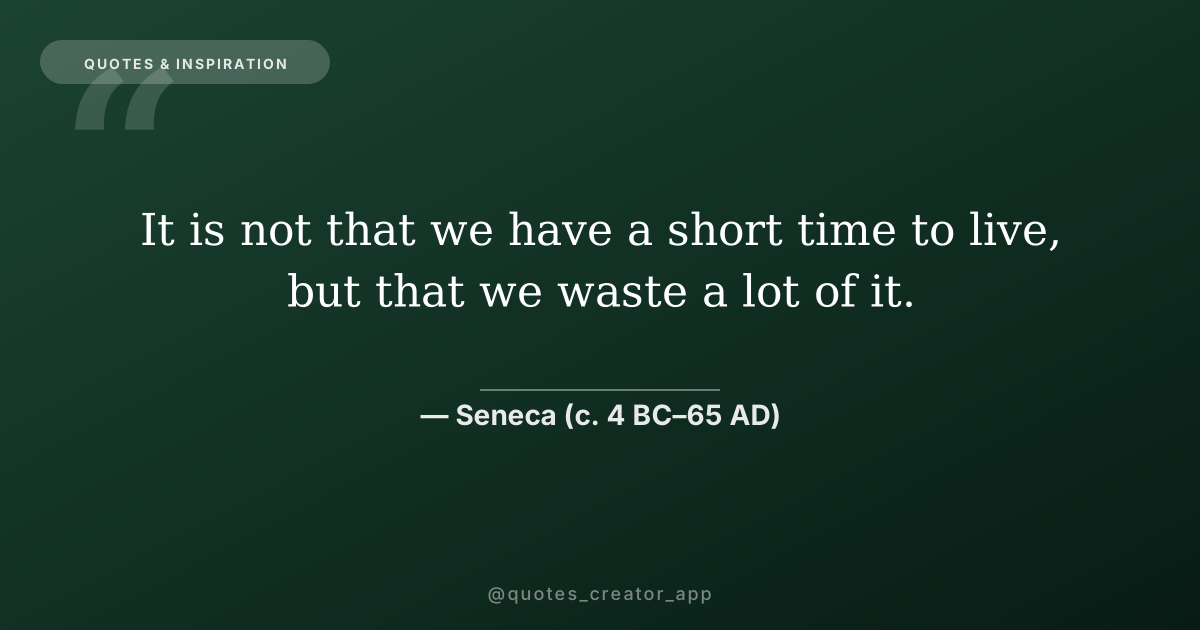
“It is not that we have a short time to live, but that we waste a lot of it.”
The context
When Seneca composed On the Shortness of Life around 49 AD, he had just returned from eight grueling years of exile on the island of Corsica. Banished by the emperor Claudius on a dubious charge of adultery with Caligula’s sister, Seneca had spent nearly a decade stripped of his wealth, his political influence, and his place in Roman society. He was in his mid-forties, at an age when many Romans considered a public career essentially over, and he had every reason to feel that his life had been stolen from him. The essay he produced upon his return, addressed to his father-in-law Paulinus, was not the bitter diatribe of a man who had been wronged. It was something far more unsettling: a calm, surgical diagnosis of how virtually everyone wastes their life, delivered by someone who had been given a front-row seat to the fragility of fortune.
The essay’s premise is almost insultingly simple. People complain constantly that life is too short, Seneca observes, yet they behave as though they have an infinite supply of it. They lend their attention to patrons who do not value them, spend years grooming themselves for dinner parties that will be forgotten by morning, drift through idle amusements, and pursue wealth they will never have time to enjoy. The central argument is not that life is short but that we make it short by squandering it on things that do not matter. The quote that has echoed for two thousand years is the essay’s thesis statement packed into a single devastating sentence: the problem is not the quantity of time but the quality of our relationship with it. Seneca was not interested in making people feel guilty about their choices. He was trying to wake them up before it was too late — and his urgency came from having faced the very real possibility that it already was too late for him.
Understanding the audience helps explain why the tone is so direct. Paulinus was a senior Roman official, the prefect of the grain supply, a man whose days were consumed by administrative minutiae and political obligations. Seneca’s message to him was pointed: you are a capable man running an empire’s food supply, but what are you running your own life toward? This was not a casual question in first-century Rome. Stoicism taught that the only thing a person truly owns is their moral character and the use of their present moment. Everything else — wealth, reputation, even physical health — is on loan from fortune and can be recalled without notice. Seneca chose to frame his argument not as abstract philosophy but as an urgent piece of practical advice delivered from one busy, ambitious man to another. That is part of why it still reads as though it were written yesterday: the distractions have changed, but the fundamental architecture of self-squandered time has not.
The meaning
The sentence operates as a frontal attack on the most common rationalization people use to avoid confronting their own choices. When someone says “I don’t have enough time,” they are usually making a claim about external circumstances: the demands of their job, the needs of their family, the pace of modern life. Seneca refuses to accept the premise. He insists that the claim itself is a form of self-deception. Life is not short in any absolute sense, he writes earlier in the essay; it is long enough — even abundant enough — to accomplish the greatest things, provided it is well invested. The person who reaches the end of life feeling cheated is not a victim of a cosmic shortage of minutes. They are someone who spent decades buying things they did not need with time they could not afford to lose. The quote is a mirror: it forces the reader to stop looking outward for someone or something to blame and to start looking inward at the daily decisions that constitute a life.
But there is a subtler layer to the argument that most casual readers miss. Seneca is not merely saying that wasting time is bad; he is redefining what it means to possess time at all. For Seneca, the future does not belong to you, and the past is irretrievable. The only moment you genuinely own is the present one. But the present moment, by its nature, is vanishingly brief — a razor’s edge between what has already disappeared and what has not yet arrived. Most people, he argues, let even that single point of ownership slip through their fingers by filling the present with preoccupations about the past or anxieties about the future. The person who is truly present to their own life can stretch a single hour into what feels like a day of meaningful existence. The person who is mentally absent even during their leisure might live eighty years and experience perhaps five of them. The waste, then, is not only about choosing the wrong activities; it is about being mentally absent from the activities you do choose. Seneca anticipates by two millennia what modern psychology calls “mind wandering” and what mindfulness traditions call “being lost in thought.” The tragedy is not that life is brief; it is that most people are not there for most of it.
There is also a social critique embedded in the quote that was radical in its time and remains uncomfortable today. Seneca explicitly names the Roman obsession with client-patron relationships, with attending endless morning receptions, with currying favor from the powerful, as one of the primary mechanisms by which life is wasted. He calls these people “busy idlers” — men who look perpetually occupied but who are, in reality, doing nothing of substance. The modern equivalent is the calendar full of meetings that decide nothing, the networking event attended out of FOMO rather than genuine connection, the social media scrolling that feels like activity but is actually passive consumption. Seneca’s diagnosis is that busyness is often a sophisticated form of avoidance, a way of filling the hours so completely that you never have to sit alone with the uncomfortable question of whether any of it matters. The quote, then, is not just about laziness. It is equally about the kind of frantic overcommitment that looks like productivity from the outside but leaves the soul bankrupt on the inside.
Why it still matters today
In an age of infinite scroll, push notifications, and algorithmically optimized attention capture, Seneca’s warning feels less like ancient philosophy and more like a survival manual. The average smartphone user now touches their device over two thousand times a day. Streaming platforms auto-play the next episode before the credits finish rolling. Social media feeds are engineered by some of the most talented minds in the world to keep you engaged for just a few more seconds, which compound into hours, which compound into years. None of this technology is evil in itself, but the aggregate effect is the systematic erosion of sustained attention, which is the very faculty Seneca identified as the mechanism by which life is either lived or lost. When he wrote about people who “waste” their lives, he was describing a phenomenon that modern technology has industrialized and scaled to a degree he could never have imagined. The market for human attention is now the most valuable commodity on earth, and every participant in that market has a financial incentive to ensure you keep wasting.
Equally urgent is the relationship this quote has with what social scientists call “time affluence” — the subjective feeling of having enough time. Research consistently shows that time affluence is a stronger predictor of happiness than material wealth, and yet people in developed economies systematically trade time for money even when the trade makes them measurably less happy. The person who checks work email during a child’s soccer game or takes a conference call during a vacation is making exactly the error Seneca described: trading the irreplaceable for the replaceable. The money can be earned again. The client can be called back. The moment with the child, the sunset on the beach, the conversation with an aging parent — these will not return. Seneca’s quote has endured not because it is comforting but because it is correct, and because each generation rediscovers the same painful truth in its own context. The medium of waste changes; the mechanism does not.
How to apply this in your own life
The first and most difficult step is to conduct a time audit with radical honesty. For one week, track not just what you do but the quality of attention you bring to it. When you are at work, are you working, or are you half-working while refreshing news sites? When you are with family, are you present, or is your mind still looping through a disagreement from earlier in the day? When you are relaxing, are you actually restored, or are you numbing yourself with content you will not remember consuming? Most people discover that very few of their waking hours meet Seneca’s standard of genuine presence. This is not a cause for shame but for recalibration. Seneca himself was not a monk; he was a wealthy statesman who attended dinner parties and managed political affairs. His ideal was not the elimination of activity but the elimination of unconscious activity — the kind you do not choose and do not remember. The goal is to inhabit your hours rather than merely occupy them.
The second application is to identify the specific activities, relationships, and obligations that you would cut immediately if you learned you had five years left to live, and then begin cutting them now. This is the Stoic practice of memento mori applied practically. Seneca’s point is not that you should quit your job and move to a cabin. It is that most people already know, with startling clarity, which parts of their lives are authentic and which are filler. They simply avoid acting on that knowledge because doing so would require uncomfortable conversations or status sacrifices. But every day you spend on the filler is a day permanently subtracted from what you could have spent on what matters. The quote is not an invitation to panic about time running out; it is an invitation to stop pretending that time is not already running out. Seneca did not write On the Shortness of Life to make people anxious. He wrote it to make them free. And freedom, for a Stoic, was not the absence of obligations. It was the presence of conscious choice about where your life’s irreplaceable hours are directed.
Create your own quote graphic with this quote
This is the kind of quote that carries weight. When you pair timeless words with thoughtful design, you create something people want to save, share, and return to. Use our free online quote maker to turn this exact quote into a shareable image in seconds — no signup needed. For advanced features like video quotes and 100+ templates, try the Quotes Creator Android app.
Why we chose this quote
Most people encounter Seneca through short-form summaries or social media excerpts that strip away the philosophical architecture supporting his claims. We wanted to return to the source text and treat the sentence as what it actually is: not a platitude about productivity but a complete moral argument about attention, presence, and the definable difference between a life lived and a life merely passed through. The modern world has given us tools of distraction that would have stunned Seneca into silence, but his central diagnosis — that the waste is ours, not time’s — has only grown sharper with each technological advance. We chose this quote because it is the rare piece of ancient wisdom that becomes more practically useful the more the world speeds up around it.
— ThinkPeak Studio Editorial Team
Create your own quote graphic with this quote
Turn this line into a shareable graphic in seconds — free, no signup needed. For video quotes and 100+ templates, try the Android app.
Advertisement
Enjoyed this article? Get more like it in your inbox.