Quote Explained: “People don’t buy what you do; they buy why you do it.”
By Simon Sinek, author of Start with Why
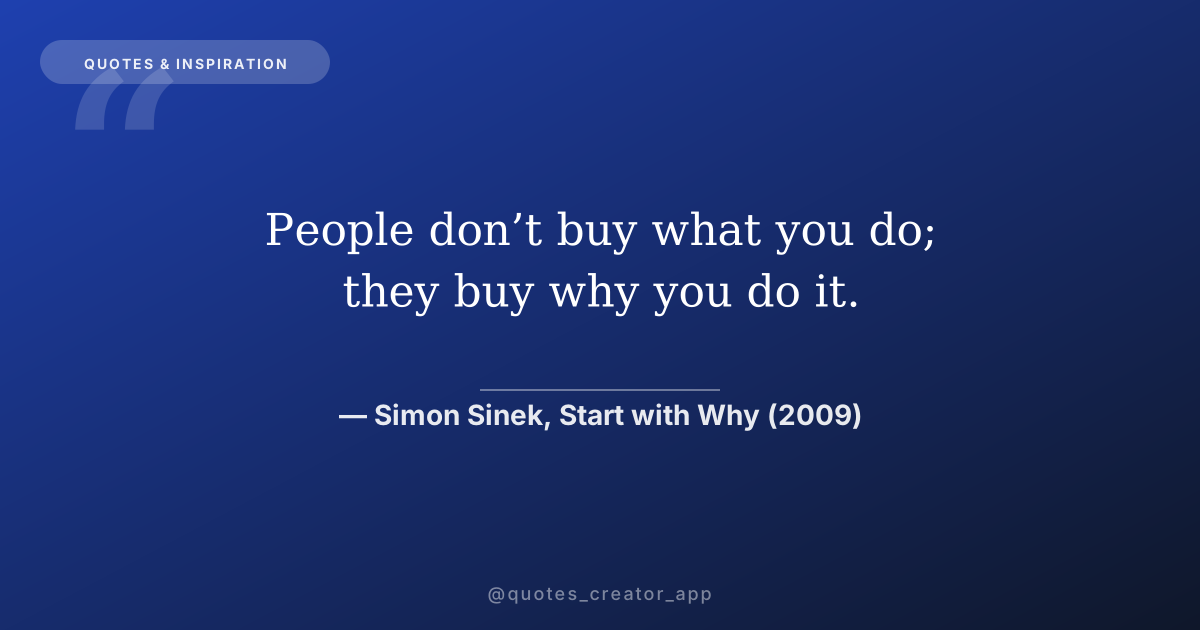
“People don’t buy what you do; they buy why you do it.”
The context
Simon Sinek arrived at the idea behind this sentence not in a boardroom but in a moment of personal and professional crisis. By the mid-2000s he had built a small marketing consultancy, and, by his own account, he was losing his passion for the work. The problem was not a lack of clients; it was a lack of a reason. In search of an answer, he began studying the leaders and organizations he most admired — Apple, Martin Luther King Jr., the Wright brothers — and noticed something counterintuitive: none of them started by explaining what they did. They all communicated, with almost religious consistency, a cause, a purpose, a belief. They inspired loyalty that outlasted features and price tags. That observation crystallized into a simple diagram he called the Golden Circle — three concentric rings labeled, from the outside in, what, how, and why — and it became the intellectual engine of everything he has written since.
The idea first reached the public in September 2009, when Sinek stepped onto the stage of TEDx Puget Sound and delivered an eighteen-minute talk called “How Great Leaders Inspire Action.” It was a quiet talk — no slides packed with data, no product demo, just a man with a whiteboard and a drawing of the Golden Circle. Yet it spread with a speed that defied every expectation, eventually becoming one of the most-viewed TED talks ever recorded. The same year, Sinek expanded the concept into Start with Why, a book that argued, against the grain of decades of marketing doctrine, that the companies and leaders who change the world do not begin with the product. The quote at its center is the book’s thesis compressed into nine words — a single sentence that reorders the entire logic of persuasion, commerce, and leadership.
To understand why the line landed, you have to see what it displaced. The business culture Sinek was writing into had spent the twentieth century perfecting the art of the what — features, specifications, competitive advantages, the endless language of “faster, cheaper, better.” Every company could tell you exactly what it made and how it was superior to the alternative. What almost none of them could articulate was why they existed in the first place. Sinek’s insight was not that products are irrelevant; it was that they are rarely the reason anyone cares. People do not fall in love with a specification sheet. They fall in love with the belief behind it. The quote reframed the entire conversation: not “what should we build?” but “why should anyone care?”
The meaning
The sentence gains its force from the distinction it draws between two very different kinds of motivation. “What you do” is the observable surface of any organization or person: the products you sell, the services you render, the tasks on your job description. It is rational, measurable, and easy to copy. “Why you do it” is the invisible core: the purpose, cause, or belief that animates the work, the reason it exists beyond making money. Sinek’s claim is that the second, not the first, is what actually moves people to act. A customer who buys only on features will defect the moment a cheaper or faster alternative appears. A customer who believes in your why will endure inconvenience, pay a premium, and defend you to strangers — because in buying from you they are affirming something about themselves.
Beneath the aphorism lies a strikingly precise biological argument. Sinek points out that the Golden Circle maps directly onto the structure of the human brain. The outer ring — the what — corresponds to the neocortex, the newest part of the brain, responsible for rational thought and language. The inner two rings — the how and especially the why — correspond to the limbic brain, which governs feeling, trust, and decision-making and, crucially, has no capacity for language. This is why people so often struggle to explain a decision they feel certain about: they made it in a part of the brain that cannot speak. The quote is therefore not a piece of poetic exaggeration but a description of how decisions actually happen. Behavior is driven from the inside out, from the limbic system, and when a message speaks only to the rational brain — features, facts, logic — it is addressing the part of the mind that does not decide.
There is also a subtler, more uncomfortable implication that casual readers often miss. If people buy why you do it, then the absence of a why is itself a liability — one that no amount of marketing can paper over. A company that manipulates with discounts, pressure tactics, and fear can drive transactions, but it cannot manufacture loyalty, because manipulation is a transaction about the what, not an invitation to share a belief. The same is true of people. An employee who works only for a paycheck will do exactly enough to keep it; an employee who believes in the mission will give more than is asked. The quote is ultimately a claim about the anatomy of trust: trust is not a calculation, it is a resonance, and it can only be generated by a purpose people can feel, not a pitch they can audit.
Why it still matters today
In 2026, the quote has arguably grown more urgent than when it was written, because the what has been commoditized to the point of meaninglessness. In almost every industry, quality has become table stakes: products from competing brands are functionally identical, built in the same factories, benchmarked to the same standards. The internet has made every feature and price instantly comparable, collapsing the rational case for any single choice. In that environment, the only durable differentiator left is the one Sinek identified — the why. Consumers increasingly buy from brands whose values mirror their own, and walk away from those whose beliefs feel hollow or hypocritical. The rise of purpose-driven purchasing, corporate accountability, and the demand for authenticity is not a fad; it is the market finally catching up to a sentence Sinek wrote seventeen years ago.
The quote also speaks with new force to the experience of work itself. The past several years have produced a well-documented crisis of meaning — quiet quitting, burnout, the “Great Resignation,” and a generation of workers asking what their labor is actually for. Organizations responded with perks, ping-pong tables, and polished mission statements, and discovered that none of it worked, because none of it addressed the why. Employees, like customers, do not give their best effort to a what. They give it to a cause they can believe in. Sinek’s sentence, once read as advice about marketing, has become a diagnosis of an entire culture — a reminder that both markets and people are starved not for more products, but for more purpose, and that any organization that ignores this will keep paying for loyalty it cannot buy.
How to apply this in your own life
The most practical application begins with a discipline Sinek calls “finding your why.” It starts with a simple but rigorous exercise: do not begin with what you do or how you do it. Instead, ask why — what cause, what belief, what experience in your past made you care about this work in the first place? The answer will not be “to make money”; profit, Sinek insists, is a result, not a purpose. Write down the specific moments when your work felt meaningful, look for the pattern running through them, and articulate it as a single sentence beginning with “to” — a contribution you want to make, not a product you want to sell. Then use that sentence as a filter. Before taking a job, launching a project, or agreeing to a partnership, ask whether it advances the why or merely fills the calendar. The reason is that a why that never governs a decision is not a purpose; it is a poster on the wall.
The deeper application is existential, and it changes how you measure a life. Most of us are trained to evaluate ourselves by the what — title, salary, output, the visible scoreboard of achievement. Sinek’s quote quietly relocates the entire question. It asks not “what have you accomplished?” but “why does what you do matter to you, and does anyone else feel it?” The most magnetic people and organizations are not necessarily the most competent; they are the most convinced — so certain of their why that others cannot help but want to be part of it. The invitation of the sentence is to stop competing on features you cannot control and start communicating the belief you cannot fake. Do that, and the people who share your why will find you. They will not be customers or coworkers in the transactional sense; they will be believers — and believers do not merely buy. They stay.
Create your own quote graphic with this quote
Few ideas reorder the way you think about work, leadership, and loyalty the way this one does. When you pair a conviction this clarifying with thoughtful design, you create something worth saving and sharing. Use our free online quote maker to turn this exact quote into a shareable image in seconds — no signup needed. For advanced features like video quotes and 100+ templates, try the Quotes Creator Android app.
Why we chose this quote
Simon Sinek is frequently reduced to a single viral TED talk and a diagram that decorates corporate slide decks, which is exactly why his central idea deserves a closer look. We wanted to treat the quote as what it actually is: not a marketing slogan but a complete account of how trust is built, one grounded in the biology of the brain. The sentence is rare in that it is both a business insight and a moral one — it explains why some companies inspire loyalty while others only buy attention, and it quietly turns the same question back on the reader: what is your why, and does anyone feel it? In a culture drowning in products and starving for purpose, it is a reminder that the thing people are truly buying has never been the thing on the shelf. That is why it endures long after the applause fades.
— ThinkPeak Studio Editorial Team
Create your own quote graphic with this quote
Turn this line into a shareable graphic in seconds — free, no signup needed. For video quotes and 100+ templates, try the Android app.
Advertisement
Enjoyed this article? Get more like it in your inbox.