Quote Explained: “One is not born, but rather becomes, a woman.”
By Simone de Beauvoir, author of The Second Sex
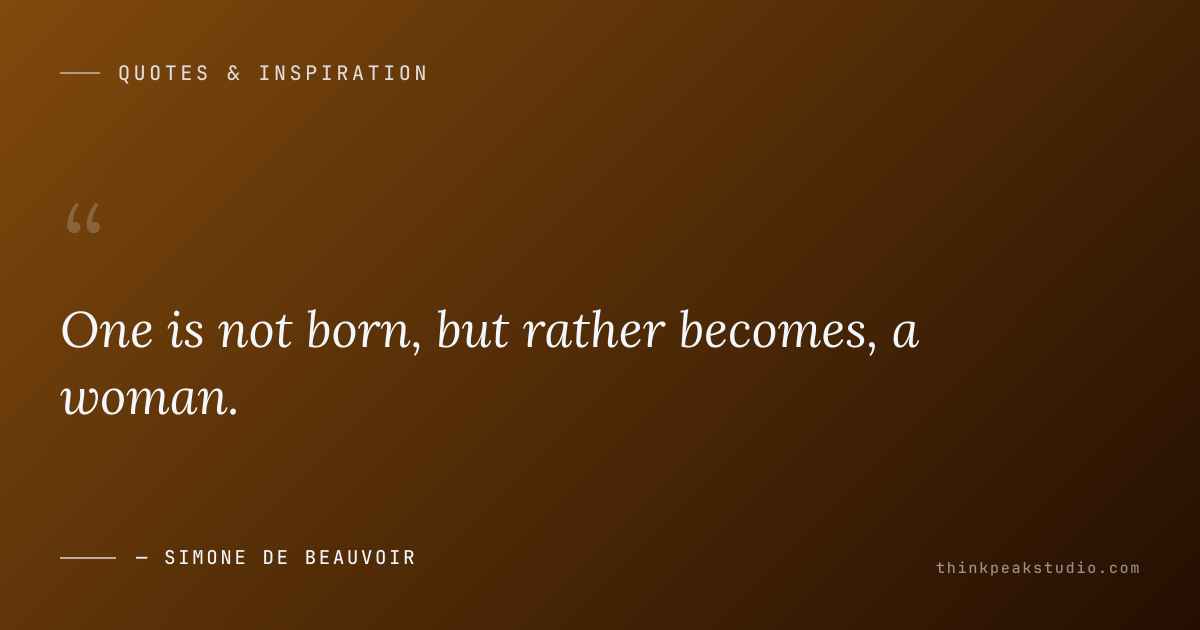
“One is not born, but rather becomes, a woman.”
The context
Simone de Beauvoir was born in Paris in 1908 and died there in 1986. She studied philosophy at the Sorbonne and passed the agrégation in philosophy in 1929, the same year she began the lifelong intellectual partnership with Jean-Paul Sartre that would define the shape of her public life. After the Second World War she emerged as one of the central figures of the existentialist movement, and in 1945 she helped found the journal Les Temps Modernes, which became the movement’s principal platform. She was, by the mid-1940s, already an accomplished novelist and essayist — and she was about to write the book that would outlive everything else she made.
The Second Sex was published by Gallimard in 1949 in two volumes: Les faits et les mythes (Facts and Myths) and L’expérience vécue (Lived Experience). It was an enormous undertaking, drawing on history, biology, psychoanalysis, sociology, anthropology, and literature to answer a single question: what has it meant, and what does it still mean, to be a woman? Beauvoir’s answer was that woman has been constructed throughout history as the Other — defined in relation to man, who occupies the position of the neutral, the universal, the subject. The book caused an immediate scandal. The Vatican placed it on the Index Librorum Prohibitorum, and its frankness about female sexuality and its assault on the myth of a natural maternal instinct made it genuinely dangerous in its moment. It nevertheless sold around 22,000 copies in its first week in France, and it has since been translated into some forty languages. In 1954, five years after The Second Sex, her novel Les Mandarins won the Prix Goncourt.
The sentence we quote today opens the second volume of The Second Sex, at the beginning of Part I, “Formation,” in the first chapter, “Enfance” (Childhood). Its original French is stark and rhythmic: On ne naît pas femme : on le devient. Its English life is more complicated than most readers realise. The first English edition, an abridged translation by H. M. Parshley published by Knopf in 1953, rendered it “One is not born, but rather becomes, a woman.” The complete translation by Constance Borde and Sheila Malovany-Chevallier, published in 2009 in the United Kingdom and 2010 in the United States, dropped the article: “One is not born, but rather becomes, woman.” That small grammatical decision became a scholarly argument in its own right, because “a woman” names an individual instance while “woman” names a category — a construct, an institution, a social position. Beauvoir, the translators argued, meant the second.
The meaning
On its surface the sentence is a refusal of biological destiny. It is immediately followed, in the same paragraph, by Beauvoir’s explanation: no biological, psychological, or economic fate determines the figure that the human female presents in society; it is civilisation as a whole that produces this creature, intermediate between male and castrate, which is described as feminine. The target is what she called the “eternal feminine” — the ancient and comfortable idea that there is an unchanging female essence, that women are by nature gentle, nurturing, intuitive, passive, or mysterious. Beauvoir’s claim is that none of this is nature. It is learned, enforced, and reproduced through upbringing, culture, and social expectation long before a child can question any of it.
Beneath that surface claim lies the existentialist core of the book. Beauvoir is applying the principle that existence precedes essence: a human being is not first a fixed thing with a predetermined nature and then a life; the life is what makes the person. To be human is to become, through choices made inside a situation one did not choose. Crucially, Beauvoir does not deny that bodies differ, and she does not claim that sex is nothing. She denies that biology is fate. The body is what she calls a situation — the given ground on which freedom must operate — and a situation can constrain without dictating. That distinction is the hinge of the whole essay. It lets her hold two things at once: women are shaped by real, material conditions, and women are nonetheless free to act within and against them.
The translation controversy adds a final layer. If the line reads “a woman,” it can sound as though each individual simply fails to be born with a completed identity and must assemble one — a broadly individualist reading. If it reads “woman,” the emphasis falls on the social category itself: womanhood as an institution produced and maintained by a civilisation. Most scholars now read Beauvoir as arguing something closer to the second, while still insisting on the lived, embodied, phenomenological reality of becoming. What the sentence is not is a verdict. It is a description of a process, and therefore a statement of possibility — a door rather than a wall.
Why it still matters today
The sentence is arguably the founding statement of modern feminist thought and a direct ancestor of the sex-and-gender distinction that would be formalised decades later. Its influence runs from the second wave — Betty Friedan, Kate Millett, Germaine Greer all worked in its shadow — through to contemporary debates about social construction, performativity, and identity. That is precisely why it remains a flashpoint. Arguments about whether gender is constructed or given, whether biology constrains or merely conditions, whether the category “woman” should be defined by bodies or by social position, are all, in a real sense, arguments conducted on the ground Beauvoir cleared. To read the sentence is to encounter the origin of a conversation we are still having.
But its relevance is not confined to gender. The quote makes a general claim about how much of what we call nature is actually culture — how many of the scripts we treat as fixed facts about ourselves were written by inheritance, environment, and expectation. In an age that oscillates between determinism (you are your biology, your trauma, your algorithmically assigned type) and a brittle, curated selfhood, Beauvoir insists on becoming. She offers neither the comfort that we can be anything at all nor the comfort that we are already complete. She offers the harder, more accurate position: we are made by conditions we did not choose, and we are the ones who must still make ourselves.
How to apply this in your own life
The first application is an audit of the fates you were handed. Take the sentences you have always believed about who you are — what you are naturally good at, what is simply not for people like you, which emotions you are allowed, what role you are supposed to play in a family or a workplace — and ask whether each one describes a fact or an inheritance. Beauvoir’s method is not to deny limits but to refuse unnecessary ones. Some constraints are real and material; others are social furniture that has simply been in the room so long that no one remembers it was placed there. Naming the difference is the beginning of freedom, because what has been made can, in principle, be unmade.
The second application is to treat identity as a project rather than a possession, and to extend the same generosity to everyone else. Because becoming is always situated, a person is never responsible for their starting conditions — only for what they do within them. That insight dissolves both contempt and self-blame: you can hold people accountable for their choices without pretending their choices were made on a level field, and you can hold yourself to the same standard. To live with Beauvoir is to stop confusing what has been constructed with what must be, and to accept the strange, demanding dignity of being unfinished. One is not born, but rather becomes. That is not only a claim about womanhood. It is a description of what it means to be a person at all.
Create your own quote graphic with this quote
This is the kind of sentence that reorganises how you see a whole argument. When you pair an idea this foundational with thoughtful design, you create something worth saving and returning to. Use our free online quote maker to turn this exact quote into a shareable image in seconds — no signup needed. For advanced features like video quotes and 100+ templates, try the Quotes Creator Android app.
Why we chose this quote
We chose this sentence because it is one of the few lines in modern thought that changed the vocabulary of an entire subject. Before Beauvoir, the question of what a woman is was usually answered with nature — instinct, essence, destiny. After her, it had to be answered with history, culture, and choice. What makes the quote worth returning to is how much is happening inside eleven words. It is a piece of philosophy compressed into an aphorism, an existentialist thesis about becoming delivered as a proverb, and a political claim disguised as a description of childhood. Its translation history is a lesson in itself: a single article, “a,” quietly decides whether we read the sentence as being about individuals or about institutions — which is exactly the kind of ambiguity Beauvoir spent her life asking us to notice. The line has been quoted, misquoted, and argued over for more than seventy years, and it still does what the best sentences do: it makes the previously invisible look constructed, and therefore changeable. That is why it endures, and why it remains worth explaining.
— ThinkPeak Studio Editorial Team
Create your own quote graphic with this quote
Turn this line into a shareable graphic in seconds — free, no signup needed. For video quotes and 100+ templates, try the Android app.
Advertisement
Enjoyed this article? Get more like it in your inbox.


