Quote Explained: “The unexamined life is not worth living.”
By Socrates, classical Greek philosopher
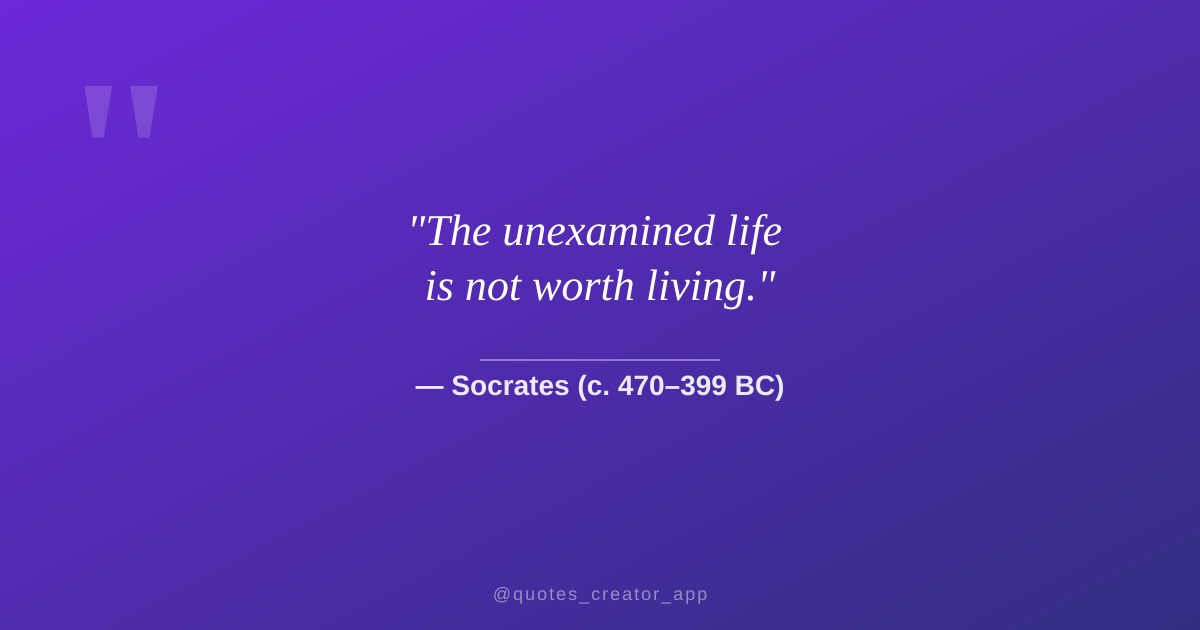
“The unexamined life is not worth living.”
The context
In the spring of 399 BC, a seventy-year-old man stood before a jury of roughly five hundred Athenian citizens, on trial for his life. The charges against Socrates were impiety — failing to honor the gods of the city — and corrupting the youth of Athens. Behind the formal accusations lay a city in trauma. Athens had lost the Peloponnesian War to Sparta just five years earlier, endured the brutal rule of the Thirty Tyrants, and only recently restored its democracy. Some of the most notorious figures of that dark period, including the tyrant Critias and the traitor Alcibiades, had once been companions of Socrates. To many Athenians, the old philosopher who spent his days in the marketplace questioning everyone’s certainties was not a harmless eccentric. He was a symbol of everything that had gone wrong.
Socrates did not say the famous line during his defense. He said it after he had already been found guilty. Under Athenian law, the penalty phase allowed the condemned man to propose an alternative to the prosecution’s demand for death. This was Socrates’ opportunity to save himself. He could have proposed exile, and the jury would almost certainly have accepted. He could have promised to simply stop philosophizing — to go home, stay quiet, and live out his remaining years in peace. Instead, he told the jury that abandoning his daily practice of questioning himself and others was impossible, because “the unexamined life is not worth living for a human being.” In the original Greek — ho de anexetastos bios ou biōtos anthrōpōi — the claim is even starker: such a life is not merely diminished, it is unlivable. He then half-mockingly suggested that his true punishment should be free meals at public expense, an honor reserved for Olympic champions.
The jury, unsurprisingly, sentenced him to death by hemlock. What we know of that day comes primarily from Plato, who was present at the trial as a young man and later reconstructed the speech in his Apology — from the Greek apologia, meaning “defense,” not regret. Whether Plato recorded the words verbatim or polished them into literature is a question scholars still debate. What is beyond dispute is the effect. Socrates’ refusal to trade his examined life for survival transformed a local trial into one of the founding dramas of Western civilization, and the sentence he uttered in that moment became perhaps the most famous declaration in the history of philosophy.
The meaning
On its surface, the claim is simple: a life spent without reflection — without ever questioning what you believe, why you act as you do, or whether your values are actually yours — is a life not worth having. But notice how extreme the statement is. Socrates does not say the unexamined life is worse, or poorer, or less noble. He says it is not worth living at all. This is not gentle self-help advice about journaling; it is a radical redefinition of what makes a human life human. For Socrates, the capacity for rational self-scrutiny is precisely what separates a person from an animal that merely eats, sleeps, and follows habit. To decline to use that capacity is, in his view, to decline to be fully human — to sleepwalk through existence inside opinions you never chose.
The deeper layer of the quote lies in what Socrates meant by “examination.” He was not recommending private introspection alone. The Greek word anexetastos comes from the vocabulary of interrogation and testing — the same scrutiny an auditor applies to accounts. Socratic examination is an active, often uncomfortable process: cross-examining your own beliefs, exposing them to challenge, and following the argument wherever it leads, even when it demolishes something you cherish. It is the practice we now call the Socratic method. Behind it stands the inscription at the temple of Delphi — gnōthi seauton, “know thyself” — and Socrates’ own conviction, expressed elsewhere in the Apology, that his only wisdom was knowing that he knew nothing. Examination, in this sense, is not a route to comfortable certainty. It is the permanent willingness to discover you are wrong, undertaken because truth about how to live matters more than the pleasure of feeling right.
The emotional force of the quote is inseparable from the circumstances in which it was spoken. These are not the words of a professor at a podium; they are the words of a man choosing death over intellectual surrender, in real time, in front of the people about to kill him. That is why the sentence has never faded. It carries the ultimate proof of sincerity: Socrates valued the examined life more than life itself, and he demonstrated it with the only currency that cannot be counterfeited. Weeks later, when friends arranged his escape from prison, he refused that too, drank the hemlock calmly, and died discussing philosophy. The quote endures because it is not merely an idea. It is an idea that was paid for in full.
Why it still matters today
Twenty-four centuries later, the unexamined life has never been easier to live. Algorithms now curate what we see, recommend what we buy, and quietly shape what we believe, optimizing not for our understanding but for our attention. Social media feeds reward reaction over reflection, and echo chambers ensure that our opinions are applauded rather than tested. In such an environment, Socrates’ warning reads less like ancient philosophy and more like a diagnosis of the present. The sentence is quoted constantly — in commencement speeches, in debates about digital wellbeing, in critiques of misinformation — because it names the precise thing modern life is engineered to help us avoid: the slow, unprofitable work of asking whether the life we are living is actually the one we would choose on reflection.
At the same time, the hunger for examination is visibly resurging. The explosive growth of therapy, journaling apps, meditation practices, and even the revival of Stoic and classical philosophy in bestseller lists all point to the same unease — millions of people sensing that a life of pure consumption and reaction is hollow, exactly as Socrates claimed. His question has also become institutional: critical thinking is now the stated goal of education systems worldwide, and the Socratic method remains the backbone of law school teaching. Whenever a society worries that its citizens believe things they have never questioned — about politics, technology, identity, or truth itself — it is rediscovering, usually without credit, the argument a barefoot Athenian made to the jury that condemned him.
How to apply this in your own life
The most direct application is to build a deliberate practice of self-examination into your week, because it will not happen by accident. Socratic examination begins with questions, so start with the ones he would ask: Why do I believe this? Where did this belief come from — evidence, or inheritance? What would change my mind? Set aside twenty minutes weekly to put one of your own convictions on trial — a career assumption, a political certainty, a story you tell about yourself — and argue the other side honestly. Journaling works, but so does conversation with someone who disagrees with you and whom you respect. The measure of success is not comfort. If your examination never overturns anything, you are not examining; you are ratifying.
The second application is to treat examination as a filter for how you live, not just how you think. Before major decisions — taking a job, ending a relationship, adopting a position — ask the Socratic question: is this choice mine, or is it the unexamined momentum of habit, fear, or other people’s expectations? Most of what feels like choosing is actually drifting. Socrates’ life suggests a harder discipline: identify the one or two principles you would not trade even under pressure, and test everything else relentlessly. You will not be asked to drink hemlock for your convictions. But you will be asked, daily and quietly, to trade reflection for convenience — and every time you decline that trade, you are living the sentence instead of just quoting it.
Create your own quote graphic with this quote
This is the kind of quote that carries weight. When you pair timeless words with thoughtful design, you create something people want to save, share, and return to. Use our free online quote maker to turn this exact quote into a shareable image in seconds — no signup needed. For advanced features like video quotes and 100+ templates, try the Quotes Creator Android app.
Why we chose this quote
Few sentences are quoted as often and understood as rarely as this one. It appears on posters and graduation cards as a mild encouragement to be thoughtful, when in reality it was a defiant answer given by a condemned man who preferred death to a life without questioning. We chose it because its original setting — a courtroom, a hostile jury, a genuine offer of survival in exchange for silence — transforms its meaning entirely, and because its challenge has never been more pointed than in an age when algorithms are happy to do our examining for us. Socrates staked his life on the claim that reflection is what makes a life worth having. Twenty-four centuries later, that wager still demands an answer from each of us.
— ThinkPeak Studio Editorial Team
Create your own quote graphic with this quote
Turn this line into a shareable graphic in seconds — free, no signup needed. For video quotes and 100+ templates, try the Android app.
Advertisement
Enjoyed this article? Get more like it in your inbox.