Quote Explained: “Life can only be understood backwards; but it must be lived forwards.”
By Søren Kierkegaard, Danish philosopher and father of existentialism
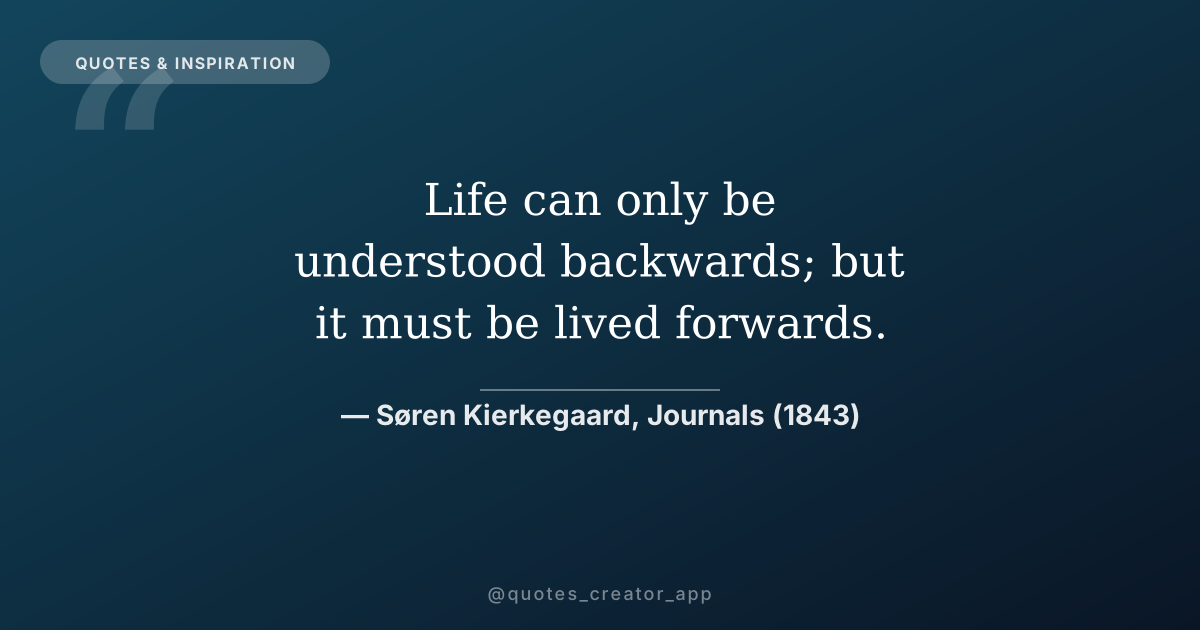
“Life can only be understood backwards; but it must be lived forwards.”
The context
The quote has an unexpectedly humble origin for a sentence that has circled the world. It is not the opening thesis of one of Søren Kierkegaard’s great pseudonymous books, the way “Either/Or” or “Fear and Trembling” announce themselves. It was found in his private journals — specifically the notebook scholars label JJ, entry 167, dated 1843, the same astonishingly productive year in which he published Either/Or, Fear and Trembling, and Repetition in a single burst. The original Danish reads “Livet kan kun forstås baglæns, men må leves forlæns” — a sentence written for no audience but himself, in the quiet of reflection, and only brought to light decades later when his journals were published after his death. There is a fitting poetry in that: a line about the delayed meaning of life was itself delayed in reaching the world, its significance ripening in exactly the backward glance it describes.
To understand the line, you have to understand the man who wrote it, because almost nothing in Kierkegaard’s biography was lived in a straight line. He was born in Copenhagen in 1813, the youngest of seven children, the son of a melancholic father whose religious guilt cast a permanent shadow over the household. The two defining facts of his early life were the broken engagement to Regine Olsen — which he ended in 1841, and which haunted his writing ever after as the emblem of every choice that can never be unmade — and his conviction that he would die young, a prophecy he repeated so often that his death at forty-two in 1855 seemed less a surprise than a fulfillment. He published under a parade of invented names — Johannes de Silentio, Constantin Constantius, Johannes Climacus — each a mask he wore to force readers to confront an idea rather than defer to an author. All of it converged on a single obsession: the individual, and the impossible position of a person who must act, choose, and commit while knowing that no amount of thinking can ever make the outcome certain in advance.
The quote is also a summary of his entire quarrel with the philosophy of his age. Kierkegaard wrote in the shadow of G. W. F. Hegel, whose grand system promised to comprehend all of reality — history, spirit, God — within a single backward-looking logic that explained everything after the fact. Kierkegaard’s objection was devastatingly simple: a system can only ever describe life after it has already happened, from a standpoint outside it. But no one lives from that standpoint. The living individual is always inside the stream, facing a future that has not yet been decided, and no retrospective system can tell that person what to do in the next moment. The quote is that entire critique, compressed into a single breath: understanding belongs to the past; living belongs to the future; and no bridge of pure reason ever fully spans the gap between them.
The meaning
The sentence is built on a hinge, and the hinge does all the work. “Life can only be understood backwards” — the first clause names a truth everyone recognizes but almost no one articulates. Meaning is retrospective. The significance of a decision, a relationship, a loss, or a victory is rarely visible while it is happening; it is revealed only later, when enough time has passed for the scattered pieces to arrange themselves into a pattern. We look back at our lives the way a reader looks back at a novel from its final page, suddenly seeing how the early chapters prepared the ending, how the detours were secretly necessary, how the seemingly random episodes formed a plot. In the moment itself, none of that coherence exists. The plot is only a plot in retrospect.
“But it must be lived forwards” — the second clause delivers the tension that makes the line a philosophy of life rather than a truism. Living is always conducted in the dark, in the direction of a future that has not happened and cannot be known. You cannot wait to understand your life before living it; by the time the understanding arrives, the moment to act is already gone. This is what Kierkegaard called anxiety — not ordinary nervousness but the vertigo of standing before an open future with no guarantee, forced to choose, commit, and leap without the comfort of certainty. The quote does not promise that the two directions will reconcile. It insists, instead, that they never can — that we are condemned to live forward into the unknown and to understand only what is already behind us, and that this mismatch is not a temporary inconvenience but the permanent structure of being human.
And yet the line is not despairing, and that is the key to reading it well. Kierkegaard was not lamenting the human condition; he was describing it honestly so that we might stop demanding the impossible. The person who insists on understanding life fully before daring to live it will never live at all. The person who waits for certainty before committing to a love, a calling, or a faith will wait forever, because certainty is only ever granted afterward, and only to those who had the courage to act first. The quote reframes the very thing that terrifies us — the opacity of the future — as the very thing that makes life genuinely ours. If we could know our lives in advance, there would be nothing to live, only something to execute. It is precisely because we must live forward without understanding that freedom, faith, and commitment exist at all.
Why it still matters today
The quote has never been more urgent, because modern life is organized around the fantasy of eliminating the very uncertainty it names. We have built an entire culture of optimization — spreadsheets for our careers, apps for our sleep, algorithms for our relationships, decades of data for every decision — all in the hope of living forward with the confidence of someone looking backward. We want to choose the right partner, the right city, the right career the way we would re-read a book we have already finished. The result is a peculiar modern paralysis: people so determined not to make a mistake that they make no decision at all, trapped in a permanent holding pattern of gathering information, waiting for a clarity that the quote reminds us can only ever arrive too late. Kierkegaard, writing with a quill in 1843, described our era’s quietest epidemic with terrifying precision.
The quote also diagnoses our tortured relationship with regret and memory in an age that never stops showing us our own past. Social media serves us our history every morning — “memories” of who we were, curated and re-lit for the backward glance — while the algorithms quietly judge the present against an idealized archive. We narrate our lives backward as a polished story, even as we live them forward in the same old fog. The result is a widespread sense that the present is always failing to measure up to the past we have already understood, and that the future must be solved before it is entered. Kierkegaard’s line is a corrective to all of it. It grants permission to live provisionally, to be a work in progress, to make choices whose meaning is still unknown — because that, and not the curated retrospective, is what a life actually is.
How to apply this in your own life
The practical application begins with a change in how you make decisions. When you face a choice and feel the familiar paralysis — the sense that you must understand the whole thing before you can move — remember that the understanding you are waiting for does not exist yet, and never will, at least not from where you are standing. Ask yourself a different question: not “can I be certain this is right?” but “is this a choice I can make with integrity, and am I willing to let time teach me its meaning?” The difference is subtle and everything. The first question hands your life over to a future that can never arrive; the second returns you to the only place life can actually be lived, which is the present moment, moving forward. You are not required to know how it will all turn out. You are only required to choose, and then to keep choosing, and to trust that the backward glance will one day make sense of what the forward step could not.
The quote is also a manual for self-compassion and for the way you treat your own past. When you look back and wince — at a mistake, a missed chance, a relationship you mishandled — you are judging a person who did not have the knowledge you now possess. The version of you that made that choice was living forward, in the fog, without the benefit of the understanding that only arrived afterward. To condemn your past self with your present clarity is to commit the exact error the quote warns against: treating hindsight as though it had been available all along. Extend the same grace to other people, too. The parent, the partner, the colleague whose decision looks so obviously wrong to you now was, like you, living forward in the dark. The quote does not excuse every choice, but it forbids the smug certainty of the backward glance, and in its place it offers the gentler, more honest posture of someone who knows that all of us are reading the book of our lives one page at a time, from the front, with no idea how it ends.
Create your own quote graphic with this quote
Few sentences in any language compress this much wisdom into this few words. Its balance, its brevity, and its bottomless depth make it perfect for social graphics, posters, journal covers, and conversation starters. Use our free online quote maker to turn this exact quote into a shareable image in seconds — no signup needed. For advanced features like video quotes and 100+ templates, try the Quotes Creator Android app.
Why we chose this quote
Most people meet this line on a graduation card or an Instagram caption and read it as a soothing piece of wisdom about “everything happening for a reason.” We wanted to restore it to its full weight. It is not a comfort — it is a diagnosis. It refuses us the illusion that we can live forward with the clarity of a backward glance, and it refuses us the cruelty of judging our past selves as though we had always known what we know now. What makes it endure is that it names, in eleven ordinary words, the exact shape of the human predicament: the future is where we live but cannot see, and the past is where we can see but no longer live. Kierkegaard’s genius was to offer no false bridge between the two, only the bracing honesty that lets us stop waiting for certainty and start living anyway. In an age of infinite optimization and endless regret, a sentence that dignifies uncertainty is not a decoration. It is a lifeline.
— ThinkPeak Studio Editorial Team
Create your own quote graphic with this quote
Turn this line into a shareable graphic in seconds — free, no signup needed. For video quotes and 100+ templates, try the Android app.
Advertisement
Enjoyed this article? Get more like it in your inbox.