Quote Explained: “The only way to do great work is to love what you do.”
By Steve Jobs, American businessman and co-founder of Apple Inc.
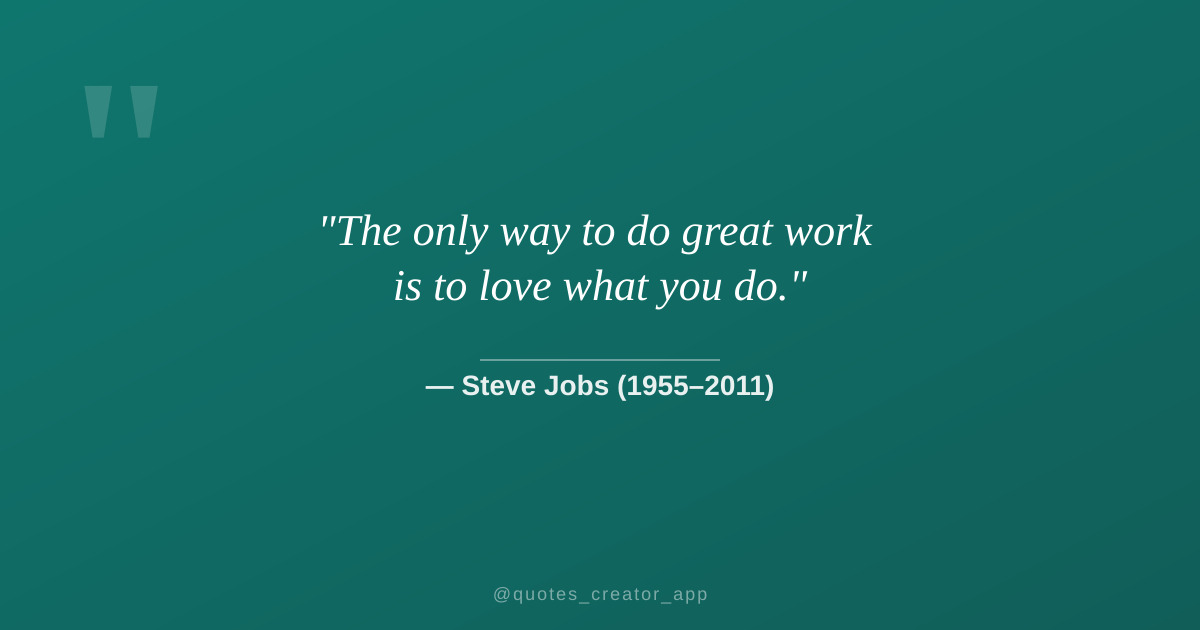
“The only way to do great work is to love what you do. If you haven’t found it yet, keep looking. Don’t settle. As with all matters of the heart, you’ll know when you find it.”
The context
On June 12, 2005, Steve Jobs walked onto the stage at Stanford Stadium in front of 23,000 graduates and their families to deliver a commencement address that would become one of the most-watched speeches in internet history. Jobs was 50 years old and had just survived pancreatic cancer. He was at the peak of his powers: Apple had launched the iPod three years earlier and was quietly developing the iPhone, though no one outside the company knew it yet. Pixar had just released The Incredibles and was riding an unprecedented string of critical and commercial hits. But Jobs chose not to speak about success. Instead, he told three stories: one about connecting the dots, one about love and loss, and one about death.
The second story — from which this quote comes — was about getting fired from Apple in 1985 at the age of 30. Jobs had co-founded the company in his parents’ garage a decade earlier, built it into a Fortune 500 company, and then been publicly ousted by the CEO he himself had recruited. It was, by any measure, a humiliating professional catastrophe. But in the speech, he reframed it as the best thing that ever happened to him. Being fired from Apple, he said, freed him to fall in love again — with NeXT, with Pixar, and eventually with the woman he married. When he returned to Apple a decade later, he brought all of that accumulated love back with him. The quote about doing great work was not an abstract maxim. It was the thesis of a man who had lost everything and rebuilt himself from the ground up by following what genuinely excited him.
Jobs borrowed the phrase “stay hungry, stay foolish” from the final issue of the Whole Earth Catalog, a counterculture publication that bridged the 1970s tech and hippie movements. This act of borrowing was itself a clue to his philosophy. He was drawing a line from the 1960s back-to-the-land ethos of following your passion to the digital future he was building. The speech was delivered just five months after the launch of YouTube, and within a year it had been viewed millions of times. It became a rite of passage for college graduates and career-changers alike, and this single sentence — “the only way to do great work is to love what you do” — became its most quoted line.
The meaning
On its surface, the sentence is straightforward: if you want to produce work that matters, you need to care deeply about it. But the word “love” here is doing far more work than it first appears. In English, love is a catch-all for everything from romantic attachment to casual preference. Jobs meant something closer to the ancient Greek concept of eros — not romantic love, but the life force that drives creation and discovery. He was saying that the energy required to do something remarkable does not come from discipline or obligation. It comes from the same place that makes an artist stay up all night painting or a musician practice the same phrase for hours. It is not a choice you make once; it is a relationship you maintain over time.
The second half of the passage — “If you haven’t found it yet, keep looking. Don’t settle. As with all matters of the heart, you’ll know when you find it.” — is the part that people often miss. It reframes the quote from a statement about the already-passionate to a message for the still-searching. Jobs was acknowledging that most people do not wake up knowing what they love. Finding it is a process of elimination, failure, and luck. The command to “keep looking” is an act of patience disguised as urgency. And the phrase “as with all matters of the heart” is a quiet confession that this is not a rational process. You cannot deduce your passion from a spreadsheet. You must experiment, fail, and pay attention to what makes you lose track of time.
The philosophical grounding of the quote runs deeper than it first appears. It echoes Aristotle’s idea that excellence is not an act but a habit, and that the activities we voluntarily repeat shape who we become. It also resonates with the Zen Buddhist concept of dō or “the way” — the practice of bringing full presence to the work in front of you. Jobs had spent years studying Zen, and the idea that work can be a form of spiritual practice is embedded in the speech’s DNA. The quote is not asking you to find a job that makes you happy. It is asking you to find work that commands your full attention, because that is the only work from which greatness can emerge.
Why it still matters today
In an era of quiet quitting, burnout epidemics, and the “great resignation,” Jobs’s line has never been more contested or more necessary. Critics argue that the “love what you do” ethos has been co-opted by employers who want workers to derive their identity from their jobs rather than demanding fair pay and boundaries. There is truth to this critique. The phrase has been used to justify overwork, to shame people who see their job as a means to an end, and to create a culture where not being passionate about your work feels like a personal failure. But the original context of Jobs’s speech resists this reading. He was not telling Stanford graduates to accept exploitation in exchange for fulfillment. He was telling them, from his own experience of being fired and losing everything, that the work you do matters less than the relationship you have with it.
The deeper relevance of the quote lies in what it says about attention and meaning. Modern work is fragmented by notifications, meetings, and the constant pressure to optimize. Jobs’s generation of technologists helped create this condition, and his quote can be read as its antidote. Loving what you do is not about finding a magical job. It is about bringing enough care to your work that it becomes a site of meaning rather than just a source of income. In a world where more people than ever have the freedom to choose their careers — and more people than ever feel paralyzed by that freedom — the instruction to “keep looking, don’t settle” is both liberating and terrifying. It asks for faith in a process that has no guaranteed outcome.
How to apply this in your own life
The most practical application of this quote is to reframe it as a diagnostic tool rather than a directive. If you are unhappy in your work, the first step is not to quit. The first step is to ask whether you have ever genuinely loved any aspect of it — a single project, a moment of flow, a problem that absorbed you completely. If the answer is yes, then the love still exists; it is just buried under the wrong conditions. The solution is to change the conditions, not the work. If the answer is no — if you have searched your entire career and never felt that pull — then Jobs’s advice to “keep looking” is an invitation to treat your career as an experiment rather than a sentence. Try something you have no qualifications for. Take the pay cut. Start the side project. The thing you love is not going to announce itself; you have to create the conditions for it to appear.
The second application is about the discipline of love itself. Passion is not a permanent state; it is a practice. Every creative professional knows that love for their work fluctuates. There are days when writing is agony, when code refuses to compile, when the canvas feels blank and hostile. Loving what you do does not mean feeling enthusiastic every day. It means returning to the work even when the feeling is absent, because the underlying commitment has not changed. Jobs was not a man who floated through his career on a permanent high of inspiration. He was famous for his tantrums, his impossibly high standards, and his ability to drive people to exhaustion. But he kept showing up because, underneath all the difficulty, he believed the work mattered. That belief — not the transient feeling of love, but the enduring choice to care — is what the quote is really about.
Create your own quote graphic with this quote
This is the kind of quote that carries weight. When you pair timeless words with thoughtful design, you create something people want to save, share, and return to. Quotes Creator gives you the tools to turn this quote into a beautiful graphic — custom fonts, gradient backgrounds, and export sizes for every platform.
Why we chose this quote
Jobs’s line about loving your work has been so widely repeated that it has nearly become a cliché. But the full passage — with its emphasis on the search, on not settling, and on the knowing that comes from the heart — is far more nuanced than the bumper-sticker version. We chose this quote because it sits at the intersection of two urgent conversations: the search for meaningful work and the danger of turning passion into a moral obligation. Jobs’s life was complicated, his advice imperfect, and his legacy contested. But the question he posed — what would you do with your one wild and precious life, and would you dare to love it? — is the same question every generation has to answer for itself.
— ThinkPeak Studio Editorial Team
Create your own quote graphic with this quote
Turn this line into a shareable graphic in seconds — free, no signup needed. For video quotes and 100+ templates, try the Android app.
Advertisement
Enjoyed this article? Get more like it in your inbox.