Quote Explained: “The supreme art of war is to subdue the enemy without fighting.”
By Sun Tzu, ancient Chinese military strategist and philosopher
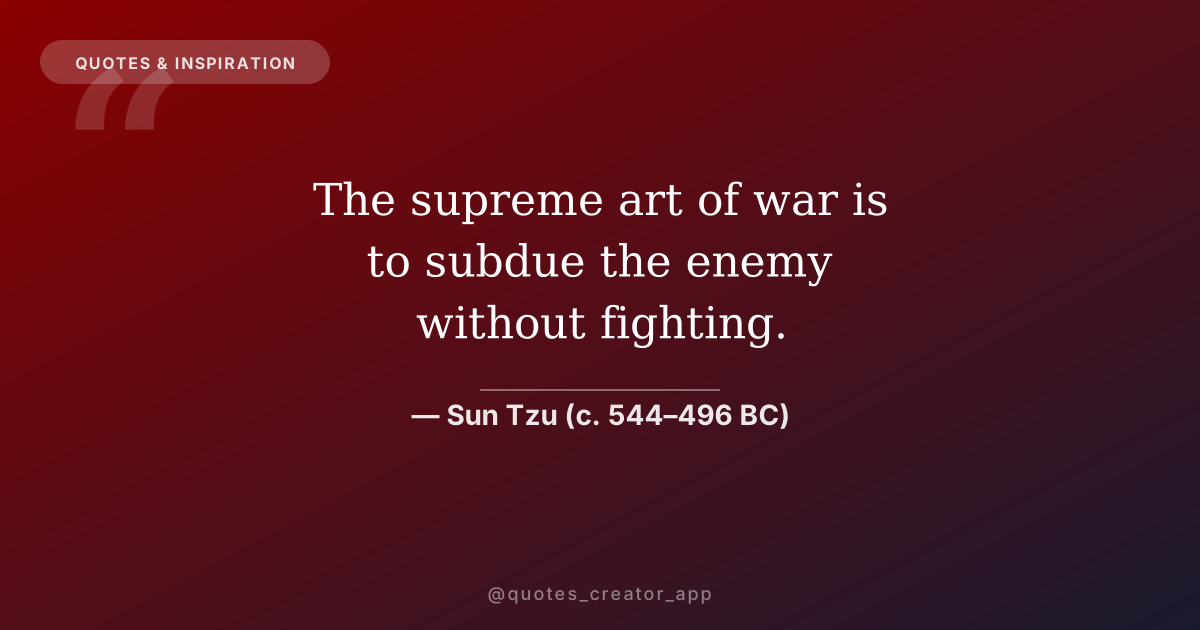
“The supreme art of war is to subdue the enemy without fighting.”
The context
Sun Tzu was a Chinese military general, strategist, and philosopher who lived during the Eastern Zhou period, roughly between 544 and 496 BC. This was the Spring and Autumn period, an era of relentless warfare among competing Chinese states. Kingdoms rose and fell, alliances shifted, and military strength was the ultimate currency of survival. It was in this crucible of perpetual conflict that Sun Tzu composed The Art of War, a treatise that would become the most influential text on military strategy ever written. Across 13 concise chapters, Sun Tzu laid out a philosophy of warfare that was unlike anything before it. He did not celebrate battle. He did not glorify courage. He argued, with an almost clinical detachment, that the greatest general is the one who wins without ever needing to fight.
The book was written for King Helü of Wu, who, according to legend, tested Sun Tzu by asking him to train a company of palace concubines into soldiers. Sun Tzu did so by beheading two of the king’s favorite concubines when they failed to obey commands, a story that underscores the brutal pragmatism beneath the philosophy. But the core message of the text is not cruelty; it is efficiency. Sun Tzu understood war as the most expensive, destructive, and unpredictable of human endeavors. Armies consumed grain. Soldiers died. Economies collapsed. Even victory left a nation weakened. His radical proposition was that the purpose of strategy is not to fight better but to fight less—to make battle itself unnecessary through intelligence, preparation, and psychological dominance.
For over two millennia, The Art of War has been read far beyond the military. It entered Japanese samurai culture, shaped the strategic thinking of Mao Zedong, and in the modern era became a staple of business schools, sports psychology, and negotiation theory. General Douglas MacArthur kept a copy on his desk. The philosopher Jean-Jacques Rousseau called it the work of “a very great man.” Venture capitalists quote it in boardrooms. Coaches quote it in locker rooms. The line at the center of this essay is perhaps the most quoted passage in the entire text, and it contains a depth of wisdom that rewards far more than a passing glance.
The meaning
On its surface, the quote makes a statement about military hierarchy: there are levels of skill in warfare, and the highest level is to achieve your objective without shedding blood. Sun Tzu elaborated on this elsewhere in the text with his famous ranking: the best policy is to attack the enemy’s strategy, then their alliances, then their army—and only as a last resort, their walled cities. Battle is the worst option not because it is immoral, but because it is inefficient. It consumes resources, introduces chaos, and invites unpredictable outcomes. A general who wins a battle and calls it success is like a surgeon who amputates a limb and calls it health. The result may be better than losing, but it is far from the ideal. The ideal is to prevent the disease from ever taking hold.
But the deeper meaning of the quote is philosophical. Sun Tzu is not merely offering a tactical tip; he is articulating a theory of power itself. In his view, true power is not the ability to destroy but the ability to shape outcomes before destruction becomes necessary. The general who must fight to win is reactive, responding to circumstances that have already escalated out of control. The general who wins without fighting has dominated the entire situation—through intelligence gathering, strategic positioning, economic leverage, diplomatic maneuvering, and psychological influence—so that the enemy knows it has already lost and either submits or withdraws. This kind of victory requires far more skill than battlefield bravery. It requires patience, foresight, and the self-discipline to resist the ego’s craving for glory through combat. Fighting is easy; winning without fighting is the mark of mastery.
There is also a moral dimension embedded in the quote that is easy to overlook. War, Sun Tzu recognized, is not a game. People die. Families are destroyed. Nations take generations to recover. To rush into battle when a strategic alternative exists is not courage; it is negligence dressed in armor. The general who seeks battle for personal glory is sacrificing the lives of soldiers and civilians for ego. The general who avoids battle and still achieves the objective is serving his people more faithfully than any hero on the battlefield. In this sense, the quote is not a celebration of cleverness but a statement of ethical leadership. The supreme art is to achieve the necessary outcome while preserving as much life, resource, and stability as possible. That is the responsibility of anyone who holds power over others, whether on a battlefield, in a boardroom, or in a household.
Why it still matters today
In the twenty-first century, Sun Tzu’s principle has been absorbed into nearly every domain of strategic thinking. In business, the highest-performing companies often do not win through price wars or aggressive litigation but through differentiation, innovation, and network effects that make direct competition irrelevant. Apple did not defeat Nokia by fighting a better phone war; it redefined what a phone was. Netflix did not attack Blockbuster head-on; it created a model that Blockbuster could not replicate. These are modern applications of the Sun Tzu principle: winning without the battle. In diplomacy and international relations, the most successful negotiations are the ones that prevent conflict from escalating into sanctions or military action in the first place. The Iran nuclear deal, the Good Friday Agreement, the Camp David Accords—all were exercises in subduing an adversary without fighting, and each required far more intelligence, patience, and emotional discipline than any shooting war.
The quote also speaks with unusual force to the digital age, where outrage has become a commodity. Social media platforms are engineered to reward conflict. The inflammatory reply gets more engagement than the thoughtful one. The public takedown generates more followers than the private resolution. Algorithms train us to fight first and think later. Sun Tzu’s maxim is a direct challenge to this culture. It says that the person who gets drawn into every online argument, who needs to have the last word, who treats every disagreement as a war to be won, is not strong but weak—easily manipulated, reactive, governed by ego rather than strategy. The strong person is the one who sees the provocation, understands its intent, and refuses to waste energy on a battle that serves no strategic purpose. In an era designed to keep you fighting, choosing not to fight is an act of genuine sovereignty.
How to apply this in your own life
The first practical application is a diagnostic question you can ask before any conflict: is there a way to achieve my objective without direct confrontation? This transforms how you approach workplace disagreements, contract negotiations, and interpersonal tension. Instead of preparing arguments, you gather intelligence. You ask yourself what the other person actually wants, what their constraints are, what they fear losing. You look for leverage points that do not require force: a shared interest you can appeal to, a third party who can mediate, a reframing of the issue that dissolves the conflict before it hardens. Often, you discover that the fight was never necessary—that the other person was ready to compromise if approached the right way, or that your own ego was the real obstacle to resolution. The habit of seeking non-confrontational solutions does not make you passive; it makes you precise, and precision is the highest form of effectiveness.
The second and deeper application is inward. Sun Tzu’s advice applies just as profoundly to internal battles—the war against your own impulses, anxieties, procrastination, and self-destructive patterns—as it does to external ones. Most people approach self-improvement as a fight: they try to overpower bad habits with willpower, to bully themselves into discipline through self-criticism, to win an exhausting war of attrition against their own nature. Sun Tzu would say this is beginner-level strategy. The supreme art is to understand yourself so well that the battle becomes unnecessary. You remove the triggers that activate bad habits instead of resisting them. You reshape your environment so that the right choice becomes the path of least resistance. You build routines that make discipline natural rather than forced. You use curiosity and self-compassion to understand why a pattern exists rather than trying to destroy it with brute force. Subdue the enemy without fighting—even when the enemy is yourself. That is the highest form of self-mastery, and it works better than any battle ever could.
Create your own quote graphic with this quote
This is the kind of quote that carries weight. When you pair timeless words with thoughtful design, you create something people want to save, share, and return to. Use our free online quote maker to turn this exact quote into a shareable image in seconds — no signup needed. For advanced features like video quotes and 100+ templates, try the Quotes Creator Android app.
Why we chose this quote
Sun Tzu is one of the most quoted and least understood figures in the history of ideas. Most people recognize the phrase “The supreme art of war is to subdue the enemy without fighting,” but they treat it as a clever aphorism about outsmarting opponents. We wanted to restore the full weight of what Sun Tzu was actually saying. This is not a tip for winning office politics. It is a complete philosophy of power, efficiency, and leadership responsibility, arrived at in an era when military defeat meant the annihilation of entire kingdoms. The fact that Sun Tzu could witness that reality and conclude that the highest general is the one who never fights is nothing short of revolutionary. The obstacles in your life—the conflicts, the power struggles, the battles with your own mind—are not tests of how hard you can fight. They are tests of how intelligently you can avoid needing to.
— ThinkPeak Studio Editorial Team
Create your own quote graphic with this quote
Turn this line into a shareable graphic in seconds — free, no signup needed. For video quotes and 100+ templates, try the Android app.
Advertisement
Enjoyed this article? Get more like it in your inbox.