On this page
Quote Explained: “The Road Not Taken”
Robert Frost’s most quoted lines — the joke about a friend’s indecision that the world turned into a hymn to individualism it never quite was
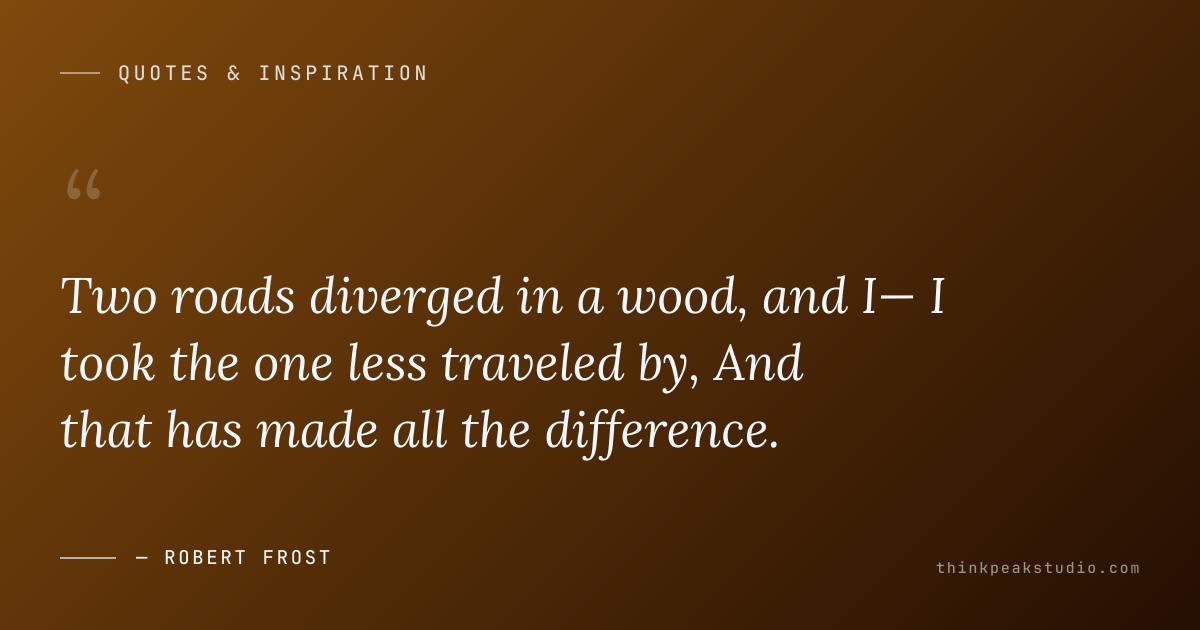
“Two roads diverged in a wood, and I—
I took the one less traveled by,
And that has made all the difference.”
Context
Robert Frost wrote “The Road Not Taken” during the years he lived in England, and it first appeared in the August 1915 issue of The Atlantic Monthly. It was not the work of an established poet looking back on a settled career. Frost had moved to England in 1912 and published his first two collections there — A Boy’s Will (1913) and North of Boston (1914) — before returning to the United States in 1915. When he assembled Mountain Interval the following year, he placed “The Road Not Taken” first, as the opening poem of the book. It runs just twenty lines, in an ABAAB rhyme scheme and an irregular iambic tetrameter that lets it sound like ordinary speech.
The occasion was a friendship. In England Frost met the critic, essayist, and eventual poet Edward Thomas, and the two men became close. They took long walks together through the countryside, and Thomas, as Frost’s biographer Lawrance Thompson recorded, was habitually unable to decide which path to take — and then habitually regretted the one he had chosen, convinced the other would have led to something better. Frost sent Thomas an advance copy of a new poem in the spring of 1915. Its title was not “The Road Not Taken.” It was “Two Roads,” and Frost intended it as a gentle joke at his friend’s expense, a parody of the habit of “crying over what might have been.”
Thomas did not take it as a joke. He took it seriously and personally, and the correspondence that followed is a small rehearsal of the confusion the poem has caused ever since. Frost protested that the sigh in the last stanza was a “mock sigh, hypocritical for the fun of the thing”; Thomas replied that he doubted anyone would see the fun without Frost standing by to explain which kind of laugh to use. Thomas enlisted in the British Army in July 1915 and was killed on April 9, 1917, the first day of the Battle of Arras; the scholar Matthew Hollis has argued that the poem was a significant contributor to his decision to enlist. The wording needs the same care as the meaning. The 1915 magazine text differs from the 1916 book text in two small places: in line 13 Frost changed “I marked the first for another day” to “I kept the first for another day,” and in line 18 he replaced a comma with a dash after “and I.” The version most people quote is the revised one.
Meaning
The poem is remembered as its final stanza, and that is precisely the problem. In that stanza the speaker says he “shall be telling” — future tense — of how he took “the one less traveled by.” It is a story he will tell, not a fact he has reported. The poem has already told us, three separate times in twenty lines, that the roads were not distinguishable. The second road was “as just as fair,” chosen on “perhaps the better claim” because it seemed grassier. But then: “the passing there / Had worn them really about the same.” And again: “both that morning equally lay / In leaves no step had trodden black.” The road he will later call less traveled is the road he has already described as equally traveled. Even the title turns away from the famous line: The Road Not Taken is about the path he did not choose, the absence at the center of the story, not the path he did.
Frost knew what he had done. According to Thompson, when he was about to read the poem aloud he would warn his audience, “You have to be careful of that one; it’s a tricky poem — very tricky.” He confessed to his friend Louis Untermeyer, “I’ll bet not half a dozen people can tell who was hit and where he was hit by my Road Not Taken.” The subject of the poem is not the superiority of the uncommon path; it is the way we manufacture a narrative after the fact. The speaker chose on impulse, could not have said why, and then — “ages and ages hence” — will convert that impulse into a decisive act that “made all the difference.” Frost is describing a comfortable self-deception, the story we tell so that our present lives look like the product of conscious design rather than chance.
Yet the poem is not merely a prank on its readers. David Orr, writing in The Paris Review in 2015, called it “the most misread poem in America” and also argued that it both is and is not about individualism — that it resists a single reading the way its two roads resist a single destination. The recurrence of “I” across the final line break (“and I— / I took”) enacts the split the poem describes: the self that chose and the self that narrates the choice are not quite the same person, and the traveler cannot go back and be one traveler on both roads. What the poem insists on is not that choices are meaningless but that choice is unavoidable, and that we live afterward inside the story we build about it.
Relevance
The poem’s cultural life is the misreading. It is recited at graduations, printed on posters, and quoted as a rallying cry for nonconformity — the teacher in the film Dead Poets Society uses the last stanza exactly that way. That the poem so readily serves the opposite of what its lines say is the interesting part. We want the final stanza to be true. We want our small, half-arbitrary decisions to have been brave and decisive, and the poem gives us the language to say so while quietly noting, three times over, that the evidence does not support it. Its endurance comes from that double action: it flatters the reader and indicts the flattery in the same breath.
Frost’s own life gives the irony an edge. He left New England for England on a long shot, found his voice and his first readers there, and came home in 1915 with two books and a career that would eventually include four Pulitzer Prizes for Poetry (1924, 1931, 1937, and 1943), the only poet to win that many; the Congressional Gold Medal, awarded in 1960 and formally presented by President John F. Kennedy in 1962; and the recitation of “The Gift Outright” at Kennedy’s inauguration in January 1961. He understood that the road which “made all the difference” is far easier to identify in retrospect than at the fork, and that the telling tidies up what the walking never was. In an age that treats every decision as an optimization problem and every alternative as a possible regret, the poem’s refusal to certify one road as correct is a useful corrective: often the options really are about the same, and the difference is made afterward, in the story.
Application
As a guide to deciding, the poem warns against two opposite errors at once. The first is paralysis: the speaker stands “long” at the fork, looks down one road “as far as I could,” and finds the two “really about the same.” When further deliberation stops changing the answer, its cost begins to exceed its value; at that point the skill is to choose and move rather than to keep peering into the undergrowth. The second error is over-attribution: treating a marginal choice as the hinge of a life. Once you have chosen, the road not taken is closed, not a standing reproach to be re-litigated on every quiet evening. Decide with the information you have, then let the fork stop haunting you.
As a discipline of honesty, the poem asks you to audit your own sentences that begin “and that has made all the difference.” Sometimes they are true; often they are the comforting story the speaker tells “ages and ages hence.” The work is to separate what you chose from what was assigned to you, what you earned from what you were merely near. And there is a craft lesson tucked into the poem’s two texts: between the 1915 magazine version and the 1916 book, Frost changed one verb and one mark of punctuation — “marked” became “kept,” and a comma became a dash. Small, deliberate revisions to a twenty-line poem that became one of the most quoted in the language. Say less, revise more, and keep your drafts. The record is what protects the work from the story everyone prefers to tell about it.
Create your own quote graphic with this quote
These lines are built to be read slowly and carried whole — the closing couplet of a poem that almost everyone thinks they know. Set it in an italic serif against a quiet field, give the two choices room on the page, and let the last line land. Use our free online quote maker to turn this quote into a shareable image in seconds — no signup needed. For advanced features like video quotes and 100+ templates, try the Quotes Creator Android app.
Why we chose this quote
We chose these lines because they are among the most widely recognized in American poetry and among the most reliably misunderstood. Robert Frost first published the poem in the August 1915 issue of The Atlantic Monthly under the title “Two Roads,” later placing it first in Mountain Interval (1916). He had written it as a joke about his friend, the English writer Edward Thomas, who could never decide which path to take on their walks and always regretted the one chosen; Thomas took it seriously, and it may have contributed to his decision to enlist in 1915 — he was killed at Arras on April 9, 1917. The poem’s text changed between the magazine and the book: “marked” became “kept,” and a comma became a dash. Most readers remember only the last stanza, where the speaker vows that he took “the one less traveled by,” but the poem has already said three times that the two roads “had worn them really about the same.” Frost called it “a tricky poem — very tricky”; the critic David Orr called it “the most misread poem in America.” We chose it because the gap between what the poem says and what we want it to say is itself the lesson: the difference is so often made not at the fork but in the telling. A poem that can flatter and correct a reader in twenty lines has earned its place on the wall.
— ThinkPeak Studio Editorial Team
Create your own quote graphic with this quote
Turn this line into a shareable graphic in seconds — free, no signup needed. For video quotes and 100+ templates, try the Android app.
Advertisement
Enjoyed this article? Get more like it in your inbox.


