Quote Explained: “Do what you can, with what you have, where you are.”
By Theodore Roosevelt, 26th President of the United States
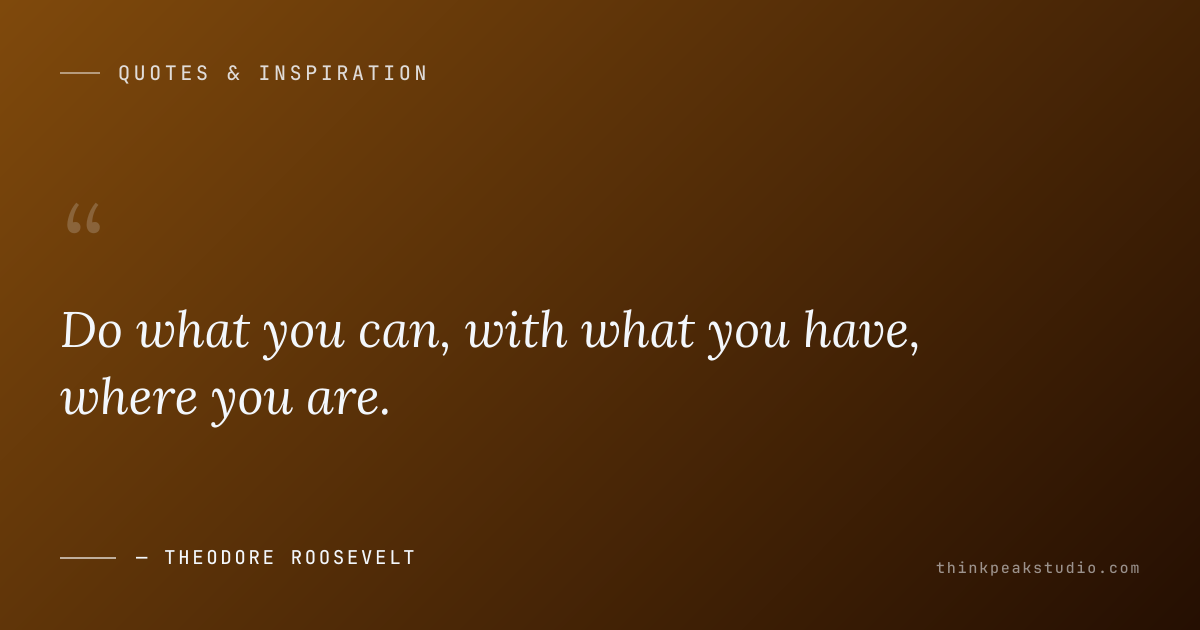
“Do what you can, with what you have, where you are.”
The context
Theodore Roosevelt was born in 1858 into a wealthy New York family, but no amount of money could change the fact that he arrived in the world frail, asthmatic, and sickly — a boy whose doctors warned his parents not to expect him to live a strenuous life. He spent his childhood gasping for breath, carried up and down stairs, unable to run with other children. What he did with that disadvantage became the defining pattern of his existence. His father told him he would need to build his body, and Roosevelt took the instruction with a literalness that bordered on ferocity. He lifted weights, boxed, rowed, and rode until the sickly boy became a man of almost cartoonish vigor — a rancher, a big-game hunter, a soldier who charged up a hill in Cuba, and eventually the youngest president in American history, taking office at forty-two. The lesson he drew from his own transformation was not that effort is always rewarded, but that a person is not defined by what they were given. You build with what you have.
The line “do what you can, with what you have, where you are” is frequently attributed to Roosevelt, and even where the exact source is uncertain, it is unmistakably his — the compressed summary of the philosophy he called “the strenuous life.” That philosophy, laid out in a famous 1899 speech, was an argument against comfort, against the habit of waiting for ideal conditions, and against the tendency to drift. Roosevelt believed that life’s highest reward is not ease but the sense of having acted, of having met difficulty head-on with whatever tools were at hand. The quote distills that entire worldview into a single sentence with three moving parts — three clauses that, together, remove every possible excuse for standing still.
What makes the quote so representative of the man is that it was written in blood, not in theory. Roosevelt lost his mother and his first wife on the same day in 1884 — the two women he loved most, gone within hours of each other, leaving him with an infant daughter. He responded not by withdrawing but by action: he fled to the Dakota Badlands, bought a ranch, and rebuilt himself through years of brutal physical labor. He lost political campaigns, was shot in the chest by an assassin and insisted on delivering his speech anyway, with the bullet still lodged in his rib. Time and again he faced circumstances that would justify waiting, grieving, or giving up — and time and again he did the only thing his philosophy allowed. He did what he could, with what he had, where he was.
The meaning
The quote’s power lies in its structure, because each of its three clauses answers a different form of procrastination. “Do what you can” answers the excuse of inadequacy — the inner voice that says you are not skilled enough, not talented enough, not ready enough to begin. Roosevelt’s reply is that you were never asked to do everything; you were only asked to do what you can. “With what you have” answers the excuse of lack — the belief that you cannot start until you have more money, more time, more knowledge, more support. It insists that the resources already in your hands are sufficient to take the next step, and that waiting for better ones is not prudence but delay. “Where you are” answers the excuse of circumstance — the fantasy that life will really begin somewhere else, in a better city, a better job, a better season of life. Roosevelt collapses all three alibis at once, leaving no ground left on which inaction can stand.
The deeper meaning is about the relationship between action and possibility. There is a widespread assumption that you must feel ready before you act — that confidence precedes movement, that clarity precedes the step. Roosevelt reverses the order. You act first, and the clarity and confidence follow. What you can do expands the moment you actually begin doing it; the resources you need tend to appear once you have committed to using the ones you have; the place where you are stops being a limitation the moment you treat it as the starting point rather than the obstacle. The quote is a statement of faith in momentum — the faith that the world rewards the person who starts, and punishes only the person who waits for a perfect beginning that never comes.
There is also, beneath its practicality, a quiet assertion of dignity. The quote refuses to treat a person as a victim of their conditions. It does not deny that conditions matter — Roosevelt knew as well as anyone how unfair the hand you are dealt can be. But it insists that within almost any set of conditions, a person retains a sliver of power: the power to do something, however small, with whatever they have, exactly where they are. That sliver is the seed of everything else. Great lives are not built from great beginnings; they are built from small, repeated acts performed in imperfect circumstances. The person who waits for the perfect conditions waits forever, because the perfect conditions do not exist. The person who starts where they are discovers that the conditions were never the point — the starting was.
Why it still matters today
The quote has never been more relevant, because the modern world is a machine for producing exactly the three excuses Roosevelt dismantled. The internet surrounds us with images of people who seem to have more talent, more resources, and better circumstances than we do — so we feel inadequate before we begin. The culture of optimization teaches us that we need the perfect course, the perfect tool, the perfect plan, and the perfect moment — so we accumulate preparations instead of taking action. And the constant promise of a better life elsewhere — a different city, a different job, a different version of ourselves we will become “someday” — keeps us perpetually waiting to begin. The result is a generation that is more informed and better equipped than any in history, and yet strangely paralyzed — reading about action, planning action, and postponing action indefinitely. Roosevelt’s sentence is the antidote to all of it.
Its relevance also lies in what it pushes back against on the other side: the exhaustion of perfectionism and the despair of all-or-nothing thinking. People abandon goals not because they stop caring but because they demand too much of themselves at once — they insist on going to the gym five times a week and, when they miss one day, quit entirely; they want to write a book and, facing the blank page, write nothing at all. “Do what you can, with what you have, where you are” lowers the bar from the impossible to the possible, and in doing so makes the possible actually happen. It is a permission slip to be imperfect, to start small, to act in conditions that are less than ideal — and it is precisely this permission, more than any grand plan, that separates people who move from people who merely wish. In an era of overwhelm, the most radical instruction is often the simplest one: begin.
How to apply this in your own life
The most direct way to apply the quote is to treat it as a filter for your excuses. The next time you notice yourself not doing something you claim to want — not starting the project, not making the call, not beginning the habit — ask which of the three clauses you are violating. Are you refusing to do what you can, holding out for the perfect version of the task? Are you refusing to use what you have, waiting for resources you do not yet possess? Are you refusing to act where you are, postponing until your circumstances change? The answer, almost always, is one of the three, and naming it robs the excuse of its power. Then take the smallest possible version of the action — not the whole project, but the first step, completed today, with the tools and time you already have. One step, repeated daily, outruns the person who is still preparing.
The deeper application is to adopt the quote as a standing philosophy of agency, a refusal to live on the condition that life first become easy. Roosevelt’s entire career was proof that a person is not the sum of their starting conditions but the product of what they choose to do with them — and the same choice is offered to you, daily, in small and ordinary form. When circumstances turn hard, when resources run short, when you feel stuck in a place you did not choose, the sentence is there to meet you: you can still do something. That something will not fix everything, and Roosevelt never promised it would. What it will do is keep you moving, and movement is the only thing that has ever carried anyone from where they are to where they want to be. Do what you can, with what you have, where you are — and you will find, as he did, that it is enough to build a life.
Create your own quote graphic with this quote
This is the kind of quote that clears the fog and gets you moving. When you pair an idea this practical with thoughtful design, you create something worth saving and returning to. Use our free online quote maker to turn this exact quote into a shareable image in seconds — no signup needed. For advanced features like video quotes and 100+ templates, try the Quotes Creator Android app.
Why we chose this quote
We chose this quote because it is the rare piece of advice that works equally well as a life philosophy and a Monday-morning instruction. In eleven words it dismantles the three excuses — inadequacy, lack, and circumstance — that keep more people stuck than any external obstacle ever could. Theodore Roosevelt was not a man who spoke about action from an armchair; he rebuilt a sickly body into a soldier’s, mourned devastating loss, survived an assassin’s bullet, and rose to the presidency, all by living the sentence he is remembered for. In a culture that teaches us to wait for the perfect conditions before we begin, it hands us back the one thing the culture cannot take away: the power to do something, right now, with exactly what we have, exactly where we are. That is why it endures — not because it is grand, but because it is true, and because it works.
— ThinkPeak Studio Editorial Team
Create your own quote graphic with this quote
Turn this line into a shareable graphic in seconds — free, no signup needed. For video quotes and 100+ templates, try the Android app.
Advertisement
Enjoyed this article? Get more like it in your inbox.


