Quote Explained: “I have not failed. I’ve just found 10,000 ways that won’t work.”
By Thomas Edison, American inventor and holder of over 1,000 patents
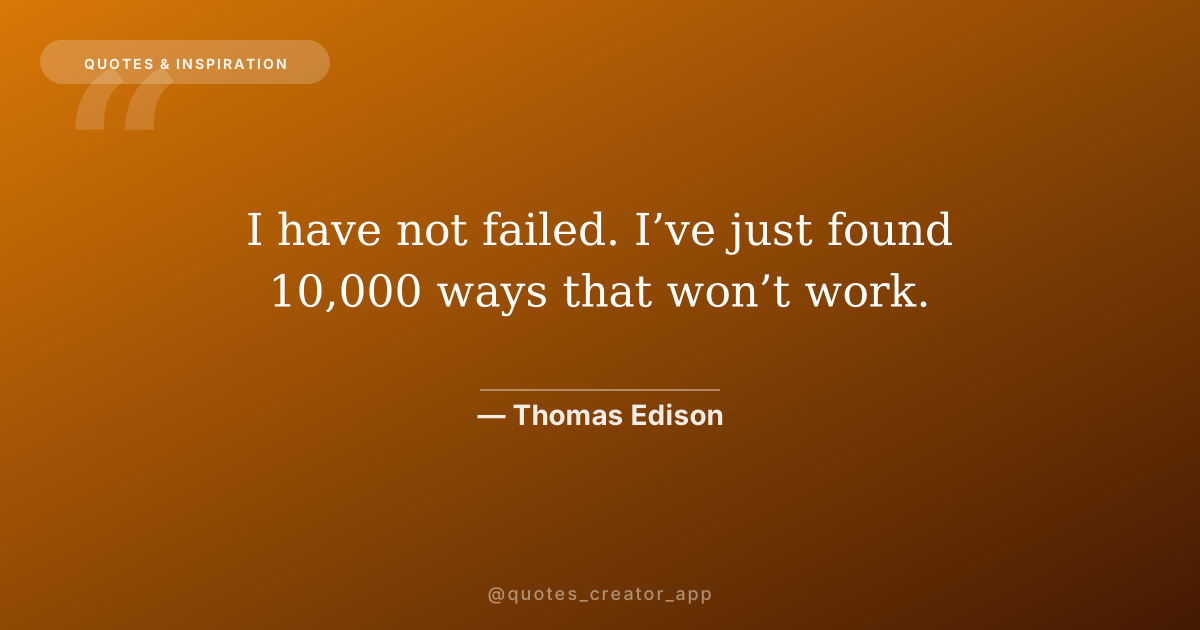
“I have not failed. I’ve just found 10,000 ways that won’t work.”
The context
The line is inseparable from a single, famously stubborn technical problem: the search for a practical light bulb filament. In the late 1870s, Thomas Edison had already made himself the most celebrated inventor in America with the phonograph, but the electric light was the prize everyone knew would change civilization. The principle was understood — pass a current through a resistant material inside a vacuum and it will glow — but no one had found a material that would burn long enough, brightly enough, and cheaply enough to be useful. Edison approached the problem the way he approached everything: not as a flash of genius but as a campaign. He assembled a team at his Menlo Park laboratory in New Jersey and set them to work testing, methodically, virtually every substance they could carbonize — cotton, flax, bamboo, cedar, hair, paper, and thousands more — cataloguing what happened as each one burned out in seconds or minutes.
The now-famous number “10,000” is, by most accounts, apocryphal in its precision but truthful in its spirit. What is documented is that the search was grueling, repetitive, and discouraging, and that Edison refused to describe any of it as failure. When a reporter asked him whether he was discouraged by the thousands of unsuccessful experiments, Edison is said to have replied that he had not failed at all — that he now knew several thousand things that would not work, and was that much closer to the one thing that would. The remark, in its various retellings, distills an entire philosophy: that a negative result is not an ending but a measurement, and that the difference between a dead end and a discovery is often nothing more than how you choose to count it.
The context that made the line land is just as important as the line itself. Edison was working at the hinge between two ages, when invention was shifting from the solitary tinkerer to the organized laboratory, and when the public was hungry for a story about how progress actually happens. The myth of the lone genius with a sudden bolt of inspiration was everywhere; Edison, in public and in his own meticulous notebooks, kept insisting on a less glamorous truth — that invention is mostly iteration, and that the road to the light bulb is paved with thousands of burned-out filaments. His quote became one of the most quoted lines about persistence in the English language because it offered a complete psychological technology for surviving a process that is, by definition, mostly made of things that do not work.
The meaning
The quote’s power lies in a single act of reframing, and it is more radical than it sounds. “Failure” is a verdict — it is what you call an attempt when you have decided the attempt defines the whole enterprise, and the whole person, as unsuccessful. Edison’s sentence quietly refuses that verdict. By restating the same facts — ten thousand attempts, ten thousand non-results — as “ways that won’t work,” he separates the outcome from the self. The experiment is not judged as a personal defeat; it is recorded as information. A person who has failed ten thousand times is a fool or a loser; a person who has discovered ten thousand things that don’t work is an expert. The identical events, described in different words, produce entirely different people. The quote is, at bottom, an argument that failure is a story we tell about data, and that we are free to tell a better one.
There is also a genuine epistemological claim hiding inside the aphorism, and it is one of the more important ideas in science and engineering. Negative knowledge — knowing what does not work — is still knowledge, and often the only kind that can actually get you to the truth. When you are searching a vast space of possibilities, every eliminated option shrinks the space. Edison genuinely was closer to the answer at attempt ten thousand than at attempt one, not because he was any nearer to the solution in some mystical sense, but because he had crossed off ten thousand regions of the map. In this light, the “ways that won’t work” are not the price you pay for the eventual success; they are the success, accumulated incrementally. The person who understands this stops dreading the negative result and starts treating it as the actual unit of progress. A dead end is only a dead end if you refuse to learn its location.
The subtler meaning concerns identity and time. The quote works only because Edison was willing to keep his identity invested in the search rather than in any single result. Most people experience failure as an injury to the self precisely because they have attached their worth to the outcome — so when the outcome fails, the self fails with it. Edison’s framing severs that attachment: the self is located in the sustained effort, in the thousands of attempts, not in any one of them. This is why the quote has survived as a monument to persistence rather than to mere optimism. It does not deny that the attempts failed in the ordinary sense; it denies that the failure means anything about you. It is a small but profound act of ownership — the refusal to hand a thousand unsuccessful experiments the power to name you.
Why it still matters today
In 2026, the quote has never been more necessary, because we live in a culture that has perfected the art of hiding its failures while quietly being terrified of them. Social media presents a world of finished products — the launched company, the toned body, the published book, the curated life — and renders invisible the thousands of discarded drafts, dead startups, and embarrassing first attempts that every one of those products required. The result is a population that judges its own messy interior against everyone else’s polished exterior, and concludes that failure is a rare and shameful event that happens only to other people — or rather, only to you. Edison’s sentence is a standing rebuke to that entire illusion. It insists that the failures are not the exception to the success story; they are the success story, and the only reason you do not see them in anyone else is that they have been cropped out of the frame.
The quote also speaks directly to the ethos of the modern technical economy, which has rediscovered Edison’s method and rebranded it as “failing fast.” The startup world now preaches iteration, the embrace of the negative result, the pivot after the failed experiment — and yet, for all that vocabulary, the underlying emotional machinery has barely changed. People still fear the failed launch, the declined pitch, the rejected application, because the culture that celebrates failure in the abstract still punishes it in the specific. What Edison offers is not a business slogan but a way of being: the ability to metabolize a setback into a data point in real time, without first passing through the swamp of shame. In an age that talks constantly about resilience while practicing relentless comparison, “I have not failed — I’ve found 10,000 ways that won’t work” remains the single most useful sentence ever uttered about the difference between a result and a verdict.
How to apply this in your own life
The practical application begins with a discipline as simple as it is rare: keep a record of what did not work. Edison did not improvise his reframe in a moment of inspiration; he was a compulsive note-taker whose notebooks are filled with hundreds of thousands of pages of observations, including the failures, recorded as carefully as the successes. Most of us do the opposite — we remember our wins and bury our losses, which guarantees that every loss stays a wound instead of becoming a lesson. The next time something you attempt fails, write down, in plain language, what you tried, what happened, and what the result now tells you is off the table. This single habit converts the vague, corrosive feeling of “I failed” into the specific, useful knowledge of “that approach won’t work” — and it is the difference between carrying a verdict and carrying a map. Over time, the notebook becomes proof that you are not a person who fails; you are a person who eliminates options, which is precisely what every successful person has actually been doing all along.
The deeper application is about where you place your identity while the work is still uncertain. When you begin a meaningful project — a career change, a business, a skill, a relationship, an artistic ambition — decide in advance that your self-worth is attached to the sustained attempt, not to any single outcome, and then behave as if that decision were true. This means, concretely, that when the tenth application is rejected or the tenth draft is thrown away, you do not let the event answer the question “who am I?” You let it answer only the question “what have I now learned?” Edison’s genius was not that he was immune to discouragement but that he had built a frame through which a burned-out filament could never reach his sense of self. You can build the same frame, one reframe at a time. Tell the truth about the result — yes, that attempt did not work — and then refuse, deliberately and daily, to extend that truth into a claim about your worth. Do this enough, and you stop being afraid to begin. The person who cannot fail is not the one who never falls; it is the one who has finally learned to count every fall as information — and to keep walking toward the one way that works.
Create your own quote graphic with this quote
This is the kind of quote that changes how you carry a setback. When you pair an idea this useful with thoughtful design, you create something worth saving and returning to. Use our free online quote maker to turn this exact quote into a shareable image in seconds — no signup needed. For advanced features like video quotes and 100+ templates, try the Quotes Creator Android app.
Why we chose this quote
Thomas Edison is usually remembered as a genius, which is precisely why his most important idea deserves a closer look — because the truth is far more useful than the myth. The line “I have not failed. I’ve just found 10,000 ways that won’t work” is so familiar that its depth is easy to miss, so we wanted to treat it as what it actually is: not a cheerful slogan about staying positive, but a complete account of how real progress is made — one eliminated option at a time, with the self kept safely separate from the result. It is a sentence that does something almost no other piece of advice manages: it makes failure feel less like a verdict and more like a measurement. In a culture that worships finished products and hides its process, it is a reminder that the people who succeed are not the ones who avoid the ten thousand dead ends. They are the ones who learn to count them without shame. That is why it still matters, long after the last light bulb has been replaced.
— ThinkPeak Studio Editorial Team
Create your own quote graphic with this quote
Turn this line into a shareable graphic in seconds — free, no signup needed. For video quotes and 100+ templates, try the Android app.
Advertisement
Enjoyed this article? Get more like it in your inbox.