Quote Explained: “If you want to fly, you have to give up the things that weigh you down.”
By Toni Morrison, Nobel Prize-winning author of Song of Solomon
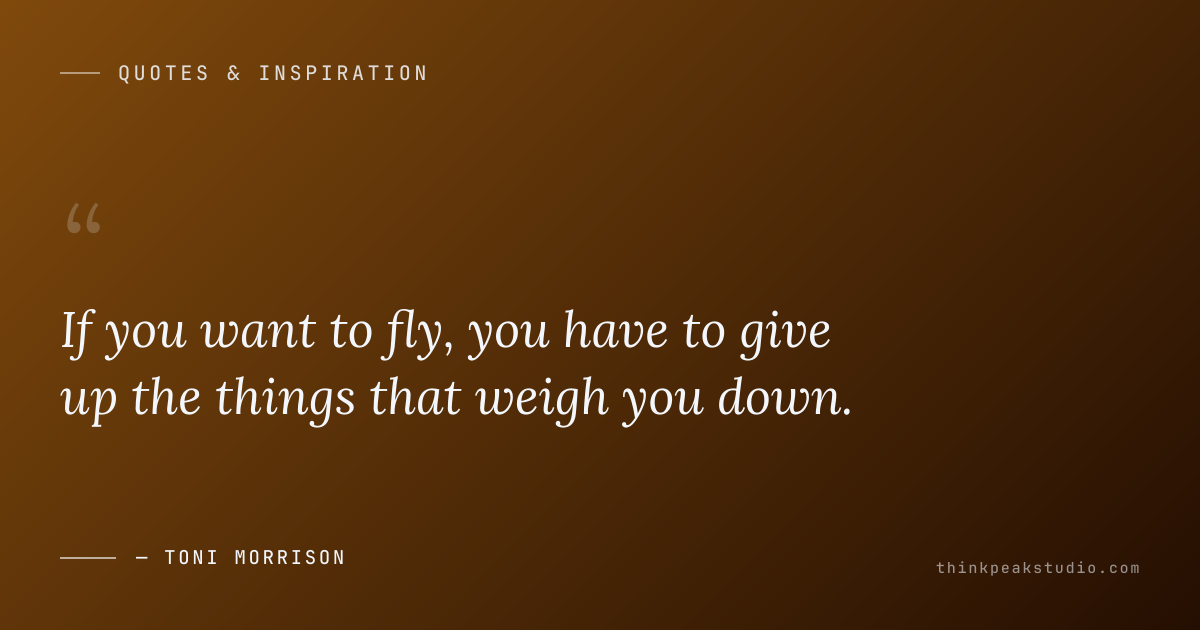
“If you want to fly, you have to give up the things that weigh you down.”
The context
Toni Morrison did not so much enter American literature as rearrange it around her. Born Chloe Ardelia Wofford in 1931 in Lorain, Ohio, she grew up in a family that treasured storytelling the way other families treasure money, and she carried that inheritance into a career that would eventually make her the first Black woman to win the Nobel Prize in Literature. Her novels — The Bluest Eye, Sula, Song of Solomon, Beloved — did something American fiction had largely failed to do: they placed Black interior life, memory, and longing at the absolute center of the frame, treating the private thoughts of Black men and women as worthy of the same weight and craft that the Western canon had reserved for kings and tragic heroes. Morrison once explained that she wrote the books she wanted to read — books that had not yet been written. The result was a body of work that did not reflect the American story so much as correct it, insisting that the people history had rendered invisible were, in fact, its most luminous witnesses.
The quote at the heart of this analysis comes from Song of Solomon, the 1977 novel that made her famous, and it is spoken by Pilate Dead — one of the most unforgettable characters in all of American fiction. Pilate is a woman born without a navel, a mark that sets her permanently outside the ordinary; she carries the bones of her murdered father in a sack, keeps a wine-making brother and a daughter she raised alone, and lives by a code that is entirely her own. The line — “You wanna fly, you got to give up the shit that weighs you down” — is Pilate’s plainspoken wisdom, delivered to the novel’s protagonist, Milkman Dead, a young man grounded by family legacy, material comfort, and fear. Flight is the novel’s master symbol. It opens with a failed flight — an insurance agent leaping from a hospital roof — and it circles always around the legend of Solomon, Milkman’s great-grandfather, who is said to have flown back to Africa, leaving wife and children behind. In Pilate’s mouth, the idea of flying becomes something more urgent and more practical than myth: it becomes a choice.
Why has this sentence — now usually rendered in its cleaner paraphrase, “if you want to fly, you have to give up the things that weigh you down” — traveled so far beyond its novel? Because it names, in a single breath, the oldest and hardest bargain in human life. Every tradition, sacred and secular alike, has circled the same truth: that to rise, you must let go. The quote migrated from a literary masterpiece to a global maxim precisely because it is not literary at all in its effect — it is a piece of grandmotherly, bones-deep common sense dressed in the language of flight. It survives on Pinterest boards and Instagram captions and therapy-office walls for the same reason it survives on the page: because it tells us something we already know, but are forever trying not to hear. You cannot ascend while refusing to release. The line endures because it is both a promise and a dare — and because no one ever feels quite finished with it.
The meaning
The surface meaning of the quote is almost embarrassingly simple, and that simplicity is its genius. Flight — whether we mean ambition, healing, reinvention, or freedom itself — requires lightness. A bird does not soar while dragging a stone. Yet most of us spend our lives trying to do exactly that: to rise while clinging to every weight we have accumulated. The things that weigh us down are not only the obvious burdens — debt, obligation, possessions, toxic relationships — but the quieter ones: old grudges, past humiliations, the identities other people assigned to us, the comfort of the familiar, the story we tell ourselves about who we have always been. The quote makes an equation of it. The reason you are not flying, it insists, is not that you lack wings. It is that you will not open your hands.
The deeper meaning lies in what Morrison is really asking us to release. She is not, after all, speaking only of objects. The heaviest things in a life are almost never physical. They are the resentments we polish like heirlooms, the regrets we carry as proof of our seriousness, the fear that keeps us small because smallness feels safe, the old self that no longer fits but that we refuse to outgrow. This is why the quote stings in a way a tidier proverb never could. Most people imagine they would gladly give up what weighs them down — until they see the list. The weight is rarely the enemy we expected; it is the past we have mistaken for ourselves. Morrison, through Pilate, is asking a harder question than it first appears: not “what are you willing to lose,” but “what are you willing to stop carrying?”
There is also a subtle and crucial nuance buried in the line, one that separates it from cheap inspiration. Flight, in Song of Solomon, is never only a triumph. Solomon flew — and left his family behind. The novel holds both truths in the air at once: flight is liberation, and flight is abandonment; rising is freedom, and rising is loss. Pilate herself is the novel’s most free-spirited character, yet she never flies anywhere — she is rooted, grounded, wholly present. Her wisdom is therefore not a naive call to escape but a precise observation about what makes flight possible in the first place. You cannot have the altitude without accepting the release. The quote does not promise that letting go will be painless — only that it is non-negotiable. Freedom, in Morrison’s accounting, is not the absence of weight but the deliberate, disciplined act of setting it down.
Why it still matters today
In 2026, the quote has never been more necessary, because the modern world has become a machine for manufacturing weight. We carry more than any generation before us: more possessions, more debt, more subscriptions, more notifications, more obligations, more versions of ourselves to maintain across more platforms. The culture does not merely permit accumulation; it enforces it, rebranding clutter as “optimization” and overcommitment as “hustle.” Into this endless and exhausting project of adding more, Morrison’s sentence arrives like a clean line drawn through the noise. It renames the problem. The issue, it says, is not that you lack the willpower or the talent or the time to rise. The issue is that you are carrying far too much — and no amount of adding will ever make you lighter. In an era that measures success by how much you can hold, the quote offers a radical alternative: success measured by how much you can release.
The quote also sits at the center of a quiet but unmistakable cultural correction. The last decade has produced a powerful counter-movement — minimalism, decluttering, boundary-setting, “protecting your peace,” the endless therapy-inflected vocabulary of letting go — and all of it, whether it knows it or not, is Pilate’s sentence wearing modern clothes. Psychologists have long understood what the novelist intuited: that chronic stress is less about what happens to us than about what we carry, and that the inability to release resentment, regret, and outdated self-concepts is among the most reliable predictors of anxiety and depression. Forgiveness, grief work, cognitive reframing — these are all, at bottom, methods of setting down weight. Morrison’s relevance is therefore not literary but practical, even clinical. She took one of the oldest truths in the human canon and compressed it into a sentence so plain it can be carried in a pocket — and in a time that has never been heavier, it is the sentence people keep reaching for.
How to apply this in your own life
The most practical way to apply the quote is to make an honest inventory of what you are carrying — and then to begin, deliberately, to set some of it down. Sit with a blank page and list the weights: the grudges you still feed, the commitments you accepted out of obligation rather than desire, the possessions you keep out of fear, the relationships that cost you more than they return, the old version of yourself you are still performing. Ask each item a single question: does this help me rise, or does it hold me down? You will find that a surprising number of the things you defend most fiercely are, in fact, anchors. You do not have to drop everything at once. Flight is built one release at a time — one conversation, one unfollow, one box donated, one apology accepted, one old story let go. The point is not perfection but direction. Every weight you release is a little more altitude.
The deeper application is to reframe what letting go feels like. Most people abandon the attempt because releasing a weight feels, in the moment, indistinguishable from loss — and they mistake that grief for a sign that they are doing something wrong. The quote corrects that misunderstanding. The heaviness you feel as you loosen your grip is not failure; it is the price of the climb. You cannot rise without that feeling, and the fact that it hurts is proof that you were holding something real. So stop asking “what am I losing?” and start asking “what am I becoming light enough to do?” The person who can finally fly is not the one who avoided the weight of living — it is the one who learned, over and over, to put it down. You have the wings. You always did. The only question that remains is what you are willing to let go of to use them — because if you want to fly, you have to give up the things that weigh you down.
Create your own quote graphic with this quote
This is the kind of quote that lands like a weight lifted the moment you read it. When you pair an idea this liberating with thoughtful design, you create something worth saving and returning to. Use our free online quote maker to turn this exact quote into a shareable image in seconds — no signup needed. For advanced features like video quotes and 100+ templates, try the Quotes Creator Android app.
Why we chose this quote
We chose this quote because it is one of the rare lines that is simultaneously a comfort and a dare. Toni Morrison was, by any measure, one of the greatest writers the English language has produced — and yet this sentence does not read like literature. It reads like the advice of someone who has already made the climb and turned back to tell you the one thing that mattered: that you will not rise by adding, only by releasing. In a culture that never stops telling us to accumulate more, a sentence that asks us to carry less will always feel like a revelation. It is plainspoken enough to live on a sticky note and deep enough to spend a lifetime practicing, and that is precisely why it has traveled from the pages of a Nobel Prize-winning novel to feeds and journals and therapy offices across the world. It does not promise that the sky is easy. It promises that the sky is possible — and that the only thing standing between you and it is the weight you are finally ready to set down.
— ThinkPeak Studio Editorial Team
Create your own quote graphic with this quote
Turn this line into a shareable graphic in seconds — free, no signup needed. For video quotes and 100+ templates, try the Android app.
Advertisement
Enjoyed this article? Get more like it in your inbox.


