Quote Explained: “When we are no longer able to change a situation…”
By Viktor Frankl, Austrian neurologist and Holocaust survivor
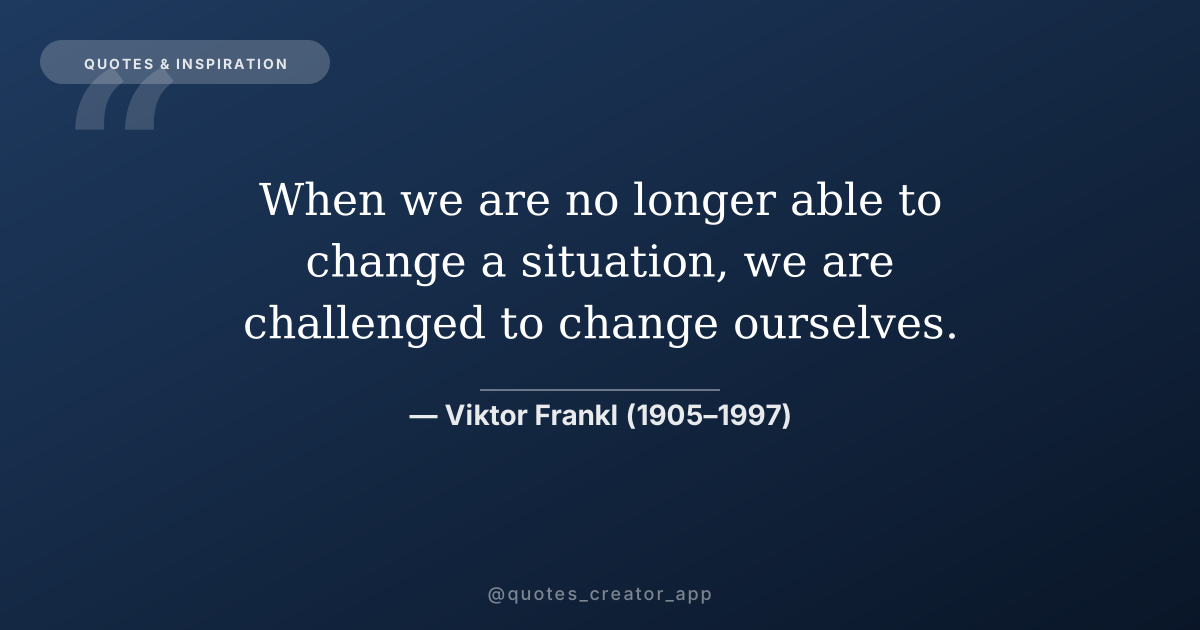
“When we are no longer able to change a situation, we are challenged to change ourselves.”
The context
Viktor Frankl wrote these words from experience most of us cannot fathom. An Austrian neurologist and psychiatrist, Frankl was deported to the Theresienstadt ghetto in 1942, then to Auschwitz, and later to Kaufering and Türkheim—subcamps of Dachau. Over the course of three years, he lost his wife, his mother, his father, and his brother to the Holocaust. He himself was reduced to a number: 119104. He watched prisoners around him succumb to despair, lose the will to live, and die within days of giving up. And yet Frankl survived—not because he was stronger or luckier, but because he discovered something about the human spirit that defied every assumption of traditional psychology.
Man’s Search for Meaning was written in just nine days after his liberation in 1945. Originally published in German under the title Trotzdem Ja zum Leben sagen—“Saying Yes to Life in Spite of Everything”—the book was not an academic treatise but an urgent, necessary testimony. Frankl had to tell the world what he had witnessed: that even in conditions of absolute degradation, human beings possess a last, irreducible freedom. The first half of the book recounts his camp experiences through the lens of a psychiatrist observing his fellow prisoners; the second half outlines logotherapy, the school of psychotherapy he founded. The quote at the heart of this essay captures the central tension of the entire work: the collision between an unchangeable reality and the demand for an inner transformation.
What makes this passage especially remarkable is that Frankl was not writing from the comfort of philosophical detachment. Every word was backed by the memory of men who starved, froze, and were beaten—and yet found ways to preserve their dignity. He tells of prisoners who gave away their last piece of bread, who comforted others through the night, who fixed their minds on loved ones they would never see again. These acts, Frankl argued, proved that a person’s deepest identity is not shaped by circumstances but by the stance they take toward those circumstances. The quote distills years of unspeakable suffering into a single, luminous insight: when the world refuses to yield, you must.
The meaning
At first glance, the quote seems to counsel acceptance—a kind of stoic resignation to fate. But Frankl is saying something far more active and demanding. He is not suggesting that we passively endure what we cannot alter. He is insisting that the inability to change external conditions triggers a deeper obligation: the obligation to transform ourselves. The word “challenged” is crucial here. It is not a gentle suggestion. It is a summons. The unchangeable situation does not merely invite inner work; it demands it. When the outer world closes its doors, an inner door opens—and walking through it requires courage, honesty, and effort that most people spend their lives avoiding.
The deeper philosophical root of this idea lies in Frankl’s conception of human freedom. In logotherapy, Frankl identified three primary sources of meaning: creating a work or doing a deed, experiencing something or encountering someone, and—most relevant here—the attitude we take toward unavoidable suffering. The third category is the most radical, because it suggests that even when the first two are stripped away entirely, meaning remains possible. A terminally ill patient, a political prisoner, a person in the grip of profound loss—all can still find meaning by choosing who they become in the face of what has happened to them. This is not the shallow positivity of “look on the bright side.” It is the hard-won recognition that suffering, when met with the right attitude, ceases to be meaningless and becomes the raw material of character.
There is also a subtle but profound inversion at work in this quote. Modern culture relentlessly promotes the idea that fulfillment comes from reshaping the external world to match our desires: get the right job, find the right partner, buy the right house, achieve the right body. Frankl turns this entirely on its head. He argues that our deepest growth occurs not when we successfully manipulate circumstances, but when we fail to do so and are forced to turn inward. The immutable obstacle becomes a mirror. It reveals our habits of blame, our attachment to control, our fear of the unknown. And in that reflection lies the opportunity—the challenge—to become someone new. The situation does not change, but the person facing it does. And that, Frankl insists, is the only change that ultimately matters.
Why it still matters today
In an age defined by unprecedented control over our environment—on-demand entertainment, algorithmically curated news feeds, same-day delivery, climate-controlled homes—Frankl’s words land with disorienting force. We have built a civilization designed to minimize discomfort and maximize convenience. Yet rates of anxiety, depression, and meaninglessness continue to climb. The paradox is that we can change almost everything about our external circumstances and still feel hollow. Frankl’s insight cuts through this confusion with surgical clarity: the problem is not that we lack control over our world; it is that we have neglected the inner work that no amount of external optimization can replace. When we cannot change a situation, we are not stuck—we are being given the most important assignment of our lives.
The quote also speaks directly to the collective trauma of the 2020s. A global pandemic forced billions into isolation. Economic upheaval destroyed careers overnight. Climate disasters displaced entire communities. Political polarization fractured families. In every case, people found themselves confronting situations they could not unilaterally fix. The natural response was anger, despair, or paralysis. Frankl offers a different path: these immovable circumstances are not merely obstacles to be endured but invitations to deepen. The parent stuck at home with young children during lockdowns, the worker laid off from a twenty-year career, the activist watching hard-won progress being rolled back—each faces a version of Frankl’s concentration camp in miniature: a reality that will not bend to their will, and the urgent question of who they will become in response.
How to apply this in your own life
The practical application begins with a simple but difficult question: what situation in your life are you still fighting to change, despite all evidence that it will not yield? It might be a chronic health condition, a relationship that has ended, a career path that has closed, or a personality trait in someone you love that will never shift. Take a sheet of paper and divide it into two columns. On the left, list everything about the situation that is genuinely outside your control. Be ruthlessly honest. On the right, list everything about yourself that could change in response: your attitude, your expectations, your daily habits, the story you tell yourself about what the situation means. The left column is your prison; the right column is your freedom. Frankl’s challenge is to spend your energy not on the left column—which will only exhaust you—but entirely on the right.
Then practice the daily discipline of the inner pivot. When you catch yourself ruminating on the unchangeable—a boss who will never appreciate you, a past mistake you cannot undo, a loss that time cannot reverse—pause and redirect the question. Do not ask “why is this happening to me?” Ask “who am I becoming through this?” The shift feels subtle, but over weeks and months it rewires your entire orientation to difficulty. You will begin to notice that your most painful experiences have also been your most formative, that the things you could not escape taught you things comfort never could. Viktor Frankl did not survive Auschwitz by wishing the camp away. He survived by finding meaning in the one domain the guards could not touch—his inner life. His challenge, handed down across eight decades, is the same for every one of us: stop trying to change what will not change, and start becoming the person the situation is asking you to be.
Create your own quote graphic with this quote
Few quotes carry the weight of lived experience the way Frankl’s words do. When you combine a profoundly tested truth with thoughtful design, you create something worth saving and sharing. Use our free online quote maker to turn this exact quote into a shareable image in seconds — no signup needed. For advanced features like video quotes and 100+ templates, try the Quotes Creator Android app.
Why we chose this quote
Viktor Frankl is frequently quoted in self-help circles, but his words are too often reduced to platitudes that strip away their context and weight. We wanted to return to the source—a man who lost everything, who documented the inner lives of prisoners with the precision of a clinician and the soul of a poet, who emerged from the twentieth century’s darkest chapter not with bitterness but with a therapeutic philosophy built on the inviolable freedom of the human spirit. This particular quote, drawn from Man’s Search for Meaning, is not just advice for difficult days. It is a complete reorientation of what it means to be human—a declaration that when the world closes every door, there is still one door left, and it opens inward.
— ThinkPeak Studio Editorial Team
Create your own quote graphic with this quote
Turn this line into a shareable graphic in seconds — free, no signup needed. For video quotes and 100+ templates, try the Android app.
Advertisement
Enjoyed this article? Get more like it in your inbox.