Quote Explained: “Everything can be taken from a man but one thing…”
By Viktor Frankl, Austrian neurologist, psychiatrist, and Holocaust survivor
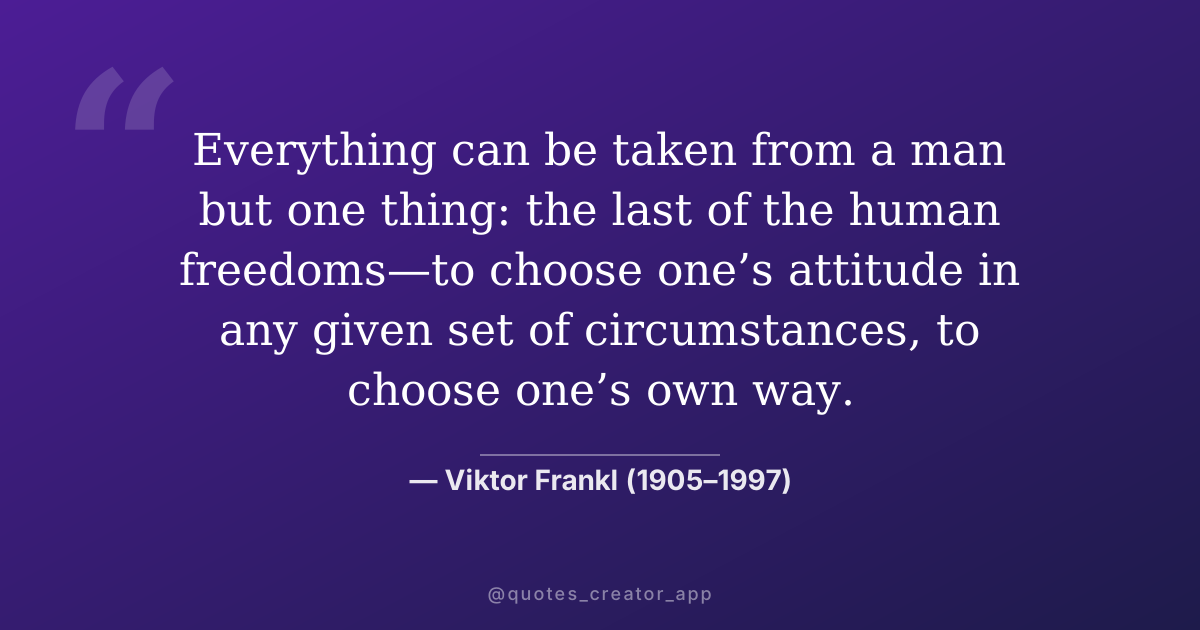
“Everything can be taken from a man but one thing: the last of the human freedoms—to choose one’s attitude in any given set of circumstances, to choose one’s own way.”
The context
Viktor Emil Frankl was born in 1905 in Vienna, the capital of a crumbling Austro-Hungarian Empire. A gifted student, he was corresponding with Sigmund Freud by the age of 19 and published his first paper soon after. By his early thirties, he had developed the core ideas of what would become logotherapy — a school of psychotherapy centered not on the pursuit of pleasure (as Freud argued) or power (as Alfred Adler contended) but on the human search for meaning. He was running a highly successful suicide-prevention program at Vienna’s Rothschild Hospital when the Nazis annexed Austria in 1938. Despite having a visa to emigrate to the United States, Frankl chose to stay. His aging parents could not leave, and Frankl refused to abandon them. The decision was, in a sense, the first application of his own philosophy: he chose his attitude in the face of an unimaginable set of circumstances.
In 1942, Frankl, his wife Tilly, his father, his mother, and his brother were deported to Nazi concentration camps. Over the next three years, he was imprisoned in four camps, including Auschwitz and Dachau. His father died of starvation in the Theresienstadt camp. His mother was killed in the gas chambers at Auschwitz. His brother died in the mines. His wife Tilly died at Bergen-Belsen. Frankl himself was stripped of everything: his name was replaced by the number 119,104, his clothes were exchanged for prison rags, his entire life’s work — a manuscript on logotherapy that he had sewn into his coat lining — was confiscated and destroyed. He endured starvation, disease, forced labor, and the constant randomness of death. And yet, in the midst of all this, he made an observation that would define his life’s work: the prisoners who survived were not necessarily the physically strongest. They were the ones who found something to live for — a loved one waiting for them, a manuscript to rewrite, a belief that suffering could be endured for a reason. The ones who lost hope, who could no longer see any meaning, died quickly — often within days.
After his liberation in April 1945, Frankl returned to Vienna to discover that everyone he loved was dead. He was entirely alone. In a burst of grief and conviction, he dictated Man’s Search for Meaning in just nine days. The book was published initially in German under the title Trotzdem Ja zum Leben Sagen: Ein Psychologe erlebt das Konzentrationslager — “Nevertheless, Say Yes to Life: A Psychologist Experiences the Concentration Camp.” Though it struggled to find a publisher at first, it went on to sell over 16 million copies in more than 50 languages. It is consistently ranked among the most influential books of the twentieth century. The Library of Congress named it one of the ten most influential books in the United States. The quote at the center of this essay is the direct distillation of everything Frankl learned in the camps, and it has since become one of the most cited and shared lines in all of psychology.
The meaning
On its surface, the quote makes a simple argument: the world can strip you of your money, your freedom, your loved ones, your health, and even your name, but it cannot strip you of the way you choose to respond. This distinction between what happens to you and what you do with it is the philosophical core of Frankl’s entire body of work. He drew a line between two realms — the external, where you may have little or no control, and the internal, where you remain sovereign. This is not a denial of suffering. Frankl wrote at length about the reality of pain, the horror of the camps, and the legitimate despair that comes from living through atrocity. What he argued was not that suffering does not hurt, but that the way you carry it — the meaning you assign to it, the dignity you maintain through it — remains yours to determine.
There are deeper philosophical layers that reward closer scrutiny. First, the quote is a direct refutation of determinism. If everything can be taken from a man but his capacity to choose his attitude, then a person is never fully a victim, never fully defined by their circumstances, never fully reducible to their biology or environment. Frankl arrived at this insight in a place where the machinery of dehumanization was as total as any society has ever built. The Nazis tried to reduce prisoners to animal reflexes — hunger, fear, exhaustion — and yet Frankl observed, even in that zero-sum environment, that some prisoners would share their last piece of bread. They chose. The choice was not large, but it was real, and that reality was everything. Second, the quote contains an implicit theory of freedom that is more demanding than most of us are comfortable with. It says that freedom is not the absence of constraints but the exercise of choice within constraints. You cannot control the circumstances, but you can control your inner posture toward them, and that inner posture may be the decisive factor in whether you survive them — physically or psychologically.
The emotional power of the quote comes from its authority. This is not a self-help slogan from someone who has never been tested. Frankl was starved, beaten, and surrounded by death for three years. Everyone he loved was murdered. He had every reason to reach the opposite conclusion — that humans are helpless products of their environment, that suffering crushes the soul, that meaning is a delusion. And yet, emerging from that darkness, he testified to the opposite truth: that the human spirit can transcend its conditions. The quote resonates because it does not promise rescue. It promises dignity. It says you may not be able to change your circumstances, but you can always change the way you relate to them, and that difference, however small it may look from the outside, is the difference between being alive and merely existing. That is a message of profound hope, but it is a hope that costs something — it requires you to take responsibility for your own inner life instead of outsourcing it to circumstances.
Why it still matters today
Frankl’s insight now lives at the heart of multiple modern disciplines. Cognitive-behavioral therapy, the most empirically validated form of psychotherapy, rests on a very similar premise: that our emotional responses are shaped less by events themselves than by the interpretations we assign to them. Resilience training for military personnel, first responders, and athletes all draw on the principle that the space between stimulus and response can be widened through practice. In the world of business leadership, executive coaches routinely cite Frankl when teaching emotional intelligence, because the ability to pause between an impulsive reaction and a considered response — what Frankl called the “last of the human freedoms” — is the behavioral signature of effective leadership. Even neuroscientists have validated the idea: research on neuroplasticity shows that repeated, deliberate choices of attention and interpretation can reshape brain patterns, meaning that Frankl’s philosophical insight has a measurable biological reality.
In the present moment, the quote speaks urgently to a generation experiencing what researchers call an epidemic of powerlessness. Social media algorithms engineer emotional reactivity, shortening the gap between stimulus and response to zero. The constant stream of global crises — climate change, political instability, economic precarity — can create a sense of learned helplessness, the feeling that nothing you do matters. It is in precisely this context that Frankl’s message is most subversive. He would say that the algorithms do not control your attention unless you let them; that the news does not determine your state of mind unless you surrender the choosing of it; that despair, however understandable, is not inevitable. The quote does not minimize the real gravity of contemporary challenges, but it insists, with the force of a life lived through the twentieth century’s worst horror, that the space between what happens to you and how you respond cannot be taken from you — and that in that space lies not just survival, but freedom.
How to apply this in your own life
The first practical application is the cultivation of the pause. Frankl’s freedom begins with a moment of interruption: a stimulus occurs — an insult, a piece of bad news, a wave of anxiety, a provocation — and before the automatic reaction kicks in, you stop. You do not suppress the feeling. You acknowledge it. Then you ask a single question: what attitude do I want to bring to this? The question is not whether the situation is fair or whether your anger is justified. The question is what serves you and what serves the people around you. The more you practice this pause in low-stakes moments — a difficult email, a tense conversation, a frustrating delay — the more available it becomes in high-stakes ones. Over time, the pause becomes instinct. You begin to experience yourself not as a leaf blown by the winds of circumstance but as a person with sovereignty over your own inner weather.
The deeper application is the practice of finding meaning in difficulty. Frankl argued that meaning can be found in three ways: through creative work, through love and relationships, and through the attitude you take toward unavoidable suffering. The third path is the most difficult, and the most transformative. When you face something that cannot be changed — a loss, a diagnosis, a failure you cannot undo — Frankl invites you to ask not “Why is this happening to me?” but “What is this asking of me?” The question flips the relationship between you and your suffering: instead of being its passive recipient, you become its active interpreter. Suffering is no longer meaningless; it becomes an arena in which you get to decide what kind of person you are. That is what Frankl meant when he said that life ultimately asks something of each of us, and that we answer by how we live. To choose your attitude in any given set of circumstances is to answer that question deliberately, with courage, and with the knowledge that even when everything else has been stripped away, you remain the author of your own response.
Create your own quote graphic with this quote
This is the kind of quote that carries weight. When you pair timeless words with thoughtful design, you create something people want to save, share, and return to. Use our free online quote maker to turn this exact quote into a shareable image in seconds — no signup needed. For advanced features like video quotes and 100+ templates, try the Quotes Creator Android app.
Why we chose this quote
Viktor Frankl’s assertion about the “last of the human freedoms” is among the most cited lines in the history of psychology, but few people know the full quote or the experience that gave rise to it. Frankl did not develop this idea in a university office or a therapeutic practice. He discovered it while starving in a concentration camp, watching fellow prisoners choose between surrendering to despair and clinging to meaning. That the insight held up under the most extreme conditions human beings have ever endured makes it, in our view, one of the most credible claims about human nature ever made. It is not a platitude; it is a witness statement. We chose this quote because understanding it fully — the context in which it was earned, the precise meaning of each clause, the way it transforms suffering from a verdict into a question — is itself an act of exercising the freedom it describes. The quote does not just tell you that you can choose your attitude. It dares you to, and shows you that there is no circumstance in which that choice is ever fully taken away.
— ThinkPeak Studio Editorial Team
Create your own quote graphic with this quote
Turn this line into a shareable graphic in seconds — free, no signup needed. For video quotes and 100+ templates, try the Android app.
Advertisement
Enjoyed this article? Get more like it in your inbox.