Quote Explained: “I disapprove of what you say, but I will defend to the death your right to say it.”
Attributed to Voltaire, French Enlightenment philosopher
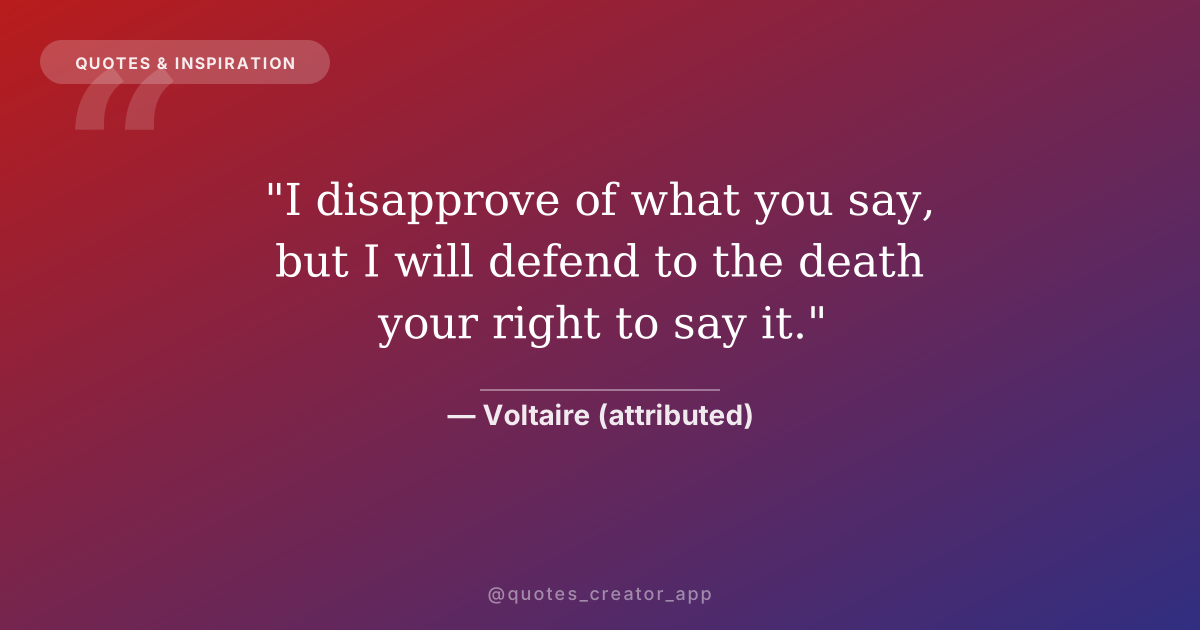
“I disapprove of what you say, but I will defend to the death your right to say it.”
The context
Here is an irony worthy of Voltaire himself: the most famous defense of free speech in the Western canon was never said by the man to whom it is attributed. The line “I disapprove of what you say, but I will defend to the death your right to say it” appears in no letter, no essay, no recorded conversation of François-Marie Arouet, known to the world as Voltaire. It was written in 1906 by an English biographer named Evelyn Beatrice Hall, who composed it as a one-sentence summary of Voltaire’s attitude toward the writer Claude-Adrien Helvétius. Helvétius had published a book, De l’Esprit, so radical in its materialism that it was condemned by the French parliament, the Sorbonne, and the Catholic Church. The book was burned in public. Its author was stripped of his royal appointments and driven into exile. Voltaire disagreed profoundly with Helvétius on almost every philosophical point. And Voltaire defended him anyway — publicly, fiercely, and at considerable risk to himself.
The historical Voltaire did not need to utter the precise words for them to be true of him. His life was a lifelong advertisement for the principle. In 1762, he spent years campaigning to exonerate Jean Calas, a Protestant merchant who had been tortured and executed on false charges of murdering his son to prevent his conversion to Catholicism. Voltaire had no personal affection for Calas, no sympathy for Protestant theology, and nothing to gain from the case except enemies. He took it up anyway, published a devastating tract, and secured a posthumous reversal of the verdict. When the philosopher Jean-Jacques Rousseau fled persecution for his controversial writings, it was Voltaire — who disagreed with Rousseau about nearly everything — who offered him sanctuary. The biography is a record of a man who kept defending people whose ideas he could not stand.
Evelyn Beatrice Hall published The Friends of Voltaire under the pseudonym S. G. Tallentyre, a common practice for women writers at the time. She intended the sentence not as a direct quotation but as a distillation of an attitude — one she deeply admired. What elevates the line from a biographical footnote to a universal principle is the precision of its architecture: it separates two acts that most people instinctively conflate. Disapproval is private; defense is public. One you feel; the other you do. The gap between them is where a free society lives, and Hall saw that Voltaire had bridged that gap with something approaching instinct. The line escaped its author and attached itself to Voltaire because it captured the spirit of the man more accurately than any verbatim quotation could have.
The meaning
At first glance the sentence looks like an ethical rule about speech — do not silence people you disagree with. That is true, but it undersells the radicalism of what the line actually demands. The quote does not say “I tolerate what you say.” It does not say “I respect what you say” or “I am curious about what you say.” It opens with the most emphatic negative available: I disapprove. The speaker is not neutral, not sympathetic, not even mildly annoyed. They are actively opposed. The sentence then performs a move so fast and so intellectually athletic that it is easy to miss: it converts total opposition into total defense without asking for a single concession in between. No promise to moderate the disapproval, no request to soften the speech, no condition that the other person first earn the defense by being reasonable. Just: I am against everything you stand for, and I will stand in front of the mob for your right to stand for it.
The deeper layer concerns the relationship between truth and freedom. Voltaire and Hall shared a conviction that truth does not need to be protected from error; it needs to be exposed to it. The Enlightenment conviction, which Voltaire embodied as much as any figure of the eighteenth century, held that error thrives in darkness and truth thrives in light. When you silence a bad idea, you do not destroy it — you drive it underground, where it festers, gains the credibility of the forbidden, and escapes the only force that can defeat it: public scrutiny. The quote is therefore not merely a rule of politeness or a preference for civil disagreement. It is an epistemological claim. The best way to defeat an idea you believe is wrong is not to ban it but to let it be heard and argued into the ground. Silencing your opponent is, in this view, a confession that you do not trust your own arguments to win in a fair fight.
There is also a psychological dimension that makes the quote so enduring and so difficult. Defending someone whose views you already agree with requires no principle at all; it is tribal loyalty dressed in the language of liberty. The moral weight of the quote falls entirely on the first clause: I disapprove. The test is defending the speech you find repellent, dangerous, or offensive — the speech that makes you want to reach for the mute button. That is why the quote is so often quoted and so rarely practiced. Most people who cite it believe they believe it. But the real question is whether they can name a recent instance in which they publicly defended the speaking rights of someone whose ideas they detest. If the answer is no, they may love the principle but have not yet had to pay for it.
Why it still matters today
The quote has never been more contested than it is right now. We live in a moment of unprecedented tension around speech: deplatforming debates, campus speaker disinvitations, social media content moderation, cancel culture, hate speech legislation, and the algorithmic amplification of outrage. On every side of the political spectrum, there are voices arguing that the old free-speech absolutism is obsolete — that some speech causes genuine harm, that platforms have a responsibility to curate, that tolerance must have limits to remain tolerance at all. These are not frivolous arguments. But notice what happens when the Voltaire principle is abandoned: every group develops its own list of speech that should be protected (its own) and speech that should be restricted (its opponents’), and the result is not a safer public square but a fragmented one in which everyone is a censor for someone else. The quote remains a valuable diagnostic. If your free-speech principle applies only to people on your side, it is not a principle; it is a partisan weapon.
The line also speaks directly to the architecture of social media. Platforms algorithmically sort us into tribes, show us content that confirms our biases, and reward outrage over reflection. The effect is to make disapproval feel like an emergency and defense feel like betrayal. In that environment, the quote is not a piece of dusty Enlightenment nostalgia; it is an active counterweight. To practice it today is to deliberately seek out views that trouble you and refuse to have them removed from your feed, your workplace, or your campus. It is to resist the seductive idea that your emotional discomfort is a reliable guide to what should be permissible. And it is to recognize that every time you silence someone you disagree with, you create a precedent that will one day be used to silence you, because power shifts, and today’s majority is tomorrow’s heretic. The Voltaire principle is not naive about danger; it is precisely designed for a world in which danger moves unpredictably.
How to apply this in your own life
The most practical application is the simplest and the hardest: find someone whose views you genuinely disapprove of, and before you argue, publicly affirm their right to say it. This does not mean endorsing, platforming, or amplifying. It means stating, explicitly, that you would not want them silenced even though you believe they are wrong. Try this in a conversation about politics, religion, or culture, and watch what happens. The room will tense. People will assume you are secretly on the other side. That reaction is itself the evidence that the principle is in trouble — because in a healthy free-speech culture, the statement “I defend your right to say this” would be a preamble, not a controversy. Apply the principle to your own information diet as well: follow one writer you respect but profoundly disagree with. Read them not to mock but to understand. If your convictions cannot survive contact with the strongest version of the opposing argument, then the problem is not with the argument — it is with your convictions.
The second application is institutional. If you have any authority — as a manager, a teacher, a community organizer, an event planner — build the Voltaire principle into the structure of how you run things. Invite dissenting speakers. Create channels for unpopular opinions. When someone complains that a viewpoint is offensive, resist the reflex to remove it and instead use it as an occasion to argue back, publicly and rigorously. The goal is not to make everyone comfortable; the goal is to make everyone incapable of claiming they were silenced. And when you are the one who is offended — because eventually everyone is — remember that the principle exists for that exact moment. It is easy to defend speech when you are not the target. The only defense that counts is the one you offer when you are.
Create your own quote graphic with this quote
Few quotes are more shareable than this one. Its elegant moral symmetry, its historical weight, and its permanent relevance make it ideal for social media graphics, posters, classroom walls, and protest signs. Use our free online quote maker to turn this exact quote into a shareable image in seconds — no signup needed. For advanced features like video quotes and 100+ templates, try the Quotes Creator Android app.
Why we chose this quote
This sentence is the closest thing Western culture has to a secular commandment about speech, and almost everything most people believe about it is wrong. It was not said by Voltaire. It was not written as a quotation. And yet it is truer to the spirit of the Enlightenment than anything Voltaire actually did write, because it captures an idea so difficult that most people who quote it have never actually practiced it — the idea that the only free speech worth defending is the speech you hate. We chose it now because the pressure to abandon this principle has never been higher, and because the consequences of abandoning it are exactly what Voltaire and Hall spent their lives warning against: a world in which every faction defends its own speech and suppresses everyone else’s, mistaking power for truth. This quote, properly understood, is not a rule for your opponents. It is a test for yourself.
— ThinkPeak Studio Editorial Team
Create your own quote graphic with this quote
Turn this line into a shareable graphic in seconds — free, no signup needed. For video quotes and 100+ templates, try the Android app.
Advertisement
Enjoyed this article? Get more like it in your inbox.