Quote Explained: “Things fall apart; the centre cannot hold”
By W. B. Yeats, Nobel Prize–winning Irish poet and one of the towering figures of modernist literature.
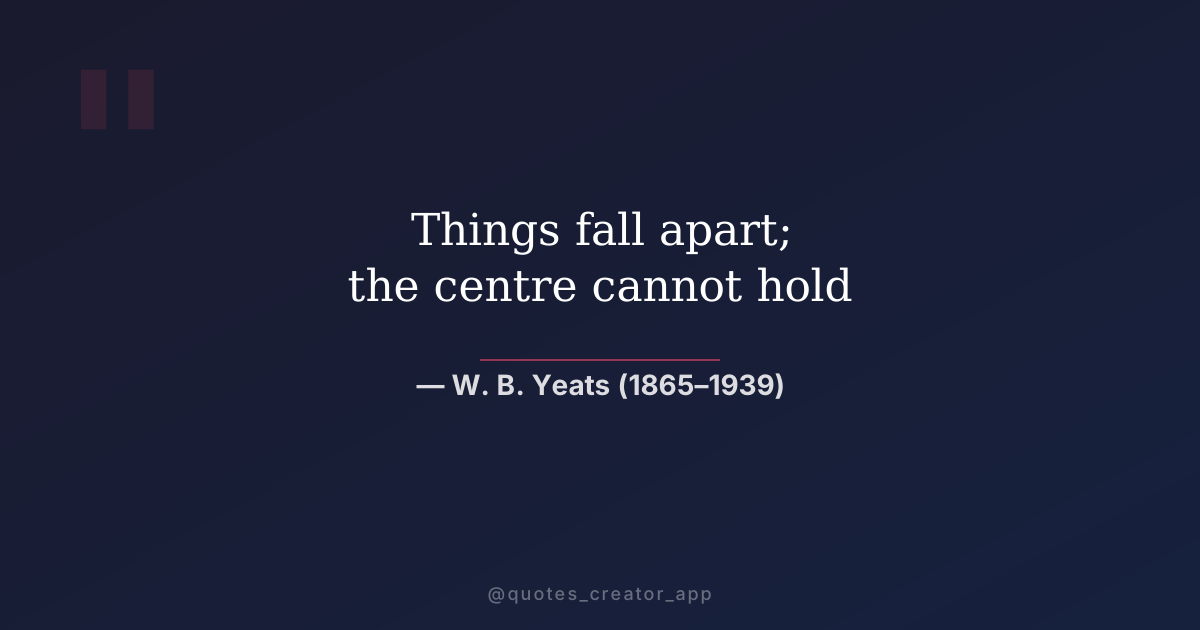
“Things fall apart; the centre cannot hold;”
The context
When William Butler Yeats sat down to write “The Second Coming” in January 1919, the world around him was convulsing. The First World War had just ended, leaving seventeen million dead and an entire continent in ruins. The old empires — Austro-Hungarian, Ottoman, German, Russian — had collapsed. The Russian Revolution had toppled a centuries-old monarchy and was spreading revolutionary fervor across Europe. And in Yeats’s own Ireland, the War of Independence against Britain was erupting, coming on the heels of the failed Easter Rising of 1916 and the executions of its leaders, several of whom Yeats had known personally.
The personal context was no less harrowing. Yeats’s pregnant wife, Georgie Hyde-Lees, had contracted the 1918–1919 influenza pandemic — a virus that would kill more people than the war itself. Among pregnant women, mortality rates in some areas reached seventy percent. Georgie survived, but Yeats drafted the poem while she was convalescing, his mind saturated with dread. He was also steeped in his own esoteric philosophy of history, which he would later codify in A Vision (1925): the idea that human civilization moves in two-thousand-year cycles, or “gyres,” and that every epoch ends in violent dissolution before a new order is born. He believed he was living through one of those inflection points.
The poem appeared in The Dial in November 1920 and was collected in Michael Robartes and the Dancer (1921). Its reception was immediate but complicated — contemporary readers recognized its power while also finding its apocalyptic vision unsettlingly opaque. It was not a conventional war poem, nor a political tract. It was something stranger: a poem that treated the collapse of civilization not as a tragedy to be mourned but as a cosmic inevitability to be named. Over the century since, it has become what Harold Bloom called “one of the most universally admired poems of our century,” and the line “Things fall apart; the centre cannot hold” has become one of the most quoted in the English language — appearing everywhere from Chinua Achebe’s novel Things Fall Apart to political commentary on Brexit, Trump, and the fracturing of democratic institutions.
The meaning
At the literal level, the line describes structural disintegration. Yeats opens the poem with the image of a falcon spiraling outward in ever-widening circles — the “gyre” of his historical theory — until it can no longer hear the falconer’s commands. The connection between controller and controlled, between the organizing principle and the thing organized, has severed. “Things fall apart” is the consequence: the constituent pieces of a system lose their coherence when the binding force — whatever held them in meaningful relation — disappears. “The centre cannot hold” is the diagnosis. Not that the centre is weak, but that it is structurally unable to perform its function. The breakdown is not a failure of will; it is a failure of physics.
But the deeper resonance flows from Yeats’s philosophy of history. In his system, a “centre” is not a political institution or a government. It is the shared moral and spiritual consensus that makes a civilization cohere — the unspoken agreements about what is true, what is sacred, and what matters. When that consensus dissolves, the social order does not simply weaken; it liquefies. What follows is the line Yeats places immediately after: “Mere anarchy is loosed upon the world.” Not anarchy as a political philosophy, but anarchy as formlessness — a world where no framework commands universal assent, where every authority is contested, and where the only remaining force is raw power. Yeats drew heavily on Nietzsche’s idea of the “transvaluation of values” — the overturning of a civilization’s moral order — and saw in the rise of fascism, communism, and militant nationalism not competing ideologies but symptoms of the same underlying disease: the centre had already failed.
There is a profound insight here about how systems actually collapse. They do not break because they are attacked from the outside; they break because the internal logic that held them together has eroded. The falcon is not shot down. It simply flies too far to hear the call. The poem is not about villains destroying the world — it is about a world that has already hollowed itself out. This is what gives the line its enduring chill: it names a form of catastrophe that does not announce itself with explosions. It arrives quietly, in the widening gap between what people once believed and what they can no longer bring themselves to trust.
Why it still matters today
Few lines of poetry have been invoked as relentlessly in the twenty-first century as this one. Journalists and commentators reached for it during the 2008 financial crisis, when the collapse of Lehman Brothers seemed to reveal that the scaffolding of global capitalism was less solid than everyone had assumed. They reached for it again during the Brexit referendum of 2016, when the United Kingdom voted to leave the European Union, fracturing a seventy-year consensus about the trajectory of European integration. The election of Donald Trump, the rise of authoritarian populism in countries from Hungary to Brazil, the spread of online disinformation, the erosion of trust in scientific institutions during a pandemic — all of these moments have been described, with varying degrees of seriousness, as evidence that “the centre cannot hold.”
But the line resonates beyond politics. It has become a shorthand for personal and institutional crises of every kind. Elyn Saks, the legal scholar and mental health advocate, titled her memoir about living with schizophrenia The Center Cannot Hold. Netflix named its 2017 documentary on Joan Didion The Center Will Not Hold, using the line to frame the late writer’s confrontation with mortality and loss. In technology, the phrase appears in analyses of platform decay, algorithmic fragmentation, and the sense that the internet’s original promise of a connected commons has given way to something more chaotic and adversarial. Yeats seized on a feeling that is not confined to one era, one nation, or one domain. It is the universal tremor that runs through any system — political, psychological, digital, ecological — when the forces that held it together suddenly let go.
How to apply this in your own life
Yeats is not offering a solution. The poem ends not with a call to action but with a vision of the “rough beast” slouching toward Bethlehem — a new order being born, and it is terrifying. That is precisely what makes the poem useful rather than merely frightening: it does not pretend there is a simple fix. The first practical takeaway is diagnostic. When you feel that things in your own life — a relationship, a career, a community, a belief system — are falling apart, the instinct is often to blame external forces: a disloyal partner, a bad boss, a hostile culture. Yeats invites a harder question: has the centre already failed? Has the shared understanding, the common purpose, the mutual trust that held the thing together quietly dissolved while you were not looking? Answering that question honestly can save you from pouring energy into fixing symptoms while ignoring causes.
The second takeaway is about how to hold a centre when you are responsible for one — whether that is a family, a team, an organization, or even your own inner life. Centres do not fail overnight. They fail when the daily work of maintaining shared meaning is neglected. The conversations that build trust stop happening. The rituals that reinforce belonging stop being performed. The values that once guided decisions become slogans that nobody quite believes. Yeats’s line, read as a warning rather than a prophecy, reminds us that coherence is not a permanent state. It must be actively renewed. That is slow, unglamorous work. It is also the only alternative to the widening gyre.
Create your own quote graphic with this quote
This is the kind of quote that carries weight. When you pair timeless words with thoughtful design, you create something people want to save, share, and return to. Quotes Creator gives you the tools to turn this quote into a beautiful graphic — custom fonts, gradient backgrounds, and export sizes for every platform.
Why we chose this quote
Few lines of twentieth-century poetry have entered the bloodstream of public discourse as completely as these six words. They appear in newspaper columns about political crises, in book titles, in documentary film titles, in corporate strategy memos, and in late-night conversations about the state of the world. Yet most people who quote them have never read the full poem and do not know the harrowing circumstances under which Yeats wrote it — the war, the pandemic, the revolution, his wife’s brush with death. We chose this quote because understanding its origin does not diminish its power; it magnifies it. A line you thought you knew becomes a window into an entire worldview, and a warning that feels pressingly relevant more than a century after it was written.
— ThinkPeak Studio Editorial Team
Create your own quote graphic with this quote
Turn this line into a shareable graphic in seconds — free, no signup needed. For video quotes and 100+ templates, try the Android app.
Advertisement
Enjoyed this article? Get more like it in your inbox.