Quote Explained: “We are what we repeatedly do.”
Written by Will Durant in 1926, paraphrasing Aristotle — and almost always credited to Aristotle himself
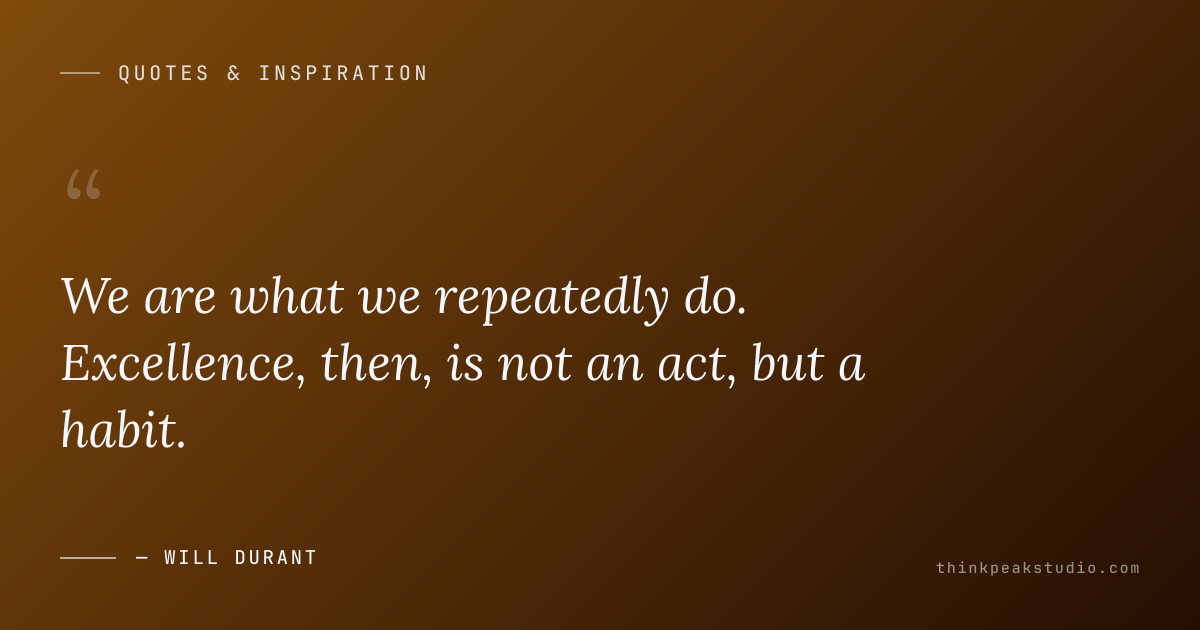
“We are what we repeatedly do. Excellence, then, is not an act, but a habit.”
The context
Almost nobody who repeats this sentence knows who wrote it. The line is everywhere — on gym walls, in locker-room speeches, at the top of habit-tracking apps — and almost everywhere it is credited to Aristotle. That attribution is the first thing worth correcting, because the true story is stranger and more interesting than the myth. The sentence does not come from ancient Greece. It comes from a one-volume popular history of Western thought published in New York in 1926, written by an American schoolteacher named Will Durant, who was summarising Aristotle for a general audience and reached for a single clean line to close the argument.
Will Durant was born in North Adams, Massachusetts, on November 5, 1885. He was a teacher, a lecturer at the radical Ferrer Modern School in New York, and a man with a gift for making difficult ideas plain. In 1913 he married one of his pupils, Ada Kaufman, whom he called Ariel; she would eventually become his full co-author. His breakthrough was The Story of Philosophy, published in 1926, which Britannica describes as a book that sold more than two million copies in less than three decades and was translated into several languages. It was followed by the vast project for which the Durants are best remembered: The Story of Civilization, eleven volumes published between 1935 and 1975, written with Ariel. The tenth volume, Rousseau and Revolution (1967), won the Pulitzer Prize for General Nonfiction in 1968, and in 1977 President Gerald Ford awarded both Durants the Presidential Medal of Freedom. Will Durant died in Los Angeles on November 7, 1981, two days after his ninety-sixth birthday, apparently never told that Ariel had died two weeks earlier.
The sentence in question sits on page 87 of The Story of Philosophy, in the chapter on Aristotle and Greek science, in a section titled “Ethics and the Nature of Happiness.” Durant was not inventing Aristotle’s doctrine; he was translating it, and the full passage shows exactly what he was doing. He wrote: “Excellence is an art won by training and habituation: we do not act rightly because we have virtue or excellence, but we rather have these because we have acted rightly; ‘these virtues are formed in man by his doing the actions’; we are what we repeatedly do. Excellence, then, is not an act but a habit.” The phrases wrapped in quotation marks are Aristotle’s own, drawn from the Nicomachean Ethics, Books I and II. The connective tissue — including the famous final two sentences — is Durant’s. Readers lifted the punchiest part of the paraphrase and, over decades, handed the whole thought to the Greek, because a paraphrase this good is indistinguishable from a quotation.
The meaning
The line works because it is built on a reversal, and the reversal is compressed into a comma. Most people assume the causal arrow runs from character to action: you are brave, therefore you do brave things; you are honest, therefore you tell the truth. Durant flips it. “We are what we repeatedly do” says the arrow runs the other way — the doing comes first, and the self is what accumulates behind it. Identity is not the cause of your habits; it is the residue of them. You do not become a writer and then write. You write, repeatedly, and a writer is what is left over. The word “repeatedly” is doing enormous work here: it quietly excludes the one-off, the heroic gesture, the New Year’s resolution, and confines the whole claim to the unglamorous arithmetic of what you actually do on an ordinary Tuesday.
The second sentence draws out the consequence for excellence, and again the move is to demote the dramatic and elevate the dull. Excellence, Durant says, “is not an act, but a habit.” An act is a moment; a habit is a structure. If excellence were an act, it would be available to anyone on any given afternoon — a lucky performance, a burst of willpower, a good day. If it is a habit, it is the product of repetition and therefore of time, and it belongs to whoever shows up consistently rather than whoever peaks once. This is precisely the point Durant was extracting from Aristotle, and it is why the quotation has outlived its own author. It converts a moral question — what kind of person are you? — into an empirical one: what do you do, over and over, when no one is watching? On that reading, character is not a mystery and not a gift. It is a ledger.
What Aristotle actually wrote makes the line sharper rather than softer. In Book II of the Nicomachean Ethics, in a passage dated by translators to roughly 350 BCE, Aristotle argues that “moral virtue comes about as a result of habit,” notes that the Greek word for character (ethike) is a slight variation on the word for habit (ethos), and insists that “none of the moral virtues arises in us by nature.” His analogy is craft: “the things we have to learn before we can do them, we learn by doing them, e.g. men become builders by building and lyre-players by playing the lyre; so too we become just by doing just acts, temperate by doing temperate acts, brave by doing brave acts.” There is one further condition Durant’s paraphrase compresses. For Aristotle, doing a just act is not enough to be just; the act must be done knowingly, for its own sake, and from a settled disposition. That is the difference between practising and merely happening to perform. A builder who frames one house by accident is not a builder. The repetition has to become the person.
Why it still matters today
The line matters now precisely because the modern self-help industry has adopted its logic while discarding its warning. A whole genre of books and apps tells us that identity change is a matter of “atomic” daily habits, that we become our routines, that one percent better every day compounds. The advice is Durant’s, and it is good advice. But it is usually presented as a cheerful productivity hack, and Aristotle’s version was a moral claim with a sting. If we are what we repeatedly do, then the things we repeat without noticing are also making us — the doom-scroll, the postponed conversation, the small dishonesty that has become a reflex. The ledger runs both ways. You are not merely building the habits you have chosen; you are also being built by the ones you have not. In an economy that is engineered to capture repetition — feeds, notifications, streaks, autoplay — the sentence is less a motivational poster than a warning about who is doing the building.
It also matters because of what the misattribution itself reveals. We wanted this sentence to be Aristotle’s, so we gave it to him, and the true author — a working populariser who spent his life translating difficult thought into plain language — was erased. That is a small parable about how we treat wisdom: we reward the ancient name and overlook the modern craftsman who did the actual labour of making the idea usable. Durant’s own life, spent forty years turning a civilisation into something a general reader could hold, is itself an argument for his quotation. He became, by doing it repeatedly, a historian. The line that carries his name least often is the one that best describes how he earned it. And the recovery of his authorship does not weaken the phrase; it deepens it, because now the sentence has a biography — a man at a desk in 1926, paraphrasing a Greek, becoming by repetition the very thing he was describing.
How to apply this in your own life
The practical use of the line is to stop thinking of character as something you discover and start treating it as something you deposit. Take an honest inventory, not of your values but of your repeats. What do you do every day without deciding to? Those actions are your identity, whatever you say you believe. If you want to know who you are becoming, look at your calendar, your browser history, your bank statement — documents that record repetition rather than intention. Then make the smallest possible change to the ledger. Aristotle’s insight, recovered by Durant and confirmed by every modern habit framework, is that you do not need a transformation; you need a repetition. Two minutes of the thing, done daily, will outbuild an hour of enthusiasm done occasionally, because the identity is formed by the count, not the intensity.
The deeper application is to choose your repetitions deliberately, because the ones you have not chosen are choosing you. This is where the quotation stops being a slogan and becomes a discipline. Audit the automatic: the phone you reach for before your feet hit the floor, the way you speak to yourself after a mistake, the work you do first when the day is unstructured. Each of those is a vote, and enough votes make a citizen. Then reverse the order of operations in your own head. Instead of waiting to feel like a disciplined person before acting disciplined — which is the trap Aristotle’s critics fall into and which will keep you waiting forever — act, and let the feeling catch up. Do the just act, and become just. Durant’s line is not permission to skip the effort; it is an instruction about where the effort goes. Excellence is not a mood you summon. It is a Tuesday you repeat.
Create your own quote graphic with this quote
This is a line made for a wall, a desk, or a lock screen — short enough to read at a glance and honest enough to hold up to a whole year. When you pair a sentence this precise with clean typography, you get something worth returning to. Use our free online quote maker to turn this exact quote into a shareable image in seconds — no signup needed. For advanced features like video quotes and 100+ templates, try the Quotes Creator Android app.
Why we chose this quote
We chose this quote because it is one of the most widely shared ideas in the self-improvement canon and one of the most consistently misattributed. Almost everyone who repeats it credits Aristotle, and the sentence does carry the substance of his argument in the Nicomachean Ethics. But the words themselves were written by Will Durant, an American historian and populariser, on page 87 of The Story of Philosophy in 1926 — a paraphrase, not a translation, and a paraphrase so good that it displaced its author. Correcting the attribution does not dull the line. It gives it a biography, and it quietly reinforces its own claim: Durant became, through decades of repeated work, exactly the kind of writer his sentence describes. In an age of engineered distraction, the idea that identity is the residue of repetition is both a promise and a warning — and it has never been more necessary to know which repetitions are ours.
— ThinkPeak Studio Editorial Team
Create your own quote graphic with this quote
Turn this line into a shareable graphic in seconds — free, no signup needed. For video quotes and 100+ templates, try the Android app.
Advertisement
Enjoyed this article? Get more like it in your inbox.


