Quote Explained: “To be, or not to be, that is the question.”
By William Shakespeare, English playwright and poet
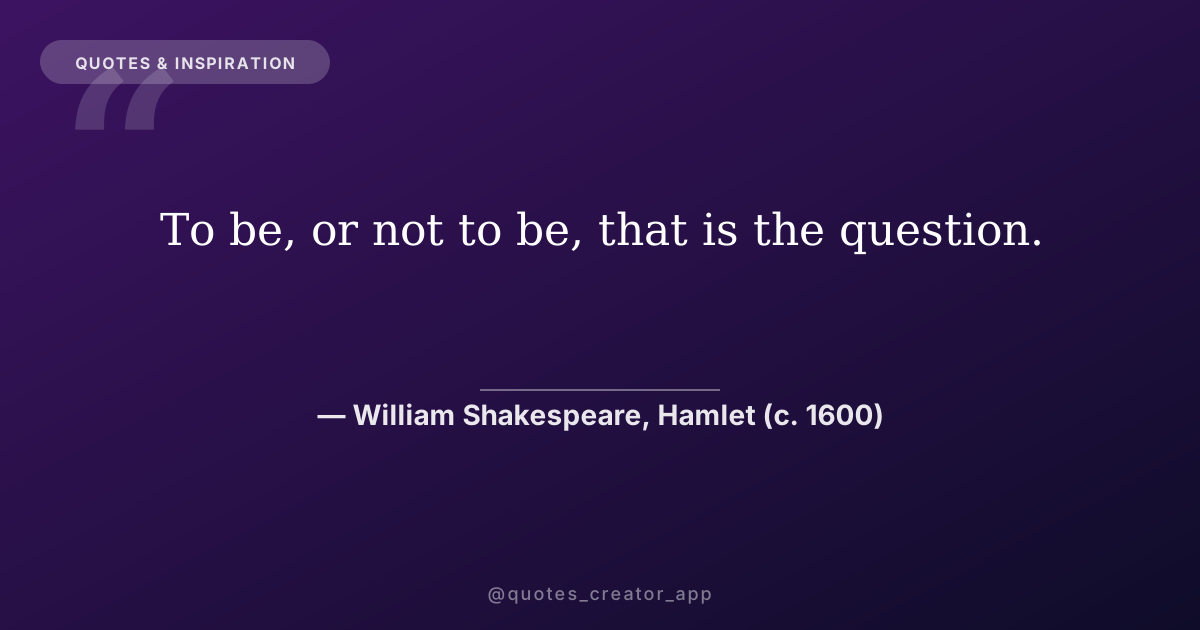
“To be, or not to be, that is the question.”
The context
The line opens the most famous speech ever written in English, and it arrives at the darkest point of the play. By Act III of Hamlet, the young prince of Denmark has learned from the ghost of his murdered father that his uncle Claudius — who now wears the crown and has married Hamlet’s mother — poured poison into the king’s ear as he slept. Hamlet has sworn to avenge the murder, but instead of acting, he stalls. He feigns madness, stages a play, second-guesses the ghost’s authenticity, and spirals into self-loathing over his own paralysis. The soliloquy that begins “To be, or not to be” is not the rhetorical flourish of a philosopher in a comfortable chair. It is the inner monologue of a grief-stricken, betrayed, deeply intelligent young man standing at the edge of his own life and asking whether that life is worth continuing at all.
The speech was written around 1599 or 1600, at the height of Shakespeare’s powers, and it sits at the exact center of the play — a deliberate placement that signals its importance. Shakespeare composed Hamlet in a culture saturated with religious teaching about mortality. Elizabethan England inherited the Christian doctrine that suicide was a mortal sin, an act of despair that damned the soul for eternity. This is precisely the doctrine Hamlet wrestles with. He does not ask the question in the abstract; he asks it as a man who believes that ending his own life might plunge him into an unknown, possibly eternal, punishment. The line’s power comes from this collision: a desperately suffering man who cannot find relief in life, and cannot be certain of relief in death. What he faces is not a choice between two options, but a trap.
It is also worth remembering that the line is not a thesis statement. It is a question, and it is spoken by a fictional character who is famously unreliable in his own reasoning. Yet this is exactly why it has endured. Shakespeare did not hand the audience an answer about the value of existence; he dramatized the act of asking. The “question” has escaped its play and become shorthand for the whole enterprise of human self-examination. For four centuries, people who have never read or seen Hamlet have quoted the line to name a feeling they could not otherwise articulate. That is the mark of a truly great sentence: it names a universal experience so precisely that the source becomes almost irrelevant.
The meaning
At its most literal, “to be, or not to be” is a meditation on suicide — the choice between continuing to exist and ceasing to exist. Hamlet frames it as a question of nobility: is it “nobler in the mind to suffer / The slings and arrows of outrageous fortune, / Or to take arms against a sea of troubles / And by opposing end them?” That is, is it more honorable to endure life’s blows patiently, or to fight back — even to the point of ending one’s own suffering? The question matters because Hamlet does not romanticize death. He imagines it as sleep, and sleep sounds sweet to a man exhausted by grief. But then the doubt creeps in: “to sleep, perchance to dream — ay, there’s the rub.” What if the sleep of death is not dreamless? What if it contains dreams we cannot escape?
The deeper meaning, however, is not really about suicide at all. It is about the paralysis of consciousness. Hamlet works through the argument that what makes us endure a miserable life is not courage but fear — specifically, fear of “the undiscovered country from whose bourn / No traveller returns.” Because we cannot know what death holds, we prefer the known miseries of life to the unknown of death, “and thus the native hue of resolution / Is sicklied o’er with the pale cast of thought.” In plain terms: thinking about the unknown poisons our resolve. The speech’s devastating final insight is that “conscience does make cowards of us all.” The very self-awareness that makes us human also makes us hesitate, and hesitation can become a kind of living death — a state of being neither fully alive nor at rest.
So the quote is doing two things at once. On the surface, it asks whether life is worth living. Beneath that, it exposes the mechanism by which we talk ourselves out of bold action: we overestimate the danger of the unknown and underestimate the cost of standing still. Hamlet is the most brilliant procrastinator in literature precisely because his intelligence gives him endless reasons not to move. His tragedy is not that he asks the wrong question, but that he becomes trapped inside it. The line is a warning as much as a lament. To ask “to be, or not to be” is to be human; to ask it forever, without ever choosing, is to be Hamlet — and the play makes clear that this is a form of destruction in itself.
Why it still matters today
The question has never gone away, but the shape of it has changed. We no longer live under the threat of the Tudor succession or the plague that shuttered Shakespeare’s own theatres, yet the underlying dilemma — endure or end, act or collapse — is unmistakably contemporary. Rates of anxiety, depression, and burnout have climbed for decades, and with them a quieter epidemic that clinicians rarely name directly: the feeling that life is something to be survived rather than chosen. Hamlet’s question speaks to this condition with eerie precision. He does not ask because he is weak; he asks because he is awake. In an age that offers infinite ways to numb the question — endless scrolling, consumption, busyness — the line is a reminder that the question itself is not the illness. It is the beginning of honesty.
The soliloquy also speaks directly to the modern experience of decision paralysis. Never have people had more choices — careers, partners, cities, identities, all endlessly renegotiable — and never have so many felt stuck. Hamlet’s “pale cast of thought” is now industrialized: we research every option, imagine every worst case, read every review, and end up doing nothing. The fear of choosing wrong, of stepping into “the undiscovered country” of an unknown future, keeps people in jobs they hate and relationships that have died. Shakespeare identified the psychology of this four hundred years before the self-help industry existed. He understood that the real obstacle to living fully is rarely a lack of options; it is the terror of the unknown, and the story we tell ourselves that standing still is safer than moving.
How to apply this in your own life
The first application is to notice when you are standing in Hamlet’s shoes. Are there decisions you have been postponing — a conversation you need to have, a change you need to make, a risk you keep weighing — because the unknown feels unbearable? Name the fear precisely. Hamlet’s paralysis dissolves only when he stops theorizing about death and starts acting. Write down the worst case you are imagining, then write down the cost of doing nothing for another year. More often than not, the imagined catastrophe is vague and survivable, while the cost of inaction is concrete and compounding. The soliloquy’s real lesson is not that the choice is easy, but that refusing to choose is itself a choice — and usually the most expensive one available.
The second application is to accept that the question has no final answer, and to stop waiting for one. “To be, or not to be” is famously unresolved within the speech itself — Hamlet never answers it. The play ultimately suggests that the answer is not an intellectual conclusion but a posture: later, Hamlet tells his friend that “the readiness is all.” You do not defeat the fear of the unknown by eliminating uncertainty; you defeat it by committing to show up regardless. When you catch yourself rehearsing every outcome before you have taken a single step, interrupt the loop with a small, concrete action. Choose to be — to be present, to be engaged, to be in motion. Shakespeare did not hand us certainty. He handed us the question, and he trusted us, like Hamlet, to eventually put it down and live.
Create your own quote graphic with this quote
Few lines in any language carry more recognition or weight than this one. Its elegance, its brevity, and its bottomless depth make it perfect for social graphics, posters, journal covers, and conversation starters. Use our free online quote maker to turn this exact quote into a shareable image in seconds — no signup needed. For advanced features like video quotes and 100+ templates, try the Quotes Creator Android app.
Why we chose this quote
This is quite possibly the most quoted line in the English language, and precisely because of that, it is almost never understood. It has been flattened into a joke about indecision, a slogan for angsty teenagers, a meme about choosing lunch. But read in full — and read as the product of a specific man, at a specific crisis, in a specific culture — it is one of the most sophisticated accounts of human paralysis ever written. Shakespeare compressed into eleven words an entire psychology: the collision between a suffering life and an unknowable death, and the way the fear of the latter keeps us trapped in the former. We chose it now because the problem it names — the paralysis of the thoughtful person facing an uncertain future — is the defining emotional challenge of our moment. This quote is not a riddle to be solved. It is a mirror to be looked into.
— ThinkPeak Studio Editorial Team
Create your own quote graphic with this quote
Turn this line into a shareable graphic in seconds — free, no signup needed. For video quotes and 100+ templates, try the Android app.
Advertisement
Enjoyed this article? Get more like it in your inbox.