Quote Explained: “Never give in, never give in, never, never, never, never…”
By Winston Churchill, British statesman and Prime Minister
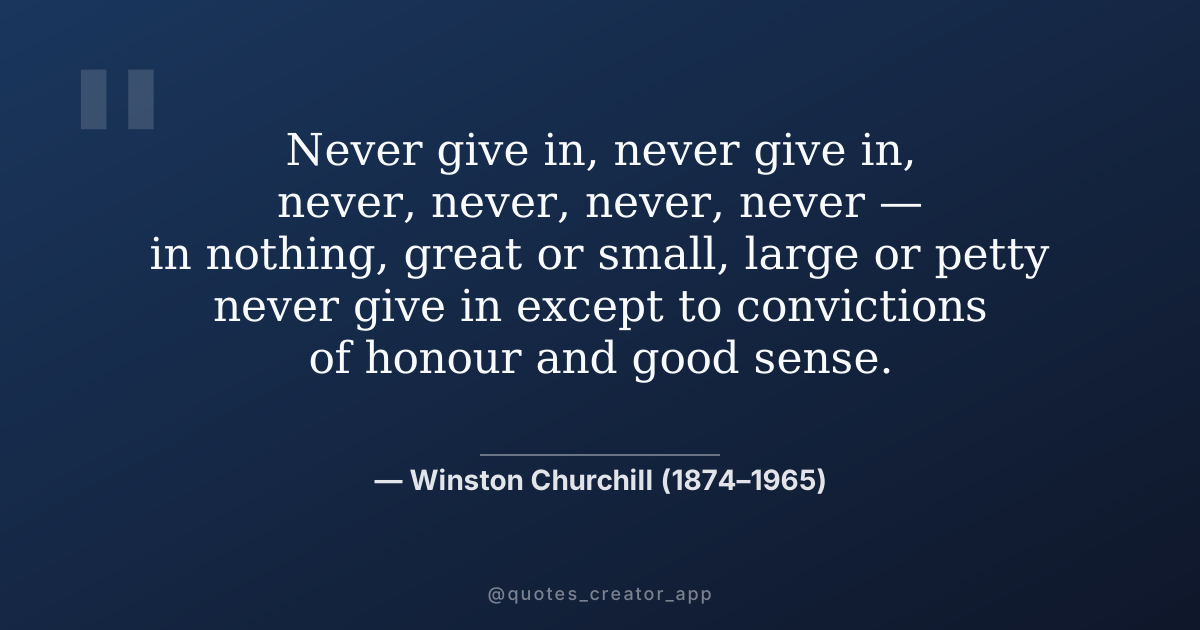
“Never give in, never give in, never, never, never, never — in nothing, great or small, large or petty — never give in except to convictions of honour and good sense.”
The context
On October 29, 1941, Winston Churchill returned to Harrow School, the institution where he had been, by his own later admission, a thoroughly mediocre student. It was a visit heavy with symbolism. Britain had been at war for over two years. The Battle of Britain had been won the previous autumn, but the Blitz was still smouldering, and the outcome of the war was far from certain. Germany had invaded the Soviet Union in June, stretching its forces across a second front, but Nazi domination of continental Europe remained absolute. Against this backdrop, Churchill stood before a hall of schoolboys, many of whom would soon be old enough to fight, and delivered one of the shortest and most powerful speeches of his career.
The speech itself was famously brief — just over 700 words. Churchill had returned for the traditional Harrow Songs, and the boys had added a verse in his honour. After the singing, the Prime Minister rose and, leaning heavily on his walking stick, spoke for barely four minutes. His voice was rasping, his movements deliberate, but his words were electric. He told the boys that the nation had endured terrible dangers, and that worse might lie ahead. Then, with rising intensity, he delivered the line that would echo through history: “Never give in, never give in, never, never, never, never — in nothing, great or small, large or petty — never give in except to convictions of honour and good sense.”
The immediate reaction was overwhelming. The boys cheered, and the speech spread rapidly through newspapers and broadcasts across the free world. Churchill was 66 years old, a veteran of war, political exile, and personal battles with what he called his “black dog” of depression. The authority behind his words came not from rhetorical flourish but from lived experience. He had been sacked from government, ridiculed in the press, and written off as a political has-been during the 1930s. Yet here he stood, a man who had refused to give in to his own defeats, urging a generation of young Britons to do the same.
The meaning
At the surface, the message is unmistakable: persistence is everything. Churchill hammers the word “never” with the rhythm of a blacksmith striking an anvil, each repetition driving the point deeper. The theatrical repetition performs psychological work — it transforms a simple piece of advice into something that resembles a command, a vow, an incantation. By stacking the adverbs — “never” four times, “great or small, large or petty” — he closes every loophole. There is no situation, he insists, no scale of problem, no degree of severity that justifies surrender.
But the true brilliance of the quote lies in its final clause: “except to convictions of honour and good sense.” This is what separates Churchill’s philosophy from blind stubbornness. He is not advocating for the kind of obstinacy that crashes headlong into disaster. He draws a careful, principled boundary. There are exactly two legitimate reasons to yield: honour and good sense. Honour means not betraying your moral compass; good sense means not persisting in something when the evidence says you’re wrong. Without this qualifier, the quote becomes dangerous — the mantra of the fanatic who cannot hear reason. With it, the quote becomes wisdom.
Philosophically, the quote aligns with a Stoic understanding of human agency. Churchill was deeply influenced by the Stoics, and here he channels a central insight of that tradition: you do not control outcomes, but you do control your response to them. The crucial arena of action is internal — the decision to stand firm or to bend, to persist or to yield. By placing honour and good sense as the only permissible off-ramps, Churchill makes resilience a moral discipline rather than a mere survival tactic. The quote is not just about winning; it is about winning in a way that lets you live with yourself afterwards.
Why it still matters today
Churchill’s words have outlived their wartime context because they name a psychological truth that every generation rediscovers: the hardest battles are often the invisible ones fought inside your own head. In an era of constant comparison on social media, rapid professional pivots, and widespread burnout, the temptation to give in — to abandon a difficult project, a struggling relationship, a creative ambition — is omnipresent. The quote has become a fixture in self-help literature, motivational posters, and leadership seminars precisely because the impulse to quit is not situational but structural to the human condition. People reach for Churchill’s words not because the Luftwaffe is overhead, but because their own form of Dunkirk is unfolding in their living room at midnight.
The qualifier about “honour and good sense” is arguably more relevant now than it was in 1941. We live in a moment of deep polarization, where digging in has become a cultural reflex. People cling to positions long past the point where evidence and decency have abandoned them, mistaking rigidity for strength. Churchill’s exception clause is an antidote to this. It gives permission to change your mind without shame, provided the motivation is integrity rather than cowardice. In a world that rewards performative certainty, Churchill reminds us that the strongest people are the ones who know when strength means holding firm and when it means bending.
How to apply this in your own life
The most practical way to carry this quote forward is to use it as a two-question filter whenever you feel like giving up. First: am I stopping because the situation truly demands it in service of my principles or the facts, or am I stopping because it is hard and I am tired? If the answer is the latter, the Churchill test says: keep going. Second: if I keep going, am I doing so because I am committed to a worthy goal, or am I clinging to a position out of pride, fear of embarrassment, or sunk-cost fallacy? If the answer is the latter, the Churchill test says: this may be the moment where honour and good sense require you to let go. The discipline is in asking both questions honestly.
Beyond the moment of decision, the quote offers a deeper practice: the cultivation of a personal narrative of resilience. Churchill did not just give this advice; he lived it. His wilderness years of the 1930s, his catastrophic Gallipoli failure in 1915, his repeated electoral defeats — each could have ended his career. What kept him going was a conviction that his work was not finished and that surrender would dishonour the promises he had made to his country and himself. You do not need to be a prime minister to adopt this framing. Whether you are building a business, raising a child, or recovering from a setback, you can ask yourself: what is the honourable and sensible version of not giving up here? That is the question Churchill posed to those Harrow schoolboys. It is the same one he poses to you, eight decades later.
Create your own quote graphic with this quote
This is the kind of quote that carries weight. When you pair timeless words with thoughtful design, you create something people want to save, share, and return to. Use our free online quote maker to turn this exact quote into a shareable image in seconds — no signup needed. For advanced features like video quotes and 100+ templates, try the Quotes Creator Android app.
Why we chose this quote
Churchill’s Harrow speech is often quoted in fragments, but the full version rewards careful reading. The phrase everyone remembers — the drumbeat of “never give in” — is only half the idea. The other half, the escape hatch of honour and good sense, is what makes the quote genuinely wise rather than merely loud. In a moment when the world could use more thoughtful resilience and less performative intransigence, we thought it was time to give this classic a full and honest reckoning.
— ThinkPeak Studio Editorial Team
Create your own quote graphic with this quote
Turn this line into a shareable graphic in seconds — free, no signup needed. For video quotes and 100+ templates, try the Android app.
Advertisement
Enjoyed this article? Get more like it in your inbox.