Quote of the Day: Abdul El-Sayed on the Audacity to Change the World
Days after winning Michigan’s Democratic Senate primary, the physician and epidemiologist’s most famous line — spoken at a commencement speech nearly twenty years ago — is circulating again: change is possible, and each of us is part of it.
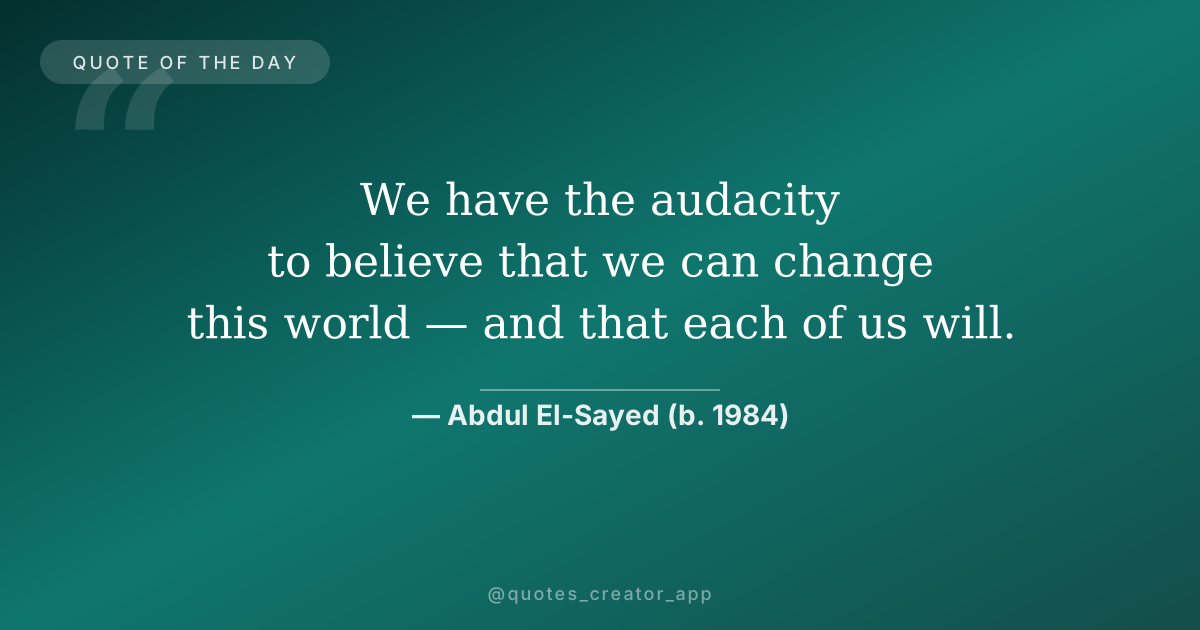
“It’s that we have the audacity to believe that we can change this world and that each of us will.”
What this quote means
There are two separate claims hiding inside this sentence, and it is worth pulling them apart, because most of us manage the first while quietly refusing the second. The first claim is that the world can be changed — that the shape of our cities, our schools, our healthcare, our politics is not a fixed law of nature but a set of choices that human beings made, and can therefore unmake and remake. This is the easy half. Almost everyone nods along with it, the way people nod at a toast. The audacity the quote actually demands sits in the second half: and that each of us will. Not someone. Not them. Not the government, the market, the next generation, the people more qualified than us. Each of us. The sentence turns a comfortable platitude into a personal assignment.
When El-Sayed spoke these words, he was not yet a doctor, an author, or a Senate nominee. He was a 22-year-old graduating senior chosen to deliver the student commencement speech at the University of Michigan — the first time he had ever spoken in front of a crowd that large. He was the son of Egyptian immigrants, a wrestler and lacrosse player turned biology major, still years away from the Rhodes Scholarship, the medical degree from Columbia, and the public health work that would define his career. The audacity was therefore not something he had earned and was now describing; it was the very thing the speech was asking the entire graduating class to practice. The words were delivered as an act of courage, which is exactly what makes them land.
The line works because it does not promise the outcome, only the commitment. It would be easy to write a speech that says we can change the world and stop there — comfortable, hopeful, and entirely free of obligation. El-Sayed closed the gap by adding the second clause. To say “each of us will” is to volunteer, in public, before thousands of witnesses. It binds the speaker and the audience to the work rather than merely to the hope. That is the whole architecture of the quote: it converts belief into responsibility, and it does so with the old, unfashionable word audacity — a word that insists change requires not just permission but nerve, and that timidity is a form of surrender.
For a reader in August 2026, the quote carries a sharp afterglow. Two days before this post, El-Sayed won Michigan’s Democratic Senate primary, and the internet promptly resurfaced his 2007 words. The student who once told 50,000 people in a football stadium that change was his to help make is now the man who knocked on doors for months, who refused corporate PAC money, and who ran a campaign powered by individual donations — living the second clause out loud. The quote is a reminder that the audacity it describes is not a speechwriter’s flourish but a decision repeated daily: to believe the world can be better, and to act as though it is partly on you.
About Abdul El-Sayed
Abdulrahman Mohamed El-Sayed was born on October 31, 1984, in Rochester Hills, Michigan, to Egyptian immigrant parents. He grew up in the Detroit suburbs, a high school team captain in wrestling, football and lacrosse, and enrolled at the University of Michigan planning to become a doctor — a dream his father gently reframed: “Wouldn’t it be better to learn why people die, and then teach everyone around you to save lives? Wouldn’t that save more lives?” The question stuck. El-Sayed graduated Phi Beta Kappa in 2007 with highest distinction, delivered the commencement speech quoted above, and went on to earn a Rhodes Scholarship to Oriel College, Oxford, where he completed a doctorate in public health, followed by a medical degree at Columbia University.
Instead of practicing clinical medicine, he became an epidemiologist and systems scientist — an assistant professor at Columbia’s Mailman School of Public Health and the co-author of more than 100 scholarly articles on health disparities. In 2015, at the age of 30, Detroit’s mayor appointed him the city’s Health Officer and Executive Director of the Detroit Health Department, making him the youngest health director of a major American city. His mandate was extraordinary: after Detroit’s 2013 municipal bankruptcy, the department itself had been outsourced to a nonprofit and had to be rebuilt from the ground up. El-Sayed led it through the fallout of the Flint water crisis, testing Detroit schools for lead, opposing a refinery’s sulfur-dioxide expansion, and restoring services a bankrupt city had lost.
El-Sayed has written three books, including the memoir Healing Politics (2020) and the co-authored Medicare for All: A Citizen’s Guide (2021), and has hosted the podcast America Dissected since 2019. He first ran for office in 2018, placing second to Gretchen Whitmer in Michigan’s gubernatorial primary after being endorsed by Bernie Sanders and Alexandria Ocasio-Cortez. After leading public health for Wayne County from 2023 to 2025, he entered the 2026 race for the U.S. Senate seat being vacated by Gary Peters. On August 5, 2026, the Associated Press called the Democratic primary for El-Sayed — a victory that sent his Wikipedia page to roughly 635,000 views in a single day and made him one of the most-read figures on the entire English Wikipedia. The 22-year-old who asked a stadium full of graduates to have the audacity to change the world now carries that audacity onto a national stage.
Create your own quote graphic with this quote
This is the kind of quote that resonates most when it is presented visually. A clean typographic layout, a fitting color palette, and readable font sizing can transform these words into a graphic that people save and share. If you want to turn this quote into an Instagram post, WhatsApp status, Pinterest pin, or reel cover, Quotes Creator gives you all the tools to do it in minutes — custom fonts, gradients, backgrounds, and export sizes ready for every major platform.
Editor’s note
Abdul El-Sayed was among the most-read people on the internet this week — his Wikipedia page drew more than 630,000 views on August 5, the day he won Michigan’s Democratic Senate primary. In the coverage that followed, one of the lines doing the rounds was from a speech he gave at 22, to a graduating class that didn’t yet know his name. It is a useful test of a quote: it was true before he was famous, and it is just as true now that he is. Before you share it, ask yourself the question the second clause forces — not whether the world can change, but whether you are going to be part of how it does.
— ThinkPeak Studio Editorial Team
Tips for designing this quote
- ✓ Use deep teal and emerald tones to echo El-Sayed’s public-health roots and the hopeful, forward-looking spirit of the line
- ✓ Let the two clauses — the belief and the commitment — breathe as separate centered lines to land their full weight
- ✓ Keep the serif italic typography elegant and timeless; the quote deserves the gravitas of a commencement address
- ✓ Add a subtle gradient background rather than a flat color for depth and dimension
- ✓ Export in square format for Instagram feed and portrait for Stories or Pinterest
Create your own quote graphic with this quote
Turn this line into a shareable graphic in seconds — free, no signup needed. For video quotes and 100+ templates, try the Android app.
Advertisement
Enjoyed this article? Get more like it in your inbox.