Quote of the Day: Aimee Mann on Fears Larger Than Life
Aimee Mann is having a moment. Her page surged onto Wikipedia’s ten most-read articles on September 2 as readers looked her up ahead of her sixty-fifth birthday on September 8, four decades after “Voices Carry,” and just weeks after the New York opening of Girl, Interrupted, the musical built from her songs. The line everyone keeps finding is from Momentum, her song on the Magnolia soundtrack — a quiet confession about the way we let our fears grow while we keep moving to avoid looking at them.
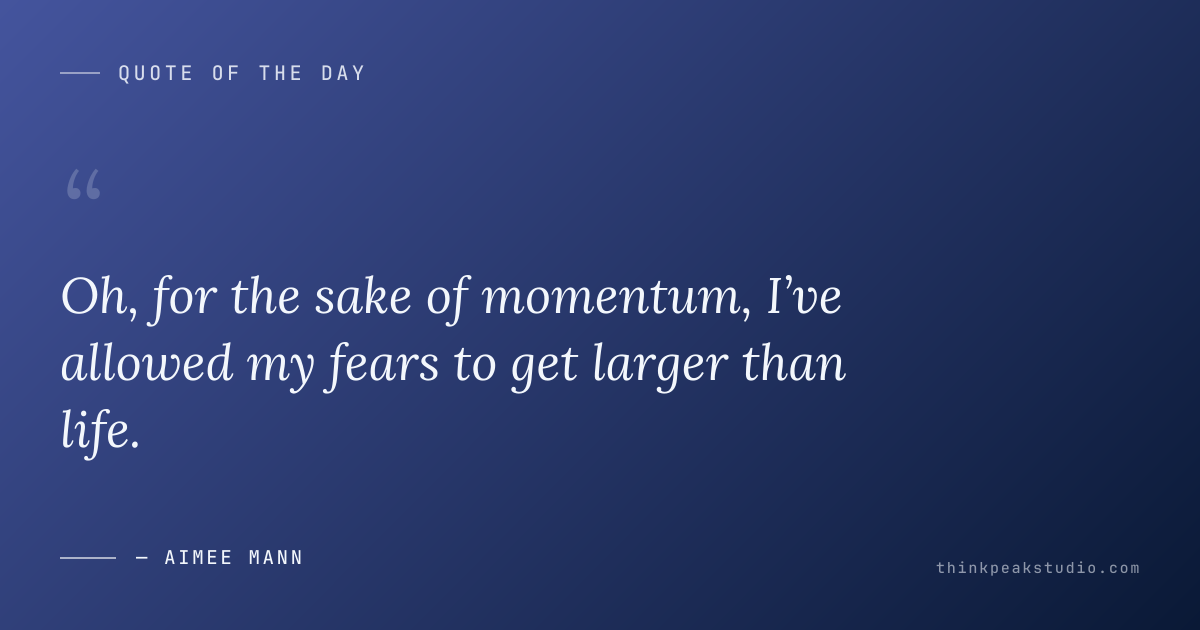
“Oh, for the sake of momentum, I’ve allowed my fears to get larger than life.”
What this quote means
The line arrives halfway through Momentum, a song so careful and so dry that its confession almost passes unnoticed. Mann sings it in the plainest register she has: Oh, for the sake of momentum, I’ve allowed my fears to get larger than life. It is not a cry, not a lament — it is an accounting. A person looks back at the road they have been traveling and realizes they have not been running toward anything. They have been running to stay in motion, and in that motion their fears — unchecked, unexamined, unchallenged — have been quietly inflating until they loom over everything like figures on a movie screen.
Momentum is the comfortable lie. It is the busy schedule, the unfinished project, the routine that fills the day so completely that nothing real has to be faced. Mann — a songwriter who has built a career out of naming what people prefer not to say — understood that fear thrives on this. A fear that is looked at, named, and walked toward shrinks to its actual size: a deadline, a conversation, a risk, a rejection. A fear that is never turned to faces you at the scale you have given it. “Larger than life” is the phrase we use for heroes and villains and icons — and Mann uses it deliberately, because that is exactly what we make of the things we refuse to confront. We blow them up to mythic proportion, then wonder why they have become so difficult to face.
The second verse of the song makes the cost explicit: I know life is getting shorter, I can’t bring myself to set the scene. There it is — the whole trap. Life is finite, and still we cannot make ourselves stop, turn, and take stock. The routine is torture, and yet we keep it, because stopping means meeting the fear, and meeting the fear means discovering it was never as big as the shadow it cast. The song does not offer a triumphant cure. It offers something more useful: the admission. Notice it. Say it. The moment you can say I have allowed this is the moment you stop allowing it.
Few people have earned the right to this sentence more than Mann. As a child she was taken to Europe in a custody dispute and had to be brought home by a private detective; she has spoken openly about the PTSD that followed, the anxiety and depression that sent her into treatment in 2002, and the nervous-system disorder that silenced music for her for a year. She has written about mental illness, fear and brokenness her whole career — and she has kept working, kept recording, kept touring, kept painting and making comics, kept saying the honest thing in the plainest tune. Momentum is her song about the danger of motion without meaning. In one line she hands us the warning and the way out at the same time.
About Aimee Mann
Aimee Elizabeth Mann was born on September 8, 1960, in Richmond, Virginia. When she was three, her mother — pregnant and newly divorced — took her to Europe, and Mann spent a year abroad before her father hired a private detective to bring her back. She did not see her mother again until she was fourteen. The experience left her with lifelong anxiety and a distrust of the familiar; as a teenager she was quiet, withdrawn, sent to a psychiatrist, and found her way to music through David Bowie and Iggy Pop and the discovery that punk was, in her words, “so interesting, so inventive — literally do whatever you want.”
She enrolled at Berklee College of Music in 1978 to study bass, dropped out after eighteen months, and played in the Boston bands the Young Snakes and Ministry before forming the new wave band ’Til Tuesday. Their debut single, “Voices Carry,” reached number eight on the Billboard Hot 100 in 1985 and won the MTV Video Music Award for Best New Artist, making Mann an early female MTV star. The band released three albums before she left in 1990 to go solo — and walked straight into a decade of label fights. Her first solo albums, Whatever (1993) and I’m with Stupid (1995), earned glowing reviews and disappointing sales, and her label, Geffen, refused to release her third album, insisting it contained no hit singles.
What she did instead became a landmark of artist independence. In 1999 she sold homemade EPs of the new songs at her own shows — a “DIY fuck-you-record-company-I’m-selling-it-myself move,” she called it — then bought back her masters, founded SuperEgo Records, and released Bachelor No. 2 (2000), an album that outsold her previous label releases and became one of the best-reviewed records of the decade. The songs on it had been written while Paul Thomas Anderson was making Magnolia, a film he later said he sat down to write as “an adaptation of Aimee Mann songs.” Her soundtrack for the film went gold; “Save Me” was nominated for both an Academy Award and a Grammy, and Mann performed it at the 2000 Oscars.
She kept going on her own terms for the next two decades: Lost in Space (2002), the concept album The Forgotten Arm (2005), Mental Illness (2017), which won the Grammy for Best Folk Album, and Queens of the Summer Hotel (2021), the songs she wrote for a stage adaptation of Susanna Kaysen’s memoir Girl, Interrupted that was postponed by the pandemic and finally opened at the Public Theater in New York in June 2026. NPR and Paste have named her one of the greatest living songwriters. She reunited with ’Til Tuesday in 2025 for their first show in 33 years, and in June 2026 she joined Rush on stage for “Time Stand Still,” the song she first sang with them in 1987.
Her page, which usually draws modest daily traffic, entered Wikipedia’s ten most-read articles on September 2, 2026, as readers rediscovered her ahead of her sixty-fifth birthday on September 8. They found a songwriter who has spent four decades writing about fear, failure and the underdog — always with wit, never with self-pity — and who has made a career of proving her own best lines. When she said, in 2005, that she had learned “getting hit is not that bad,” she meant it as a fighter does. When she sings that she has allowed her fears to get larger than life, it is the sound of someone who has walked into that room, looked around, and walked back out — and who is telling you, in three and a half minutes, that you can do the same.
Create your own quote graphic with this quote
This line deserves a frame as thoughtful as the sentence itself. A clean typographic layout, a moody dusk-toned gradient, and generous whitespace can turn these words into a graphic people save and share — a small reminder that fear is only as large as you let it become. If you want to make a quote card from this — or any quote — Quotes Creator gives you the fonts, gradients, backgrounds, and export sizes to do it in minutes, ready for Instagram, Stories, Pinterest, and everywhere else.
Editor’s note
Aimee Mann is one of the most-read people on Wikipedia this week. Her page entered the daily top-ten most-viewed articles on September 2, 2026 — four decades after “Voices Carry” made her a star, days before her sixty-fifth birthday on September 8, and weeks after Girl, Interrupted, the musical built from her songs, opened at the Public Theater in New York. We are featuring this quote because it is the rare confession that works as a command: name the fear, and it stops being larger than life. Mann has spent her whole career writing about underdogs and the anxious, the broken and the brave — and this one line from Momentum is the whole of her teaching in a breath. Momentum keeps us busy; it does not keep us free. Before your next ordinary Tuesday, ask yourself what you have been moving too fast to look at — and whether the thing you are avoiding is really as big as the shadow it casts.
— ThinkPeak Studio Editorial Team
Tips for designing this quote
- ✓ Use a dusk gradient of deep indigo through violet to rose to echo the film-noir mood of Magnolia and Mann’s wry, literary voice
- ✓ Keep the text centered and italic in a serif font so it reads like the lyric it is — a voice, not a headline
- ✓ Break the quote so that the turn — “I’ve allowed my fears” — lands on its own line with full weight
- ✓ Add a subtle gradient background rather than a flat color to suggest the soft light of a late, honest conversation
- ✓ Export in square format for Instagram feed and portrait for Stories or Pinterest
Create your own quote graphic with this quote
Turn this line into a shareable graphic in seconds — free, no signup needed. For video quotes and 100+ templates, try the Android app.
Advertisement
Enjoyed this article? Get more like it in your inbox.


