Quote of the Day: Alan Greenspan on Human Values
Trended with over 300,000 Wikipedia pageviews on June 22, 2026 — the late economist and former Federal Reserve Chairman reflects on what makes us moral.
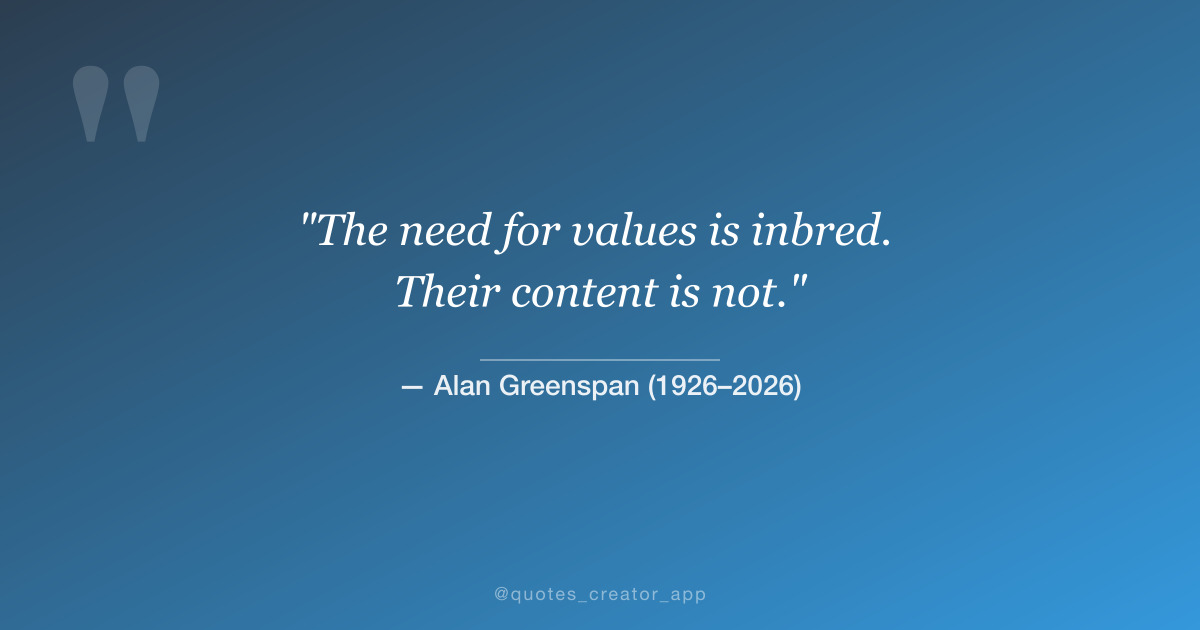
“The need for values is inbred. Their content is not.”
Editor’s note
Alan Greenspan’s words draw a crucial line between what we are born with and what we choose. The instinct to value something — anything — may be hardwired, but the content of our values is entirely our own making. It is a liberating and sobering thought: we cannot outsource our moral framework to biology. If this resonates, take five minutes today to ask yourself what your actions, not just your words, reveal about what you actually value.
— ThinkPeak Studio Editorial Team
What this quote means
On the surface, Greenspan is making a simple but profound observation: every human being is born with a moral instinct — a built-in need to believe in something, to orient life around principles and priorities. The need itself is not learned; it is part of what makes us human. No one has to be taught to care about what is right, good, or meaningful. That drive is wired into us from the start.
The deeper insight is the second half: “Their content is not.” While the hunger for values is innate, what we actually choose to value is shaped by culture, upbringing, experience, and reflection. Greenspan draws a line between nature and nurture in the moral domain. We come wired with the capacity for devotion, but the specific beliefs and principles we adopt are learned, chosen, and therefore our responsibility. The hardware is given; the software is written by how we live.
Greenspan wrote these words in the introduction to his 2008 memoir The Age of Turbulence, published just as the global financial system was unravelling. He had spent a career championing deregulation, market self-correction, and the wisdom of financial institutions — and he watched those values fail in real time before a congressional committee. His observation is not abstract. It is a man who spent a lifetime studying what people value, watching the system built on those values fracture, and reflecting on what that reveals about human nature.
In everyday life, this insight is both liberating and demanding. It means we cannot blame our biology for our moral choices. The instinct to value is given; what we value is chosen. It calls us to examine what we actually stand for — and to recognise that the work of building a personal moral code is never finished. If values were simply inherited, there would be no growth. They are not, so there is.
About Alan Greenspan
Alan Greenspan was born on March 6, 1926, in the Washington Heights neighbourhood of New York City. His parents divorced when he was young, and he was raised by his mother, Rose, who worked in the furniture business. A gifted child with a talent for mathematics and music, he studied clarinet at Juilliard and played professionally in the Henry Jerome swing band alongside the saxophonist Stan Getz before deciding to pursue economics. He earned a bachelor’s degree in economics from New York University in 1948 and went on to complete a master’s and doctorate in the same field.
Greenspan’s career spanned seven decades. He served as Chairman of the Council of Economic Advisers under President Gerald Ford and, most famously, as the 13th Chairman of the Federal Reserve from 1987 to 2006 — serving under four presidents from Ronald Reagan to George W. Bush. His tenure saw the longest peacetime economic expansion in American history, and markets around the world hung on his every syllable. The phrase “the Greenspan put” entered finance to describe his perceived willingness to rescue markets from downturns. After the 2008 financial crisis, he acknowledged before Congress that he had found a “flaw” in his free-market worldview — a moment of rare public humility from a figure who had been treated as an oracle. He was awarded the Presidential Medal of Freedom in 2005.
Outside of economics, Greenspan was a lifelong devotee of Ayn Rand’s philosophy of Objectivism and remained one of her closest confidants until her death in 1982. He was married to NBC News correspondent Andrea Mitchell from 1997 until his death. He lived to be 100 years old, passing away on June 22, 2026 — a life that spanned the Great Depression, the rise of the American century, and the dawn of the artificial intelligence era.
Create your own quote graphic with this quote
This is the kind of quote that resonates most when it is presented visually. A clean typographic layout, a fitting color palette, and readable font sizing can transform these words into a graphic that people save and share. If you want to turn this quote into an Instagram post, WhatsApp status, Pinterest pin, or reel cover, Quotes Creator gives you all the tools to do it in minutes — custom fonts, gradients, backgrounds, and export sizes ready for every major platform.
Tips for designing this quote
- ✓ Use a serif font (Georgia, Playfair Display) to honour the philosophical gravitas of the quote
- ✓ Keep the quote on one or two lines — its brevity is its strength; let it breathe
- ✓ Pair the quote with a deep navy and cool blue gradient for gravitas and intellectual depth
- ✓ Add the author name in a smaller, lighter weight below the quote
- ✓ Export in square format for Instagram feed and portrait for Stories or Pinterest
Create your own quote graphic with this quote
Turn this line into a shareable graphic in seconds — free, no signup needed. For video quotes and 100+ templates, try the Android app.
Advertisement
Enjoyed this article? Get more like it in your inbox.