Quote of the Day: Alexander Pushkin on Habit and Happiness
Born on this day in 1799, the father of Russian literature left us a quiet, piercing observation about the quiet force that sustains us when joy recedes.
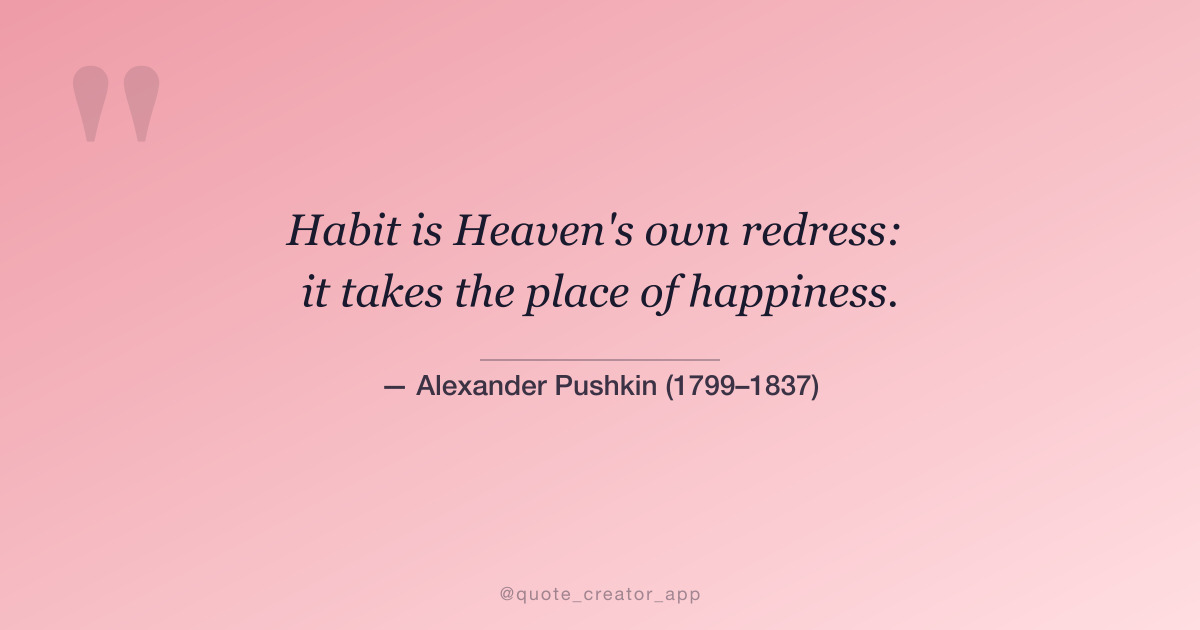
“Habit is Heaven’s own redress: it takes the place of happiness.”
Editor’s note
Born in 1799, Alexander Pushkin’s line — “Habit is Heaven’s own redress: it takes the place of happiness” — is a quieter, more sustainable wisdom than the modern cult of happiness. Happiness is fleeting, but habit — the small, repeated actions that structure our days — is the steady pulse that carries us through. If this resonates, step away from devices for 15 minutes tonight and note one small thought in a journal.
— ThinkPeak Studio Editorial Team
What this quote means
On the surface, Pushkin observes that habit — the repetitive, unthinking patterns we fall into — replaces happiness in our lives. When passion fades and joy dims, habit steps in as a kind of divine substitute, keeping us moving through our days even after the original spark has gone. The force of routine, this suggests, is powerful enough to fill the space that happiness once occupied.
The deeper insight is ambivalent, and that is what gives the line its lasting power. On one hand, this might sound like a lament: we settle for the mechanical comfort of habit when genuine happiness eludes us. But Pushkin calls it “Heaven’s own redress,” which reframes the whole sentiment. Habit is not a consolation prize — it is a gift. It is how we survive disappointment, how we keep showing up when motivation fails. The line quietly acknowledges that most of life is not lived in peaks of ecstasy but in the steady rhythms of routine, and that this is not only acceptable but providential.
Pushkin wrote Eugene Onegin across nearly a decade, from 1823 to 1832. The novel-in-verse traces a jaded aristocrat who rejects sincere love only to recognise his error too late. The line about habit appears in a passage depicting the quiet, contented rural life of Onegin’s neighbour Lensky — a young poet who lives by the steady habits of love, friendship, and literary ambition. Pushkin himself, having tasted both the heights of creative inspiration and the bitter lows of political exile under Tsar Alexander I, knew intimately how swiftly passion burns out and how necessary habit becomes as the vessel that holds daily life together.
In the modern world, we are constantly urged to pursue happiness as though it were a permanent destination. Pushkin’s line offers a quieter, more sustainable wisdom: happiness is fleeting, but habit — the small, repeated actions that structure our days — is the steady pulse that carries us through. Build good habits, and you build a life that does not depend on always feeling happy.
About Alexander Pushkin
Alexander Sergeyevich Pushkin was born on June 6, 1799, in Moscow into an aristocratic Russian family. His great-grandfather, Abram Petrovich Gannibal, had been an African page to Peter the Great — a fact that Pushkin took great pride in and later wrote about. He was educated at the prestigious Tsarskoye Selo Lyceum, where his extraordinary literary talent emerged early; he published his first poem at the age of fifteen and was already celebrated in Russian literary circles by his early twenties.
Pushkin is universally regarded as the greatest Russian poet and the founder of modern Russian literature. His novel-in-verse Eugene Onegin, the historical drama Boris Godunov, and his epic poem The Bronze Horseman are cornerstones of world literature. He revolutionised the Russian literary language by fusing high poetic forms with the cadence of everyday speech, opening the door for every major Russian writer who followed — from Gogol to Dostoevsky to Tolstoy. His life was cut short on February 10, 1837, at the age of thirty-seven, from wounds sustained in a duel fought to defend his wife’s honour.
A remarkable detail: Pushkin seemed to sense his fate. Months before the fatal duel with Georges d’Anthès, he wrote to his wife recalling a fortune-teller who had predicted he would die at the hands of a tall blond man — a description that matched d’Anthès exactly. The duel itself was Pushkin’s twenty-ninth, though most earlier encounters had been resolved without bloodshed. This final one would not be spared.
Create your own quote graphic with this quote
This is the kind of quote that resonates most when it is presented visually. A clean typographic layout, a fitting color palette, and readable font sizing can transform these words into a graphic that people save and share. If you want to turn this quote into an Instagram post, WhatsApp status, Pinterest pin, or reel cover, Quotes Creator gives you all the tools to do it in minutes — custom fonts, gradients, backgrounds, and export sizes ready for every major platform.
Tips for designing this quote
- ✓ Use a serif font (Georgia, Playfair Display) to honour the literary feel of the quote
- ✓ Keep the quote on one or two lines — shorter display text reads better on mobile
- ✓ Pair the quote with a soft gradient that matches the emotional tone: soft rose for wisdom and reflection
- ✓ Add the author name in a smaller, lighter weight below the quote
- ✓ Export in square format for Instagram feed and portrait for Stories or Pinterest
Create your own quote graphic with this quote
Turn this line into a shareable graphic in seconds — free, no signup needed. For video quotes and 100+ templates, try the Android app.
Advertisement
Enjoyed this article? Get more like it in your inbox.