Quote of the Day: Alexander Zverev on 2026 Being the Outcome of Every Year Before It
Alexander Zverev is the most-read person in tennis right now. His Wikipedia page surged past 430,000 views in a single day — roughly sixty times its usual traffic — after he beat Ben Shelton 6-3, 7-6 (2), 5-7, 6-2 on Sunday to win the US Open, his second Grand Slam of a career year and the title that slipped through his fingers six years ago. Among the lines his visitors keep landing on is the one he gave his team at the trophy presentation, a sentence about suffering, patience and a promise kept: 2026 is the outcome of all the years that happened before.
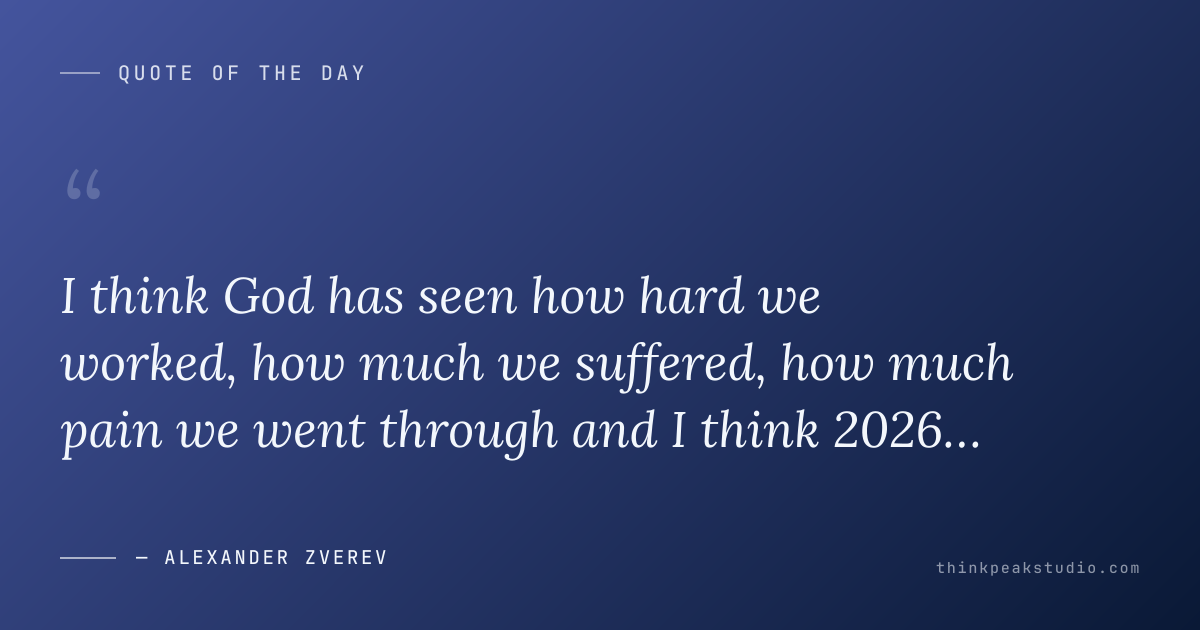
“I think God has seen how hard we worked, how much we suffered, how much pain we went through and I think 2026 is the outcome of all the years that happened before.”
What this quote means
Zverev said this sentence to his box at Arthur Ashe Stadium, minutes after beating Ben Shelton in four sets to win the US Open — and he meant it literally. Six years earlier, in September 2020, he had been two points away from lifting this exact trophy before Dominic Thiem beat him in a fifth-set tiebreak, making him the first man in 71 years to blow a two-set lead in a major final. Two years after that, in the 2022 French Open semifinal against Rafael Nadal, he rolled his ankle in the second set, tore several ligaments, left the court in a wheelchair, underwent surgery and missed the rest of that season, with many wondering whether he would ever be the same player. Between those two dates, he lost three more Grand Slam finals. So when he said that 2026 was the outcome of the years that came before, he was not being mystical. He was describing a ledger: every collapse, every surgery, every final that ended in handshakes for the other man, every off-season of hitting the same forehand into the same corner — it all went into the account, and this year the account paid out.
Read the sentence again and notice what it refuses to do. It does not say that suffering is good, or that pain was the point, or that everything happens for a reason. It says something sharper and more honest: that the years you think you are losing are still doing work on your behalf. The 2020 final taught him how to hold a lead under pressure and, more painfully, how to lose one without being destroyed by it. The 2022 injury gave him a body rebuilt from scratch and a patience he had never needed before. The three finals he lost in between — to Nadal at Roland Garros in 2022 and 2024, to Sinner at Wimbledon this past July — each one shortened the distance between “almost” and “enough.” That is the quiet claim at the heart of the quote: outcomes are not events, they are sums. You do not get 2026 because you won in 2026. You get 2026 because of what 2020, 2021, 2022, 2023, 2024 and 2025 deposited into it.
There is also a theology in the sentence, and it matters even if you share none of it. “I think God has seen how hard we worked,” Zverev said — not “how hard I worked” but “how hard we worked,” not a solo triumph but a family’s, and not a belief that God rewards winners but that God merely witnessed the effort, which was enough. The line reframes ambition from a performance to a testimony: you work not because you are guaranteed a trophy but because someone is watching, and because the work itself is the only thing you control. For Zverev, that framing is not abstract. He has lived with Type 1 diabetes since he was four years old, was told as a boy that elite sport was impossible for him, and spent years hiding his glucose monitor between changeovers rather than let anyone think the illness made him fragile. Every year he kept playing was a year of refusing to accept a limit someone else had drawn. When he says the outcome belonged to all the years that came before, he means the ones that ended in victory and the ones that did not — and that he could not have known, in any of them, which kind he was living through.
And that is why the quote escapes the trophy room. Most of us cannot point to a 2026 that retroactively explains our lives; most of our years are not even labeled yet. The line works because it invites you to stop reading your present as a verdict. The project that keeps failing, the body that keeps breaking, the audition that keeps ending in a polite no — those are not proof that the story is over. They are years before, adding quietly to an outcome you cannot see yet. Zverev spent six years as the man who almost won, and the phrase “almost won” was not a scar, it was a savings account. The lesson he has been living since he was four, and finally said out loud in a stadium full of people who wanted the other man to win, is this: the years that humiliate you and the years that crown you are the same years, doing different parts of the same job. Keep putting them in. The outcome is coming.
About Alexander Zverev
Alexander Zverev was born on April 20, 1997, in Hamburg, Germany, into one of tennis’s rare dynasties: both of his parents, Irina Zvereva and Alexander Zverev Sr., were professional players for the Soviet Union, and his older brother Mischa reached the tour as well. Known in the family as Sascha, he first picked up a racket at three, with his mother as his early coach — he credits his backhand to her — and his father running the famously demanding physical sessions. At four years old, he was diagnosed with Type 1 diabetes, and his parents were told he could expect a restricted life. His mother’s answer, quoted by Zverev at the US Open trophy ceremony, has become part of the family’s origin story: “It takes a very, very strong mother to walk out of those offices and to say, ‘My son will be whatever he wants to be.’… this illness will not define us.”
He turned professional in 2013 and rose faster than almost anyone in his generation: a first tour title at 19, a first Masters 1000 crown just after turning 20, back-to-back ATP Finals titles in 2018 and 2021, and an Olympic gold medal at the 2021 Tokyo Games. But the Grand Slams kept eluding him. In 2020 he was two points from the US Open title before losing to Dominic Thiem. In 2022 he reached a career-high ranking of world No. 2, only to tear ligaments in his ankle in the Roland Garros semifinal against Rafael Nadal, undergo surgery and miss the rest of the year. He returned in 2023, re-entered the top 10, and reached the 2024 French Open final — but he had still never won a major, and the label “the best player never to win one” followed him everywhere he went.
2026 changed the account. In June, on his 34th major appearance, he won the French Open — his first Grand Slam title, the first for a German man in three decades, and the first major singles title ever won by someone with Type 1 diabetes. In July he reached the Wimbledon final, where Jannik Sinner beat him. And on September 13, as the No. 1 seed at a US Open that top-ranked Sinner missed through injury, he beat Ben Shelton 6-3, 7-6 (2), 5-7, 6-2 in a final in front of a crowd that was, by his own generous accounting, 99.9% rooting for the American. “I know today 99.9% of the people wanted Ben to win, so I’m very sorry first of all,” he said at the trophy ceremony, “but it was an incredible atmosphere to play in. Even though the crowd was against me, the crowd was always incredibly fair.” The win was his second major of the season, his 27th career title, a record $5.5 million prize — and the quiet end of six years of unfinished business.
Outside the court, the story is inseparable from the quote. In 2022, the same year he revealed his diagnosis, he launched the Alexander Zverev Foundation in Hamburg to support children living with Type 1 diabetes, and he has partnered with Medtronic’s MiniMed to advocate for continuous glucose monitoring. He manages the condition openly mid-match — checking his sensor and, when needed, injecting insulin during changeovers — and has described the constant calculation as “playing two games at once.” His Wikipedia page, which draws a few thousand views on an ordinary day, surged to 430,774 on September 13 as the world revisited the 29-year-old who refused the life that was prescribed for him at age four. This week, at last, the ledger caught up: a man who spent his life being told the outcome would never come stood in the biggest stadium in tennis and explained, to anyone who would listen, that the outcome had been coming all along — one hard, suffered, invisible year at a time.
Create your own quote graphic with this quote
A quote about patience and accumulated years deserves a graphic that lets the words breathe. A deep emerald-to-teal gradient, a centered italic serif, and a restrained layout can turn these words into a card people save and share — a reminder that the years that feel wasted are the ones doing the work. If you want to make a quote card from this — or any quote — Quotes Creator gives you the fonts, gradients, backgrounds, and export sizes to do it in minutes, ready for Instagram, Stories, Pinterest, and everywhere else.
Editor’s note
Alexander Zverev was one of the most-read people on Wikipedia this week. His page surged to 430,774 views on September 13, 2026 — roughly sixty times his usual daily traffic — after he beat Ben Shelton 6-3, 7-6 (2), 5-7, 6-2 to win the US Open, his second Grand Slam of the year and the title he let slip two points away in 2020. We are featuring this quote because it is the closest thing to a mission statement in modern sport: 2026 is the outcome of all the years that came before. It is a theory of patience, a refusal of the phrase “almost,” and — for a man told at four years old that elite sport was impossible — the quiet proof that a limit only counts if you accept it. Before your next stalled project, your next recovery, or your next ordinary Tuesday, ask the question his whole career keeps answering: what are the years I am counting as wasted, and what might they already be building? Keep putting them in. The outcome is coming.
— ThinkPeak Studio Editorial Team
Tips for designing this quote
- ✓ Use a deep emerald-to-teal gradient to echo the Quote of the Day palette — green for growth and a patient season coming to harvest
- ✓ Keep the text centered and italic in a serif font so the line reads like a quiet conviction rather than a victory speech
- ✓ Break the quote so the turn — “the outcome of all the years that happened before” — lands on its own line with full weight
- ✓ Add a subtle gradient background rather than a flat color to echo the depth of a career six years in the making
- ✓ Export in square format for Instagram feed and portrait for Stories or Pinterest
Create your own quote graphic with this quote
Turn this line into a shareable graphic in seconds — free, no signup needed. For video quotes and 100+ templates, try the Android app.
Advertisement
Enjoyed this article? Get more like it in your inbox.


