Quote of the Day: Annie Dillard on How We Spend Our Days
Annie Dillard spent her working life insisting that attention is a form of devotion — that the world is already burning with meaning if you will only stop and look. The author of Pilgrim at Tinker Creek, who won the Pulitzer Prize at 28 and died at her home in South Wellfleet, Massachusetts on September 15, 2026, at the age of 81, left behind more than a dozen books and one sentence that does the work of a whole philosophy: How we spend our days is, of course, how we spend our lives.
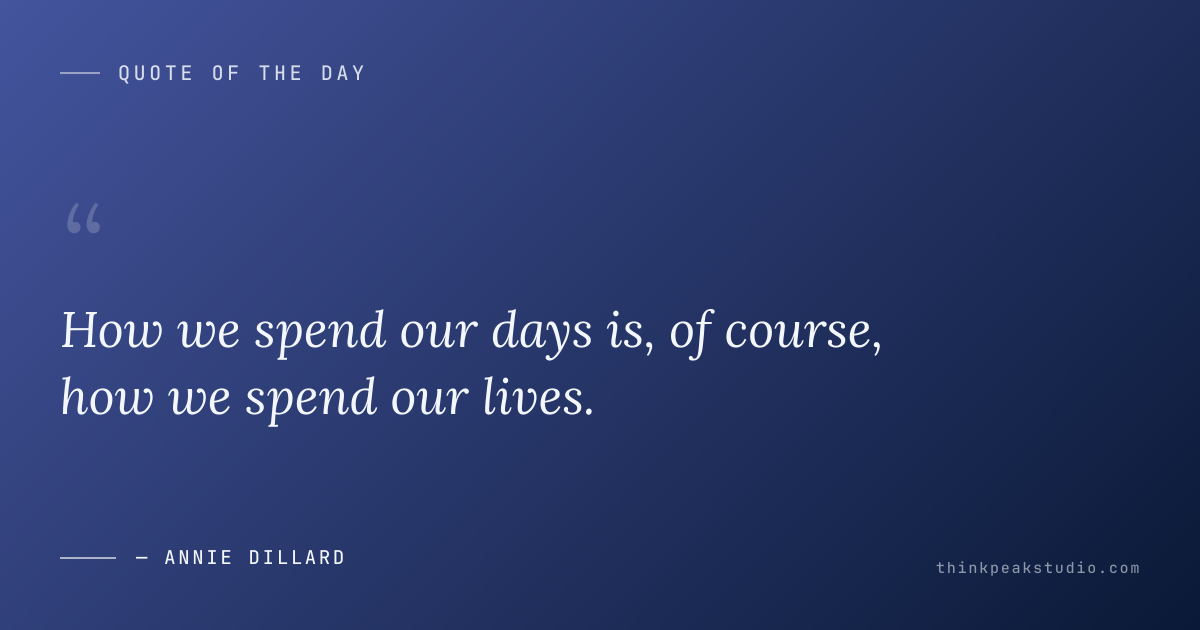
“How we spend our days is, of course, how we spend our lives.”
What this quote means
The line comes early in The Writing Life, Dillard’s 1989 book about the unglamorous daily labour of making art. She begins the passage by admitting she has been “looking into schedules” — reading how painters, poets and novelists arranged their hours. Then she states the arithmetic plainly: How we spend our days is, of course, how we spend our lives. The “of course” is the load-bearing phrase. It is not a revelation; it is something we all know and spend most of our waking hours behaving as if we did not. A life is not a separate thing that happens to us somewhere up ahead. It is the sum of the ordinary days we are already spending, one after another, whether or not we are paying attention.
She immediately sharpens it: What we do with this hour, and that one, is what we are doing. The unit of account is not the decade or the project or the résumé; it is the hour. And then the passage turns practical, almost tender, about what a schedule is for: “A schedule defends from chaos and whim. It is a net for catching days. It is a scaffolding on which a worker can stand and labour with both hands at sections of time.” This is the part people miss when they quote the sentence as a slogan. Dillard is not selling hustle or optimisation. She is describing attention — the deliberate decision to let a day be real instead of letting it drain away into distraction and drift. The net is not there to wring more out of the day. It is there so the day does not escape.
Read as a warning, the sentence is severe. Read as a comfort, it is generous. It means the life you are waiting to begin is not waiting anywhere — it is being built, hour by hour, out of exactly what you are doing now. It also means that a life is redeemable in small pieces: you do not have to fix everything at once, only choose, again and again, what this hour is for. Dillard herself lived under that discipline for five decades, and she kept it to the end. Long after she stopped travelling and stopped answering letters, the note on her website read: “I’ve got to read and concentrate.” That is the whole quote in five words — the days spent on purpose, right up until there were no more of them.
About Annie Dillard
Annie Dillard was born Meta Ann Doak on April 30, 1945, in Pittsburgh, Pennsylvania, the eldest of three daughters, and grew up in the city’s Point Breeze neighbourhood in what she later called “a house full of comedians.” Her mother was an energetic nonconformist; her father taught her plumbing, economics and the intricacies of Jack Kerouac’s On the Road. That childhood became the subject of her celebrated 1987 memoir, An American Childhood, which was a finalist for the National Book Critics Circle Award. She attended Hollins College in Roanoke, Virginia, earning a bachelor’s degree in English in 1967 and a master’s in 1968 with a thesis on Henry David Thoreau’s Walden. Her first published book, in 1974, was a collection of poetry, Tickets for a Prayer Wheel.
In the same year came Pilgrim at Tinker Creek, the sustained nonfiction narrative she built from journals kept near her home in Virginia’s Blue Ridge Mountains. It won the 1975 Pulitzer Prize for General Nonfiction and made her, at 28, the youngest woman ever to win the award; critics greeted it as an American original in the spirit of Walden. She taught at Fairhaven College and Western Washington University in the late 1970s, then joined the English department of Wesleyan University in Middletown, Connecticut, in 1980, where she taught for more than two decades until she retired as professor emerita in 2002. The books kept coming: Holy the Firm (1977), Teaching a Stone to Talk (1982), Living by Fiction (1982), The Writing Life (1989), her first novel The Living (1992), For the Time Being (1999) and the novel The Maytrees (2007), which The New York Times named among the top ten books of that year. She received a Guggenheim Fellowship in 1985, and in 2015 President Barack Obama presented her with the 2014 National Humanities Medal — an honour she accepted with her characteristic reluctance to be in the spotlight.
In 1988 she married Robert D. Richardson, the biographer of Thoreau and Emerson, after sending him a fan letter about his Thoreau book; they were married until his death in 2020. She had been married twice before, and she divided her later years among Massachusetts, Florida and Virginia. Annie Dillard died of natural causes on September 15, 2026, at her home in South Wellfleet, Massachusetts, at the age of 81. The world that had been reading her for fifty years returned almost at once: her Wikipedia page, which normally drew only a few hundred visits a day, surged to nearly 30,000 on September 17 as readers went looking for the woman behind the creek, the moth and the tree with the lights in it. What they found, as always, was a writer who had spent her days on purpose — and who left behind the clearest possible instruction for spending our own.
Create your own quote graphic with this quote
This is a quote about attention, so the graphic should feel like a room with the light coming in: quiet, unhurried, and free of noise. A deep indigo-to-slate gradient, an italic serif, and generous margins let the sentence breathe the way Dillard asked her days to breathe. If you want to make a quote card from this — or any quote — our free online quote maker turns it into a shareable image in seconds, with no signup. For advanced features like video quotes and 100+ templates, try the Quotes Creator Android app.
Editor’s note
Annie Dillard was one of the most-read people on Wikipedia this week. Her page, which normally draws only a couple of hundred views a day, jumped to 28,779 on September 16, 2026, and to 29,955 the next day, after the news that she had died at her home on Cape Cod at 81. She is the rare writer who became a household name on the strength of a book about looking at a creek, and then spent the next fifty years refusing to repeat herself. We are featuring this quote because it is the one that explains the whole of her method. Dillard did not write about nature as scenery; she wrote about attention as an act of will, and about the way a life is assembled out of hours that are easy to waste. Her advice was never to be more productive. It was to be more present — to let a day count for itself before it is gone. That is a demanding instruction, and a hopeful one. Before your next ordinary afternoon slips past, borrow her accounting: this hour is not a rehearsal for your real life. It is the life. Spend it deliberately.
— ThinkPeak Studio Editorial Team
Tips for designing this quote
- ✓ Use a deep indigo-to-slate gradient — the Quote of the Day palette, kept dark and calm to match a line about stillness rather than speed
- ✓ Set the quote in an italic serif and leave the margins wide; the sentence is a realisation, not a command
- ✓ Break the quote after “days” so “is, of course, how we spend our lives” lands as the turn
- ✓ Keep the “of course” visible — it is the quiet heart of the line and should never be trimmed
- ✓ Resist adding a creek, a moth or a tree; the quote is about time, and the frame should stay spare
- ✓ Export in square format for Instagram feed and portrait for Stories or Pinterest
Create your own quote graphic with this quote
Turn this line into a shareable graphic in seconds — free, no signup needed. For video quotes and 100+ templates, try the Android app.
Advertisement
Enjoyed this article? Get more like it in your inbox.


