Quote of the Day: Anthony Bourdain on How Travel Changes You
The chef who walked into the world’s kitchens and never really walked back out understood something most of us miss: you do not visit a place and come home the same person. As the biopic Tony brings his early years to theaters, this is the idea at the center of everything he ever made.
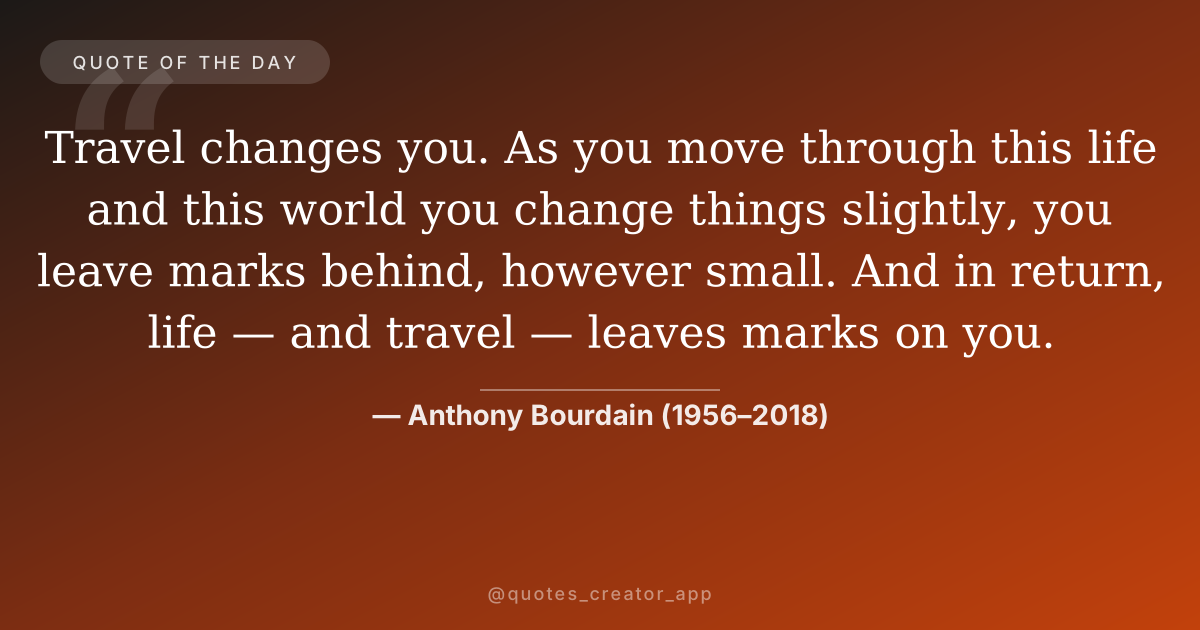
“Travel changes you. As you move through this life and this world you change things slightly, you leave marks behind, however small. And in return, life — and travel — leaves marks on you.”
What this quote means
Bourdain wrote these words in The Nasty Bits, the 2006 collection of essays that followed the global success of No Reservations — by then he had spent years eating street food in Vietnam, sitting in bunkers in Beirut, and pulling raw seal eyeballs from a carcass in the Arctic. But notice what the line does not say. It does not say that travel is fun, or exotic, or that it fills your passport with stamps. It says that travel changes you — and then it quietly describes change as a two-way street. You leave marks behind, however small. And in return, the world leaves marks on you.
That reciprocity is the whole point. Most of us think of travel as consumption: we go somewhere, look at the sights, take the photos, and come back with a slightly lighter wallet and a slightly fuller camera roll. Bourdain is describing something deeper, closer to exchange. Every conversation with a street vendor, every meal shared with strangers, every small act of curiosity leaves a trace in the place you visit. And every one of those encounters leaves a trace in you — on your body or on your heart. The sentence is doing two jobs at once: it is a reminder that we matter to the places we visit, and that they matter to us.
There is also a harder truth buried in the words, because Bourdain rarely dealt in pure sentiment. The full passage goes on: “Most of the time, those marks — on your body or on your heart — are beautiful. Often, though, they hurt.” Change is not always comfortable. Seeing how other people live can be unsettling; the marks the world leaves on you are not always the ones you wanted. Bourdain was never a travel brochure. His shows were full of joy and also of witness — to poverty, to war, to histories he could not look away from. The marks travel leaves, he is telling us, are the price of actually showing up.
That is why the quote endures, and why it lands with fresh force in 2026. In an age of pixel-perfect travel content — curated grids, sponsored getaways, “life-changing” trips that change very little — Bourdain’s version of travel is radically unglamorous. It asks for attention instead of applause, presence instead of proof. You do not have to cross an ocean to test it; the same exchange happens when you eat at a new restaurant, learn a few words of another language, or walk a different route home and actually look. Travel, in his sense, is simply the decision to let the world mark you — and the courage to carry the marks.
About Anthony Bourdain
Anthony Michael Bourdain was born on June 25, 1956, in New York City, to a classical-music executive father and a mother who was an editor at The New York Times. He grew up mostly in Leonia, New Jersey, and his life changed on a childhood family trip to France — a taste of cold vichyssoise on the voyage across the Atlantic, and later a raw oyster handed to him by a fisherman near La Teste de Buch. He would describe the oyster moment as the instant he was hooked, the moment food became “the magic I had until now been only dimly and spitefully aware of.”
He dropped out of Vassar College, spent summers cooking in Provincetown, Massachusetts, and in 1978 graduated from the Culinary Institute of America. For the next two decades he worked his way up through New York kitchens — the Supper Club, One Fifth Avenue, Sullivan’s — finally becoming executive chef at Brasserie Les Halles. Then, in 1999, The New Yorker published his essay “Don’t Eat Before Reading This,” an unflinching insider’s account of the restaurant world. It was expanded into Kitchen Confidential: Adventures in the Culinary Underbelly (2000), a New York Times bestseller that made him, at forty-four, one of the most famous writers in the country overnight.
He turned that fame into a new career as a television host: A Cook’s Tour (2002–2003), then Anthony Bourdain: No Reservations (2005–2012) and The Layover (2011–2013) on the Travel Channel, then Anthony Bourdain: Parts Unknown (2013–2018) on CNN — the show that won five straight Emmy Awards for Outstanding Informational Series or Special. Where other travel hosts offered scenery, Bourdain offered context: he sat in Tehran living rooms, walked with armed guards in West Africa, and shared a bowl of bun cha and bottles of Hanoi beer with President Barack Obama in 2016. He wrote widely — A Cook’s Tour, Typhoid Mary, The Nasty Bits, Medium Raw, and a graphic novel, Get Jiro! — and founded the Anthony Bourdain Books imprint at HarperCollins. He was a vocal advocate for restaurant workers, for undocumented cooks, and against sexual harassment and abuse in the industry he loved.
Bourdain died on June 8, 2018, while filming Parts Unknown in France, aged 61. The reaction was worldwide and immediate: tributes from chefs, presidents and strangers, tribute dinners across the restaurant industry, and a documentary, Roadrunner (2021), that explored both his genius and his contradictions. In 2026, a new generation met him through Tony, the A24 biopic released in U.S. theaters on August 7, directed by Matt Johnson and starring Dominic Sessa as the young Bourdain — and his Wikipedia page, which typically drew around 15,000 views a day, surged past 36,000 on August 11 as readers went looking for the man behind the film. Eight years after his death, the man who said travel leaves marks on you is still being marked by us — and still leaving marks on everyone who finds him.
Create your own quote graphic with this quote
This is the kind of quote that resonates most when it is presented visually. A clean typographic layout, a fitting color palette, and readable font sizing can transform these words into a graphic that people save and share. If you want to turn this quote into an Instagram post, WhatsApp status, Pinterest pin, or reel cover, Quotes Creator gives you all the tools to do it in minutes — custom fonts, gradients, backgrounds, and export sizes ready for every major platform.
Editor’s note
Anthony Bourdain is one of the most-read figures on the internet this week. His Wikipedia page drew roughly 36,000 views on August 11, 2026 — more than double its typical daily readership of around 15,000 — as the A24 biopic Tony, released in theaters on August 7 and starring Dominic Sessa as the young Bourdain, reintroduced him to a new generation. We are featuring this quote because it is the closest thing Bourdain ever wrote to a mission statement: travel as exchange rather than tourism, attention as the whole point, and the honest acknowledgment that the marks travel leaves sometimes hurt. It is a useful corrective in a moment when travel is endlessly sold as an escape. Bourdain never promised escape. He promised transformation — which is better, and far harder. The next time you step off a plane, or simply out your front door, ask what marks you are leaving, and which ones you are willing to carry back.
— ThinkPeak Studio Editorial Team
Tips for designing this quote
- ✓ Use warm amber and ember tones to echo the street-food glow of Bourdain’s travel shows
- ✓ Keep the text centered and italic in a serif font for a literary, unhurried feel
- ✓ Let the quote breathe as four short centered lines — the rhythm mirrors movement
- ✓ Add a subtle gradient background rather than a flat color for depth and dimension
- ✓ Export in square format for Instagram feed and portrait for Stories or Pinterest
Create your own quote graphic with this quote
Turn this line into a shareable graphic in seconds — free, no signup needed. For video quotes and 100+ templates, try the Android app.
Advertisement
Enjoyed this article? Get more like it in your inbox.