Quote of the Day: Aryna Sabalenka on Letting It Out — and Why Starting Over Means Emptying First
Aryna Sabalenka is one of the most-read athletes on Wikipedia right now. Her page surged to 277,850 views on September 12, 2026 — more than ten times its usual traffic — as she lost the US Open final to Elena Rybakina, and with it the world No. 1 ranking she had held for 99 consecutive weeks. But the line worth returning to is four months older, from a Vogue cover story, where she explained the temperament the world keeps misreading: Sometimes you just need to let it go, to empty it so you’re ready to start over and play the match.
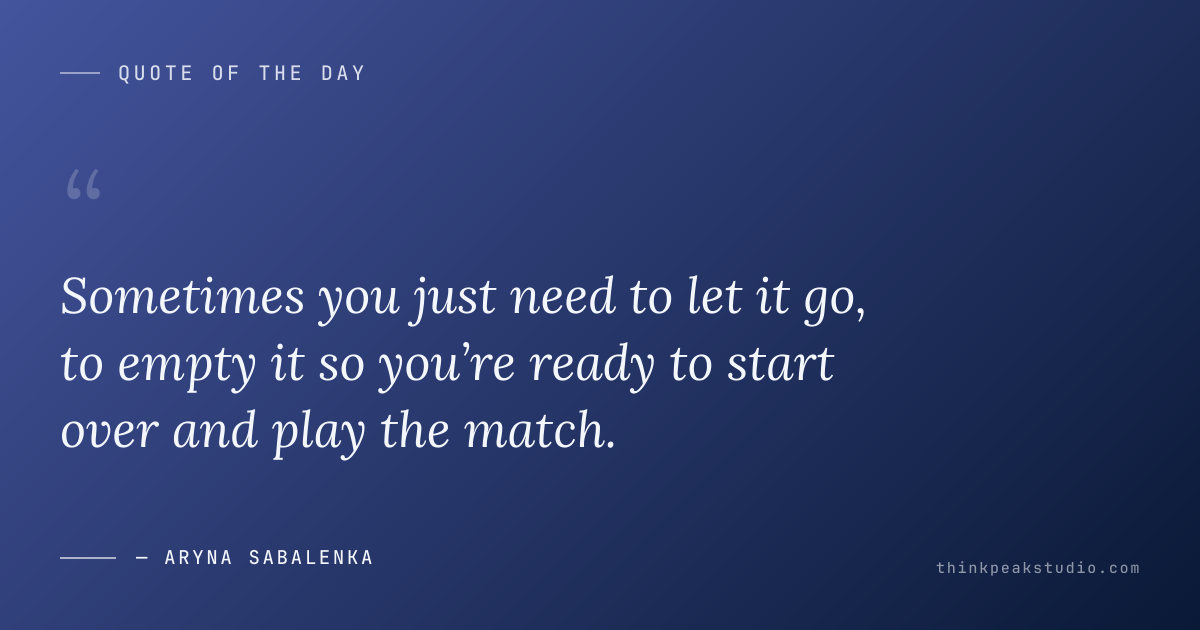
“Sometimes you just need to let it go, to empty it so you’re ready to start over and play the match.”
What this quote means
Sabalenka said it in her May 2026 Vogue cover story, in an interview with Rob Haskell, and the context is the whole point. She was not talking about winning. She was talking about what she was like before she learned how to lose. “When I was young, I would get emotional, and then I would get really pissed with myself for getting emotional,” she said. The second half of that sentence is the part most people miss: it was never the emotion that wrecked her, it was the shame about the emotion — the second fight, on top of the first. By 2026 she had arrived at the opposite conviction: “It’s okay to throw the racket. It’s okay to yell something. It’s okay to go nuts if you feel like you’re holding too much in.” And then the line that carries it all. Letting it go, she is saying, is not the loss of control. It is how she finds it.
Read closely and the sentence is almost mechanical — a procedure rather than a confession. “Empty it so you’re ready to start over.” You cannot begin the next point while you are still carrying the last one. The anger has to go somewhere, and her argument is that the body will spend it either way: in tight shoulders, a shortened swing, a double fault at the worst possible moment. Letting it out is a drain valve, not a tantrum. She even concedes the aesthetic cost — “sometimes it looks ugly and terrible” — and accepts it anyway, because the alternative is worse. Hold everything in, she says, and it destroys you from the inside. That is not a theory she read somewhere; it is what she lived. She has described a career, early on, of being “under zero control,” of throwing matches away from the inside out. Her fitness trainer, Jason Stacy, described the change as a progression “from fighter to warrior” — not a fighter who stopped feeling, but one who learned what to do with the feeling.
This is the part that travels far beyond tennis. Almost everyone is handed the same script: composure is maturity, and the person who shows nothing is the person in charge. Sabalenka tried to live inside that script and found it false. Tennis simply exposes the lie faster, because it is solitary and attritional — no teammate absorbs the pressure, and every single rally ends with a point for somebody. The rest of us carry it more quietly: the meeting where the slight was swallowed, the dinner where the resentment went underground, the year of grief we decided not to make anyone else’s problem. Then we snap at someone who had nothing to do with it, or we go numb, and we call that being calm. Her sentence is not permission to unload on whoever is nearest. It is permission to stop pretending, and to release the charge on purpose — before it starts steering you.
That is why the quote read like prophecy in September 2026. Sabalenka arrived at the US Open as the two-time defending champion, two wins from joining the shortest list in the sport, and lost the final to Rybakina 6-4, 5-7, 6-2, undone by a cascade of unforced errors. She received a code violation during the match for hitting a ball into the stands, smashed her racket when it ended, and directed an expletive at a camera operator who came too close. The tennis world criticized her for it. Then she explained herself in language that could have come straight from the Vogue interview: “It’s really tough to control your emotions when you lose in the final of a Grand Slam and when you were trying to go for the three-peat. So I just wanted to let it go, because if I would hold it inside … I wouldn’t be able to say a word or I would just go not really nice over there. So I just wanted to let all of that aggression and disappointment go outside.” In the same fortnight she had congratulated Rybakina warmly and said the better player won. Ugly and terrible on the outside; intact on the inside. That is the distinction her sentence is asking us to make.
About Aryna Sabalenka
Aryna Siarhiejeŭna Sabalenka was born on May 5, 1998, in Minsk, the capital of Belarus. Her father, Sergey, was an ice hockey player, and she has told the story many times of how tennis found her by accident: driving somewhere with her one day, he spotted some courts, pulled over, and took her to hit. She was six years old. She trained at the National Tennis Academy in Minsk and was still a teenager when the family’s finances were stretched thin to keep her career alive — a hardship her parents tried to hide from her. As she told Vogue, “Parents think we don’t know, but we know.” Her father died in 2019, at 43, before she had won anything at the level they had dreamed of together. “People say that time helps,” she said, “but in some ways I struggle more now because I know how much fun my dad would be having with my success.”
Her rise was fast, and her weakness was public. She cracked the top 100 in 2017, the top 20 in 2018, and the top 10 in 2019, collecting big hard-court titles at Wuhan and New Haven along the way. But her serve abandoned her in ways that became a running story — the yips, the double faults, the fear that a simple ball toss could betray her at the worst moment. She was talented, explosive, and, by her own account, not yet in charge of herself. What changed, she has said, began with self-respect. “I started to respect myself more,” she said after winning the 2023 Australian Open, her first major, at 24. “Every time I had a tough moment on court, I was just reminding myself that I’m good enough to handle everything.” Later that year she reached the US Open final, and in September she became world No. 1 for the first time.
Then came the years that turned a talented head case into a champion with a champion’s record. In 2024 she defended her Australian Open title and won her first US Open, and finished the season as the year-end No. 1 for the first time. In 2025 she produced one of the great seasons of the modern era: she defended the US Open, reached the final at the Australian Open, the French Open and the WTA Finals, won Madrid, Miami and Brisbane, and won 63 matches — more than any other woman on tour. She set an Open Era record for tiebreaks won in a single season, 22 of them, turning what had once been a nerve-wracking lottery into her safest ground. And she earned $15,008,519 in prize money, the most any woman has ever made in a tennis season, breaking a record Serena Williams had held since 2013. She finished 2025 as the year-end No. 1 for the second straight year, and in April 2026 was named Laureus World Sportswoman of the Year.
By 2026, at 28, she was still the most consistent force in the women’s game. She opened the season by winning Indian Wells and Miami back to back — the rare “Sunshine Double” — but the majors kept ending the same way. Rybakina beat her in the Australian Open final in January, then beat her again in the US Open final in September, and the second defeat cost her the No. 1 ranking she had held without interruption for 99 weeks. Two Grand Slam finals, two runner-up plates, both to the same rival. And yet what drew 277,850 people to her Wikipedia page on the day of that final was not the losing. It was the way she carried it: the racket smash, the raw honesty that followed, and the sense that here is an athlete who refuses to perform a serenity she does not feel. “This is part of my personality that can drive me crazy,” she told Vogue, “but it can also drive me into that real fight mode and help me play with passion. It’s two sides of the medal.” The quote of the day is what she does with the side everyone can see.
Create your own quote graphic with this quote
This is a line that works with heat in it — it is not a calm-down quote, it is a let-it-out quote. A deep indigo-to-slate gradient, a strong italic serif, and just enough breathing room around the words let the release show. If you want to make a quote card from this — or any quote — our free online quote maker turns it into a shareable image in seconds, with no signup. For advanced features like video quotes and 100+ templates, try the Quotes Creator Android app.
Editor’s note
Aryna Sabalenka is one of the most-read athletes on Wikipedia this week. Her page, which usually draws between twelve and twenty-five thousand views a day, jumped to 277,850 on September 12, 2026 — the day she lost the US Open final to Elena Rybakina in three sets — and stayed above 194,000 the following day. The defeat ended her bid for a third straight title in New York and then cost her the world No. 1 ranking, which passed to Rybakina after Sabalenka had held it for 99 consecutive weeks. We are featuring this quote because it was given four months before any of that, in a Vogue cover story, and because it explains the moment better than any commentary written afterward. On a court in New York, the world watched a champion smash her racket and heard her tell a camera operator to go away, and a lot of people called it a lack of composure. Sabalenka had already told us what it was: a valve, opened on purpose, because she had learned that holding everything inside destroyed her from within. The quote is not an excuse for losing your temper. It is a case for feeling the thing, emptying it, and being able to start the next point — or the next day — with a clear head. Before you call your own anger weakness, ask what Sabalenka keeps answering: what are you still carrying from the last point, and what would it take to finally put it down?
— ThinkPeak Studio Editorial Team
Tips for designing this quote
- ✓ Use a deep indigo-to-slate gradient — the Quote of the Day palette, but darker than usual, to match a line about pressure and release
- ✓ Keep the text centered and italic in a serif font so it reads as something admitted rather than announced
- ✓ Break the quote after “let it go” and again before “start over” — the rhythm of the sentence is emptying, then beginning
- ✓ Resist adding a racket or tennis motif; the line is about a mind, not a sport, and it travels further without the prop
- ✓ Add a subtle vignette or softening gradient rather than a flat fill to suggest pressure giving way
- ✓ Export in square format for Instagram feed and portrait for Stories or Pinterest
Create your own quote graphic with this quote
Turn this line into a shareable graphic in seconds — free, no signup needed. For video quotes and 100+ templates, try the Android app.
Advertisement
Enjoyed this article? Get more like it in your inbox.


