Quote of the Day: Barack Obama on Taking Action and Responsibility
Barack Obama, the 44th president of the United States and one of the most compelling orators of our time, shares a rallying cry about personal agency, collective responsibility, and the courage to be the change we want to see.
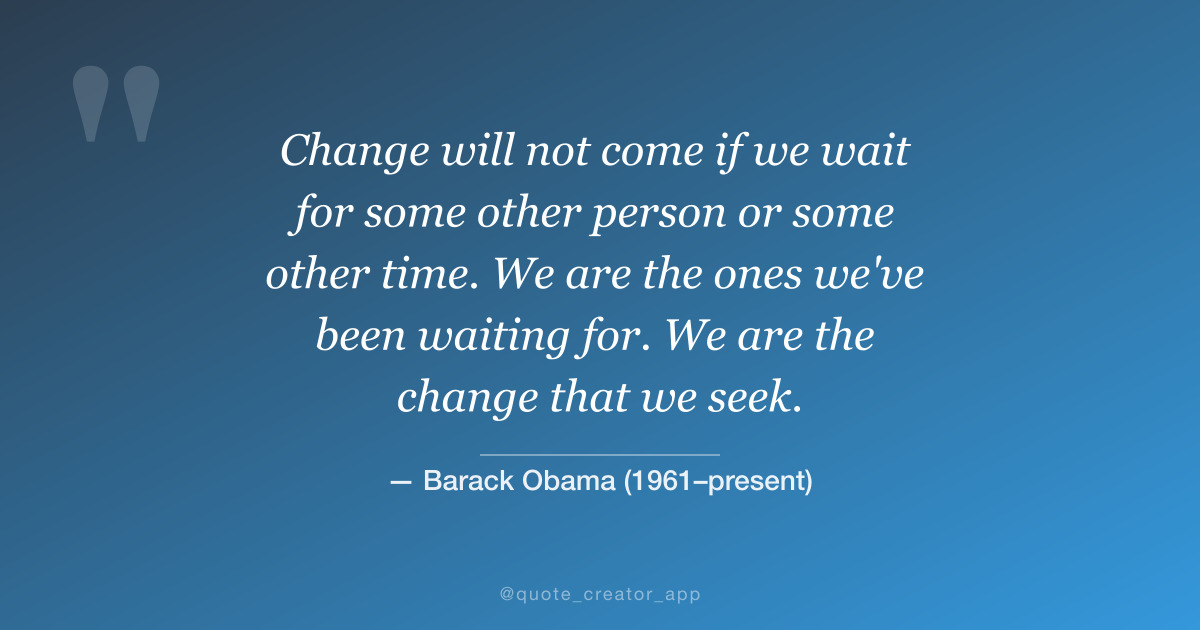
“Change will not come if we wait for some other person or if we wait for some other time. We are the ones we’ve been waiting for. We are the change that we seek.”
Editor’s note
One of the most shared Obama quotes for good reason — it cuts through the habit of waiting for rescue. Whether it is climate action, community change, or a personal goal, the temptation to defer to “someone else” is almost automatic. Obama’s challenge is to recognise that we are that someone else. If this resonates, pick one thing you have been waiting on and take the first action yourself today — not because it is easy, but because waiting solves nothing.
— ThinkPeak Studio Editorial Team
What this quote means
This quote from Barack Obama speaks directly to the human tendency to wait for someone else to solve our problems. On the surface, Obama is telling us that meaningful change — whether in our communities, our workplaces, or our personal lives — will not magically appear. If we sit back and hope that a politician, a boss, a leader, or some external force will make things better, we will be waiting forever. The responsibility for progress, he insists, lies squarely with each of us.
The deeper insight is one of radical personal agency and collective responsibility. Obama is not merely saying “take action” — he is reframing the very concept of change itself. We are not passive recipients of history; we are its authors. The line “we are the ones we’ve been waiting for” is a direct challenge to learned helplessness. It suggests that the solution to any problem already exists within the community facing it. The final line — “we are the change that we seek” — goes even further, making the profound point that change is not something external to be acquired, but something internal to be embodied.
Obama delivered these words during his 2008 presidential campaign, most famously in a speech after the Super Tuesday primaries in February 2008. At the time, America was mired in two wars, facing a looming financial crisis, and deeply divided politically. Obama’s campaign was itself an improbable proposition — a first-term senator with an unusual name and background running against the formidable Clinton political machine. His message of hope and grassroots empowerment resonated precisely because it gave people a sense of ownership over their own future. The quote became a rallying cry for millions of volunteers who saw themselves not just as supporters, but as active participants in building something larger than any one candidate.
Nearly two decades later, this message remains strikingly relevant. In an era of rapid technological change, political polarization, and global challenges from climate to artificial intelligence, the temptation to wait for “someone else” to act is stronger than ever. Obama’s words remind us that progress has always been driven by ordinary people who refused to wait — from community organizers to entrepreneurs to activists. The quote invites each of us to ask: what change am I waiting for, and what is stopping me from being that change myself?
About Barack Obama
Barack Hussein Obama II was born on August 4, 1961, in Honolulu, Hawaii, to a Kenyan father and an American mother from Kansas. After his parents separated, he was raised largely by his mother and maternal grandparents. Obama graduated from Columbia University in 1983 and spent several years as a community organizer on Chicago’s South Side — an experience he later credited with shaping his understanding of how real change happens at the grassroots level. He went on to Harvard Law School, where he made history as the first Black president of the Harvard Law Review, before returning to Chicago to practice civil rights law and teach constitutional law at the University of Chicago.
Obama’s political career took off with his keynote address at the 2004 Democratic National Convention, and just four years later, he was elected the 44th president of the United States — the first African American to hold the office. During his two terms from 2009 to 2017, his administration passed the Affordable Care Act, oversaw the mission that killed Osama bin Laden, signed the Paris Climate Agreement, normalized relations with Cuba, and appointed two Supreme Court justices, including the first Hispanic American justice. He was awarded the Nobel Peace Prize in 2009 for his efforts in international diplomacy. After leaving office, Obama has remained active through the Obama Foundation, his bestselling memoir A Promised Land, and ongoing advocacy for democracy and civic engagement worldwide. His presidential library in Chicago is set to open in June 2026.
Beyond politics, Obama is known for his intellectual depth and his skill as a writer. His books — including Dreams from My Father (1995) and The Audacity of Hope (2006) — reveal a thinker who wrestles openly with questions of identity, race, and the nature of American democracy. He has cited authors from Toni Morrison to Abraham Lincoln as influences, and his speeches consistently draw on a wide range of philosophical, historical, and literary references. This combination of eloquence, intellect, and grassroots experience made him one of the most compelling orators of his generation.
Create your own quote graphic with this quote
This is the kind of quote that resonates most when it is presented visually. A clean typographic layout, a fitting color palette, and readable font sizing can transform these words into a graphic that people save and share. If you want to turn this quote into an Instagram post, WhatsApp status, Pinterest pin, or reel cover, Quotes Creator gives you all the tools to do it in minutes — custom fonts, gradients, backgrounds, and export sizes ready for every major platform.
Tips for designing this quote
- ✓ Use a serif font (Georgia, Playfair Display) to honour the rhetorical weight of the quote
- ✓ Keep the quote on no more than three lines — shorter display text reads better on mobile
- ✓ Pair the quote with a deep blue or indigo gradient that matches its tone: cool indigo tones for conviction and leadership
- ✓ Add the author name in a smaller, lighter weight below the quote
- ✓ Export in square format for Instagram feed and portrait for Stories or Pinterest
Create your own quote graphic with this quote
Turn this line into a shareable graphic in seconds — free, no signup needed. For video quotes and 100+ templates, try the Android app.
Advertisement
Enjoyed this article? Get more like it in your inbox.