Quote of the Day: Bertha von Suttner on Compassion and Service
Born on this day in 1843, Bertha von Suttner became the first woman to win the Nobel Peace Prize — and her words remind us that helping others is among the highest expressions of love.
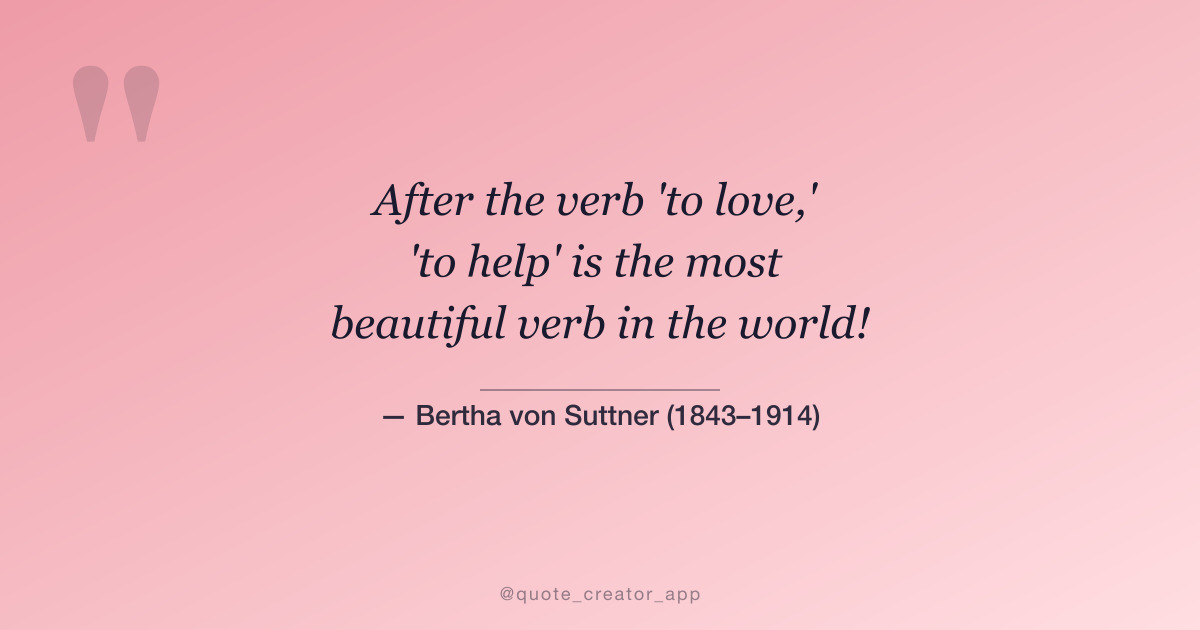
“After the verb ‘to love,’ ‘to help’ is the most beautiful verb in the world!”
Editor’s note
Born in 1843, Bertha von Suttner wrote this line in her final novel, published the year she died. The pairing of love and help remains a simple, actionable idea: love is the feeling, helping is the verb that gives it shape. If this resonates, choose one small act of help today — hold a door, write a note, listen fully — and notice how it changes the quality of your attention.
— ThinkPeak Studio Editorial Team
What this quote means
On its surface, von Suttner is ranking verbs — placing “to help” immediately after “to love” in a hierarchy of the world’s most beautiful actions. Love, universally celebrated as the highest human emotion, gets the top spot. But help, she argues, is its closest companion: the practical expression through which love becomes visible and tangible in the world.
The deeper insight here is that love without action remains abstract. Help is love made concrete — the moment when compassion crosses from feeling into doing. Von Suttner is suggesting that the measure of a person is not merely how deeply they feel, but how readily they act on those feelings for the benefit of others. This is a quietly radical idea: it shifts the moral weight from sentiment to service, from intention to impact.
Von Suttner wrote this in When Thoughts Will Soar, her final novel published in 1914, the same year she died. By then she had spent decades advocating for peace, disarmament, and international cooperation. She had watched Europe sleepwalk toward the catastrophe of World War I — a war that began just weeks after her death. In this context, the pairing of love and help takes on a deeper resonance: peace, she believed, was not merely a noble sentiment but something requiring active, tireless effort from ordinary people.
Today, this quote speaks to anyone who has ever felt the gap between wanting to make a difference and actually doing something about it. The gap between “I care” and “I helped” is often just a single decision. Von Suttner reminds us that the most beautiful thing we can do — after loving — is to show up and help.
About Bertha von Suttner
Bertha Sophie Felicitas von Suttner was born on June 9, 1843, in Prague, then part of the Austrian Empire. She came from an aristocratic family — her father was a field marshal — but the family faced financial hardship after his death when she was eleven. She worked as a governess in her youth, became fluent in several languages, and developed a deep interest in literature and philosophy. In her twenties, she moved to Paris, where she met Alfred Nobel, the inventor of dynamite. Their friendship would shape the course of her life and, ultimately, the history of peace advocacy.
In 1889, von Suttner published her most influential work, Lay Down Your Arms! (Die Waffen Nieder!), a novel that exposed the horrors of war and called for the establishment of a permanent court of arbitration between nations. The book became an international bestseller and catapulted her to the forefront of the peace movement. She went on to found the Austrian Peace Society, helped establish the Inter-Parliamentary Union, and played a key role in organising the Hague Conferences — the first major international efforts to codify the laws of war and promote peaceful dispute resolution.
In 1905, she became the first woman to be awarded the Nobel Peace Prize, a recognition of her decades of tireless advocacy. She continued writing and speaking until her death on June 21, 1914 — just weeks before the outbreak of World War I, the very catastrophe she had spent her life trying to prevent. Her legacy endures in the institutions she helped build and in the enduring idea that peace is not merely the absence of war, but the active presence of justice and compassion.
Create your own quote graphic with this quote
This is the kind of quote that resonates most when it is presented visually. A clean typographic layout, a fitting color palette, and readable font sizing can transform these words into a graphic that people save and share. If you want to turn this quote into an Instagram post, WhatsApp status, Pinterest pin, or reel cover, Quotes Creator gives you all the tools to do it in minutes — custom fonts, gradients, backgrounds, and export sizes ready for every major platform.
Tips for designing this quote
- ✓ Use a serif font (Georgia, Playfair Display) to honour the literary feel of the quote
- ✓ Keep the quote on one or two lines — shorter display text reads better on mobile
- ✓ Pair the quote with a soft gradient that matches the emotional tone: warm rose-pink for compassion and service
- ✓ Add the author name in a smaller, lighter weight below the quote
- ✓ Export in square format for Instagram feed and portrait for Stories or Pinterest
Create your own quote graphic with this quote
Turn this line into a shareable graphic in seconds — free, no signup needed. For video quotes and 100+ templates, try the Android app.
Advertisement
Enjoyed this article? Get more like it in your inbox.