Quote of the Day: Bonnie Greer on the Self That Wakes Up and the Self the World Sees
Bonnie Greer spent four decades in British public life as the playwright and critic who could be counted on to say the unsayable without raising her voice — on Question Time beside the leader of the BNP, in the boardrooms of the British Museum and the Royal Opera House, and in the pages of the newspapers she never stopped arguing with. The line she left behind that cuts deepest is also the quietest: I’m just myself. It’s only when I leave the front door that I become a black woman to the world.
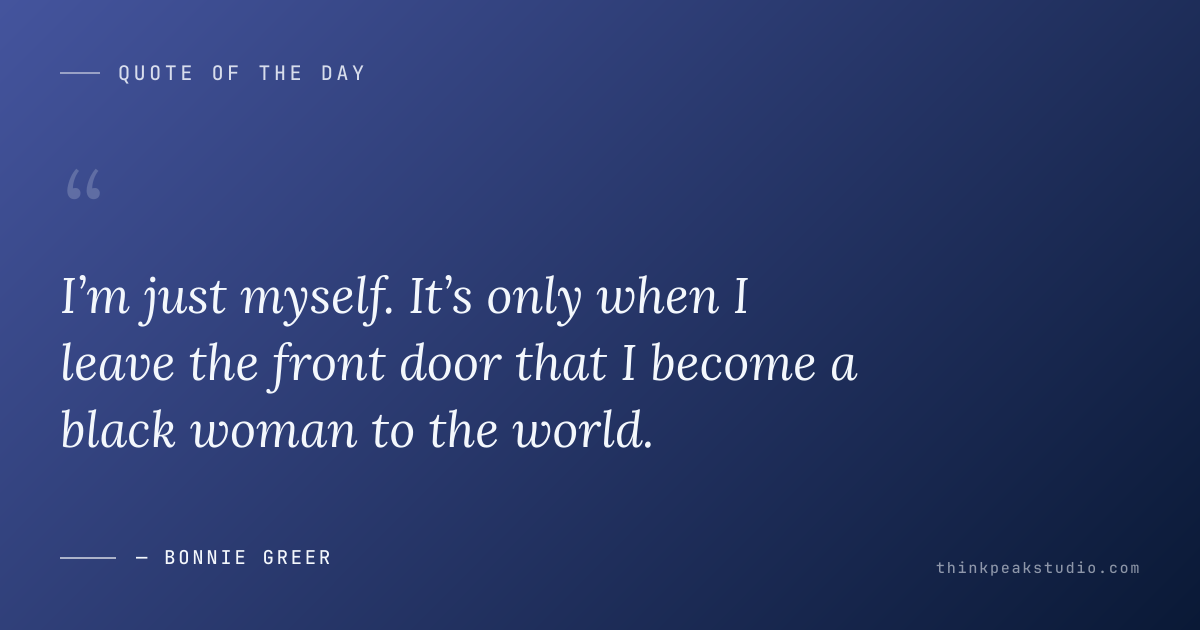
“I’m just myself. It’s only when I leave the front door that I become a black woman to the world.”
What this quote means
She said it in October 2016, in a Guardian interview with Nosheen Iqbal about The Hotel Cerise, her reimagining of Chekhov’s The Cherry Orchard as the story of a Black middle-class family in Michigan. The conversation had turned to identity, and Greer gave the thought in full: “When I wake up in the morning, I’m just myself. It’s only when I leave the front door that I become a black woman to the world.” The sentence is not a complaint, and it is not a confession of confusion. It is an observation about where identity is made. Inside the house there is a person — whole, unremarkable to herself, occupied with the ordinary business of being alive. At the threshold, a category is fastened on. The self did not change; the seeing did.
That distinction matters because we usually talk about identity as something a person is rather than something a person is read as. Greer separates the two with a door. On one side is self-knowledge, which no one can take from you; on the other is perception, which you do not control and cannot opt out of. She knew both sides intimately. She was born in Chicago, made her way through New York and, in 1986, moved to London, where for years she was routinely the only Black person in the room — on arts panels, on the boards of the British Museum and the Royal Opera House, on the stage of a television review show. She never pretended that being the only one was comfortable. But she refused to let it be a definition. “It alters the space,” she said of walking into those rooms. “It changes things up.” The point was never to fit the frame. It was to widen it.
Read the quote again and its generosity shows. Greer is not accusing anyone of seeing her wrongly; she is describing an inheritance that precedes every introduction. The category arrives before the person does, and the work of a life is to insist on the person underneath it. That is why, in the same interview, she told Black women: “Don’t apologise for yourself… Never apologise, make sure you are heard.” The instruction is the practical twin of the observation. If the world will name you at the door, then your job is not to argue with the name. Your job is to keep walking through and being heard anyway. Greer did it for forty years, and the grace of the sentence is that it hands the same move to whoever reads it: you are not the label that meets you when you step outside. You are still, always, the one who woke up.
About Bonnie Greer
Bonnie Greer was born on November 16, 1948, on the West Side of Chicago, the eldest of seven children. Her father, Ben, came from a family of Mississippi sharecroppers, worked in a factory, and had been stationed in Britain during the Second World War, taking part in the D-Day landings; her mother, Willie Mae, kept house. Greer began writing plays at nine, enrolled at DePaul University, and abandoned a planned career in law after a professor told her he did not believe women belonged in it. She studied theatre in Chicago under David Mamet and at the Actors Studio in New York with Elia Kazan, and in the late 1970s and early 1980s she was living in Manhattan’s West Village at the height of the AIDS crisis. She lost about 35 friends to the epidemic and nursed one of them, Ivan, until his death. In 1986 she moved to London, and in 1997 she became a British citizen.
In Britain she built one of the most unusually varied careers in the arts. Her 1993 play Munda Negra, about the mental health of Black women, won the Verity Bargate Award for Best Play. It was followed by Dancing on Blackwater (1994), Jitterbug (2001) and The Hotel Cerise (2016), by the musical Marilyn and Ella, about the friendship between Marilyn Monroe and Ella Fitzgerald, and by Yes, a 2011 opera for the Royal Opera House drawn from her own experience of sharing a Question Time panel in 2009 with Nick Griffin, then leader of the British National Party. She wrote novels — Hanging by Her Teeth (1994) and the experimental Entropy (2009), of which she was especially proud — as well as Obama Music (2009), a biography of Langston Hughes, Langston Hughes: The Value of Contradiction (2011), and the memoir A Parallel Life (2014).
She was, in the words of one Guardian tribute, “Newsnight’s kindest critic”: a regular panellist on Late Review and Newsnight Review, a critic for Time Out, and a commentator whose warmth never dulled her edge. She served on the boards of the British Museum, the Royal Opera House and the London Film School, and as deputy chairman of the museum’s trustees; she was president of the Brontë Society from 2011 until she resigned in 2015, and chancellor of Kingston University from 2013. She was appointed OBE in 2010 for services to the arts and elected a Fellow of the Royal Society of Literature in 2022. She married the solicitor David Hutchins in 1993, and they were together for the rest of her life. Bonnie Greer died on September 15, 2026, after a brief illness, at the age of 77. The tributes — from Clive Myrie, who called her a friend and mentor, and from figures across British public life — returned again and again to the same quality: her ability to bring people together without ever softening what she thought.
Create your own quote graphic with this quote
This is a quote about crossing a threshold, so the graphic should feel like one: a clear line between an inside and an outside, nothing crowding the sentence. A deep indigo-to-slate gradient, an italic serif, and wide margins let the two halves of the thought stand apart the way a door stands between two rooms. If you want to make a quote card from this — or any quote — our free online quote maker turns it into a shareable image in seconds, with no signup. For advanced features like video quotes and 100+ templates, try the Quotes Creator Android app.
Editor’s note
Bonnie Greer was one of the most-read people on Wikipedia this week. Her page, which normally draws only a few dozen views a day, jumped to 52,539 on September 16, 2026, the day her death was announced. She was 77. We are featuring this quote because it is the one that explains the whole of her public life: a woman who spent four decades walking into rooms that were not built for her — television studios, museum boards, a West End theatre, the stage of Question Time opposite a man who denied the Holocaust — and who refused, every time, to let the room rename her. She once said that being the only Black person present “alters the space… it changes things up,” and she was right: the institutions she joined do not look the same now. But the sentence we return to is the quieter one, the one about the front door. It does not ask you to change how you look or how you speak. It asks only that you remember who you were before the world started telling you. That is a small thing, and it is everything. Before your own day gets defined by what meets you at the door, borrow her discipline: be yourself first, and make sure you are heard.
— ThinkPeak Studio Editorial Team
Tips for designing this quote
- ✓ Use a deep indigo-to-slate gradient — the Quote of the Day palette, kept dark and calm to match a line about self-possession rather than confrontation
- ✓ Set the quote in an italic serif and leave the margins wide; the sentence is a realisation, not an accusation
- ✓ Break the quote after “myself” so “It’s only when I leave the front door…” lands as the turn — the door is the hinge of the whole line
- ✓ Keep the word “myself” unadorned; it is the quiet centre, and it should never be decorative
- ✓ Resist adding a figure, a doorway or a silhouette — the line is about interiority, and the frame should stay spare
- ✓ Export in square format for Instagram feed and portrait for Stories or Pinterest
Create your own quote graphic with this quote
Turn this line into a shareable graphic in seconds — free, no signup needed. For video quotes and 100+ templates, try the Android app.
Advertisement
Enjoyed this article? Get more like it in your inbox.


