Quote of the Day: Booker T. Washington on Character and Resilience
Born into slavery and rising to become one of the most influential voices in American history, Booker T. Washington understood something profound about the source of human worth.
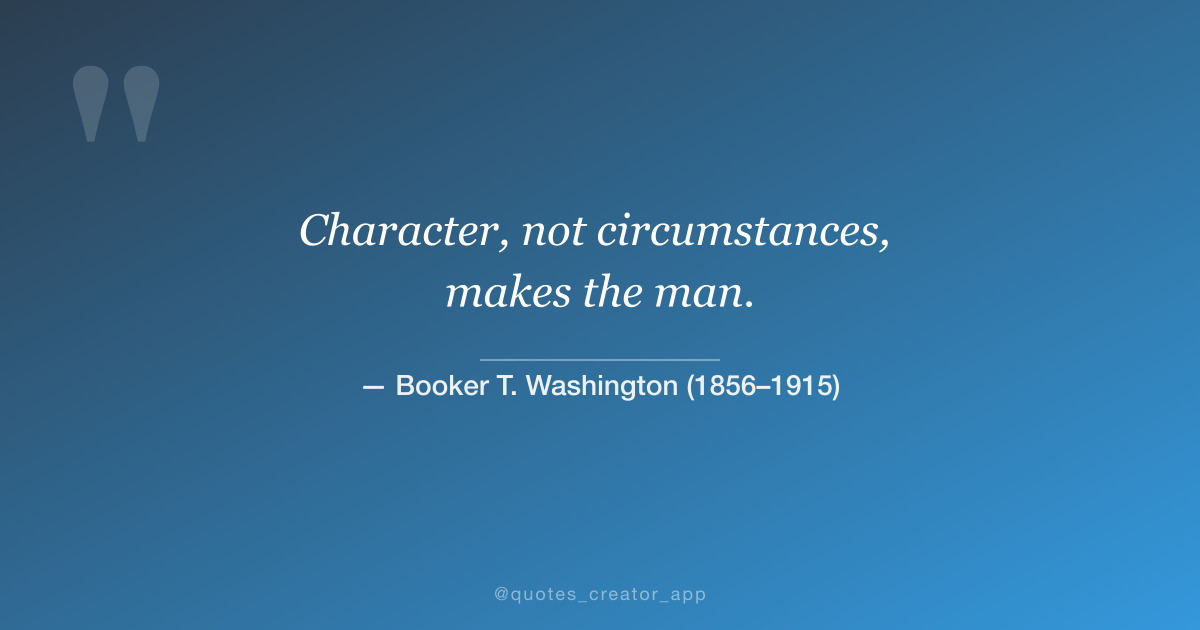
“Character, not circumstances, makes the man.”
Editor’s note
Washington’s line is deceptively simple but radical in its implication: it frees us from the role of victim. When we stop defining ourselves by what happens to us and start defining ourselves by how we respond, the locus of control shifts inward. That is not easy — especially in the face of genuine injustice — but it is the only path that returns agency to our own hands. If this resonates, take one circumstance you have been resenting and ask what response, however small, is entirely within your power.
— ThinkPeak Studio Editorial Team
What this quote means
On its surface, Booker T. Washington’s words offer a simple reframing: our worth is determined not by the situations we find ourselves in, but by how we respond to them. Circumstances — whether poverty, discrimination, or hardship — are external forces. Character, on the other hand, is something we cultivate from within. Washington draws a line between what happens to us and who we choose to be, and he places all the weight on the latter.
The deeper insight here is about agency. Washington refuses to let circumstances have the final word. He is not denying that hardship exists or that injustice is real — he lived both. Instead, he is insisting that no external condition can permanently define or diminish a person who possesses integrity, discipline, and moral clarity. Character, in this view, is not a passive trait; it is an active force that shapes outcomes more powerfully than any situation ever could.
Washington wrote these words in his 1901 autobiography Up from Slavery, a book that chronicled his journey from being born enslaved on a Virginia plantation to founding the Tuskegee Institute and advising U.S. presidents. He had every reason to believe that circumstances dictate a life trajectory — yet he built a philosophy, and a legacy, on the opposite idea. At a time when Black Americans faced systemic oppression in the post-Reconstruction South, Washington argued that excellence of character and practical skill could earn respect and open doors that legislation had slammed shut.
Today, Washington’s words resonate beyond any one era or struggle. We each face moments when our circumstances feel like verdicts — a career setback, a personal failure, a loss, or a label others have placed on us. The quote challenges us to stop looking outward for permission or validation and instead look inward. It asks: what kind of person are you becoming through this? Because that is what will last, long after the circumstances themselves have faded into memory.
About Booker T. Washington
Booker T. Washington was born into slavery in 1856 in Hale’s Ford, Virginia, and emancipated as a child when the Civil War ended in 1865. With no formal education available to him as a boy, he walked nearly 500 miles to attend the Hampton Institute, a school for freed Black Americans, where he worked as a janitor to pay his way. By 1881, at just 25 years old, he was chosen to lead the newly founded Tuskegee Normal and Industrial Institute in Alabama, which he built from a single shanty into one of the most prominent educational institutions for Black Americans in the country.
Washington became a towering figure in American public life — an author, orator, and the most influential Black leader of his era. In 1901, he became the first African American invited to dine at the White House, hosted by President Theodore Roosevelt. His philosophy of self-reliance, vocational education, and economic advancement within the constraints of segregation drew both admiration and criticism, most notably from W. E. B. Du Bois, who advocated for immediate political and civil rights. Their debate — about the best path toward racial equality — shaped American thought for generations.
A lesser-known but revealing detail: Washington secretly funded legal challenges against segregation and disenfranchisement laws while publicly maintaining a more conciliatory tone. This duality reflects the complexity of his character and the impossible tightrope he walked — a man who understood, perhaps better than anyone, that character and circumstances are always in conversation, and that the wisest among us learn to influence both.
Create your own quote graphic with this quote
This is the kind of quote that resonates most when it is presented visually. A clean typographic layout, a fitting color palette, and readable font sizing can transform these words into a graphic that people save and share. If you want to turn this quote into an Instagram post, WhatsApp status, Pinterest pin, or reel cover, Quotes Creator gives you all the tools to do it in minutes — custom fonts, gradients, backgrounds, and export sizes ready for every major platform.
Tips for designing this quote
- ✓ Use a serif font (Georgia, Playfair Display) to match the classic, timeless feel of this quote
- ✓ Keep the quote on one or two lines — its brevity is its strength; let it breathe
- ✓ Pair the quote with a deep blue or slate gradient that conveys dignity and gravitas
- ✓ Add the author name in a smaller, lighter weight below the quote
- ✓ Export in square format for Instagram feed and portrait for Stories or Pinterest
Create your own quote graphic with this quote
Turn this line into a shareable graphic in seconds — free, no signup needed. For video quotes and 100+ templates, try the Android app.
Advertisement
Enjoyed this article? Get more like it in your inbox.