Quote of the Day: Brandi Carlile on the Songs That Happen to You
This weekend Brandi Carlile headlines the All Things Go festival in New York and Washington, D.C., months after being inducted into the Austin City Limits Hall of Fame and being named one of TIME’s Women of the Year. Behind two decades of work — eleven Grammys, two Emmys, an Oscar nomination and a chart-topping memoir — sits one disarmingly humble belief about where the songs come from: they are not something she does or commands. They happen to her.
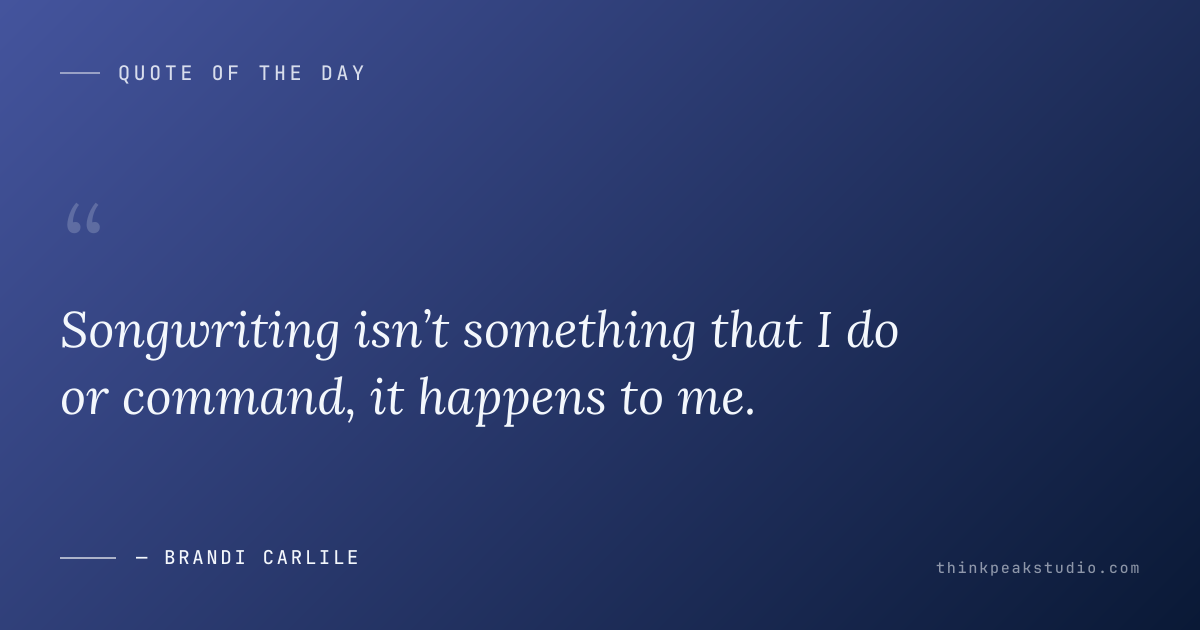
“Songwriting isn’t something that I do or command, it happens to me.”
What this quote means
As the Recording Academy records in its official artist biography, Brandi Carlile has said, “I stand firm behind the belief that, for me, songwriting isn’t something that I do or command, it happens to me.” For an artist with twenty-eight Grammy nominations, eleven wins, two Emmys and an Oscar nod to her name, this is a strange thing to say. It would be easy — and reasonable — for Brandi Carlile to describe songwriting as a craft she has mastered, a muscle she has spent a lifetime strengthening. Instead she describes it as something closer to weather. It arrives. It moves through her. She can only decide whether to open the door. That refusal to claim ownership is not modesty; it is a working theory of creativity, and it is why the line has followed her for more than a decade.
The word that carries the weight is command. A command is an order — something you can demand on schedule, with certainty, because you are in charge. Carlile’s point is that the best work is not obedient in that way. It cannot be summoned by willpower, grit, or a full calendar of writing sessions. What can be summoned is the posture: patience, attention, and the humility to be a conduit rather than a foreman. In her telling, the artist is not the source of the song but the room it chooses to enter. That is a profoundly un-American idea about success, where we prefer the story of the self-made person who wrestles the work into submission. Carlile offers a different image — less conquest, more hospitality.
Read it out of context and the quote becomes a philosophy for any creative life. The ideas that matter rarely show up on demand; they show up at the edge of a walk, in the shower, on the third day of a problem you had stopped trying to solve. Carlile’s line gives us permission to stop white-knuckling the blank page and start living in a way that makes inspiration want to visit — to keep the instrument tuned, the notebook open, the attention unhurried. You cannot command the song. But you can be ready, and present, and brave enough to stop and acknowledge it when it comes rather than letting it fade away.
About Brandi Carlile
Brandi Marie Carlile was born on June 1, 1981, in Ravensdale, Washington, a rural community about thirty miles outside Seattle, and grew up in a musical but hard-up family that moved from house to house and trailer to trailer while she was young. When she was four she nearly died of bacterial meningitis: her heart stopped several times and she slipped into a coma, a story she would later use to open her memoir Broken Horses. She was performing country songs on stage by age eight, moved between several Washington towns, and left Tahoma High School before graduating to chase music full time. After she heard Elton John she taught herself piano, and she picked up the guitar at seventeen — instruments she would eventually wield, without a degree, in front of the world.
Her career began in Seattle clubs, where she met the identical twins Phil and Tim Hanseroth, who have been the heart of her band ever since. Columbia Records signed her in 2004 on the strength of home recordings, and her self-titled debut arrived in 2005. The breakthrough came with The Story (2007), produced by T-Bone Burnett: the title track, written by Phil Hanseroth, became one of her best-known songs after a General Motors commercial aired heavily during the 2008 Summer Olympics and sent sales climbing. From there the work kept widening — Give Up the Ghost (2009), Bear Creek (2012), The Firewatcher’s Daughter (2015) and its first Grammy nomination — until By the Way, I Forgive You (2018) made her the most-nominated woman at the 61st Grammy Awards with six nods, three of which she won, including Best Americana Album and both Best American Roots Song and Best American Roots Performance for “The Joke.”
What followed was a run of collaborations and honors that few artists have matched. In 2019 she co-founded the country supergroup the Highwomen with Amanda Shires, Maren Morris and Natalie Hemby, and their album won Best Country Song for “Crowded Table” in 2021. In 2021 she published Broken Horses: A Memoir, which debuted at No. 1 on the New York Times nonfiction bestseller list. She won two Children’s & Family Emmy Awards, and in 2025 earned an Academy Award nomination for Best Original Song for “Never Too Late” with Elton John. Her 2025 album Returning to Myself, her eighth solo studio record, was made with Andrew Watt, Aaron Dessner and Justin Vernon and debuted in the Top Ten of the Billboard 200, while her Elton John collaboration Who Believes in Angels? reached No. 1 in the U.K.
The recognition has only accelerated in 2026. In February she sang “America the Beautiful” before Super Bowl 60, and that same month she was named one of TIME’s Women of the Year. In May she was announced as the newest inductee into the Austin City Limits Hall of Fame — a distinction presented by Bonnie Raitt at a ceremony in July, and broadcast as the opening episode of ACL’s fall season in September. Through it all she has kept the same collaborator’s instinct she started with, splitting everything evenly with the Hanseroth twins, raising more than $9 million for grassroots causes through her Looking Out Foundation, and treating community and chosen family as the thing that holds an artist up. That is why her longest-running line about her own gift is not a boast but a thank-you: she knows the songs were not hers to order, only hers to receive.
Create your own quote graphic with this quote
A line this gentle deserves a frame that stays out of its way. A warm rose-and-amber gradient, a centered italic serif, and generous whitespace can turn these words into a graphic people save and share — a reminder that the best work arrives when you make room for it. If you want to make a quote card from this — or any quote — Quotes Creator gives you the fonts, gradients, backgrounds, and export sizes to do it in minutes, ready for Instagram, Stories, Pinterest, and everywhere else.
Editor’s note
Brandi Carlile is one of the most-read people on Wikipedia this week. Her page, which usually draws a few thousand visits a day, surged past 50,000 views on September 25, 2026, the opening day of the All Things Go festival, where she headlined sets in New York and Washington, D.C. that weekend — the same season her Austin City Limits Hall of Fame induction aired on PBS, following her TIME Women of the Year honor and a Super Bowl performance earlier in the year. We are featuring this quote because it explains the paradox of her career: an artist with eleven Grammys and a No. 1 bestselling memoir who still talks about her songs as something that happens to her. It is a working definition of creativity as receptivity — not a faucet you turn on, but a door you keep open. This week, before you force the next idea, ask what Carlile would ask: are you trying to command the song, or are you standing ready to acknowledge it when it arrives?
— ThinkPeak Studio Editorial Team
Tips for designing this quote
- ✓ Use a soft rose-to-amber gradient to suggest warmth and the glow of a stage light rather than a hard edge
- ✓ Keep the text centered and italic in a serif font so the line reads as a confession, not a declaration
- ✓ Break the quote so that “I do or command” and “it happens to me” land on their own lines as contrast
- ✓ Add a subtle grain or paper texture to echo the intimacy of a notebook and a song written by hand
- ✓ Export in square format for Instagram feed and portrait for Stories or Pinterest
Create your own quote graphic with this quote
Turn this line into a shareable graphic in seconds — free, no signup needed. For video quotes and 100+ templates, try the Android app.
Advertisement
Enjoyed this article? Get more like it in your inbox.


