Quote of the Day: Cassandra Wilson on Music as Ritual and the Voice as the First Instrument
The two-time Grammy-winning vocalist whom Time magazine called “America’s best singer” died at home in Jackson, Mississippi on September 1, 2026, at the age of 70. In the days since, her Wikipedia page — which drew modest daily traffic for decades — surged past 70,000 views as the world rediscovered the smoky, genre-bending contralto that redefined what a jazz singer could be. Among the lines she left behind, this one from a 1996 interview is the key to everything she ever recorded: music is ritual, and the human voice is the first instrument.
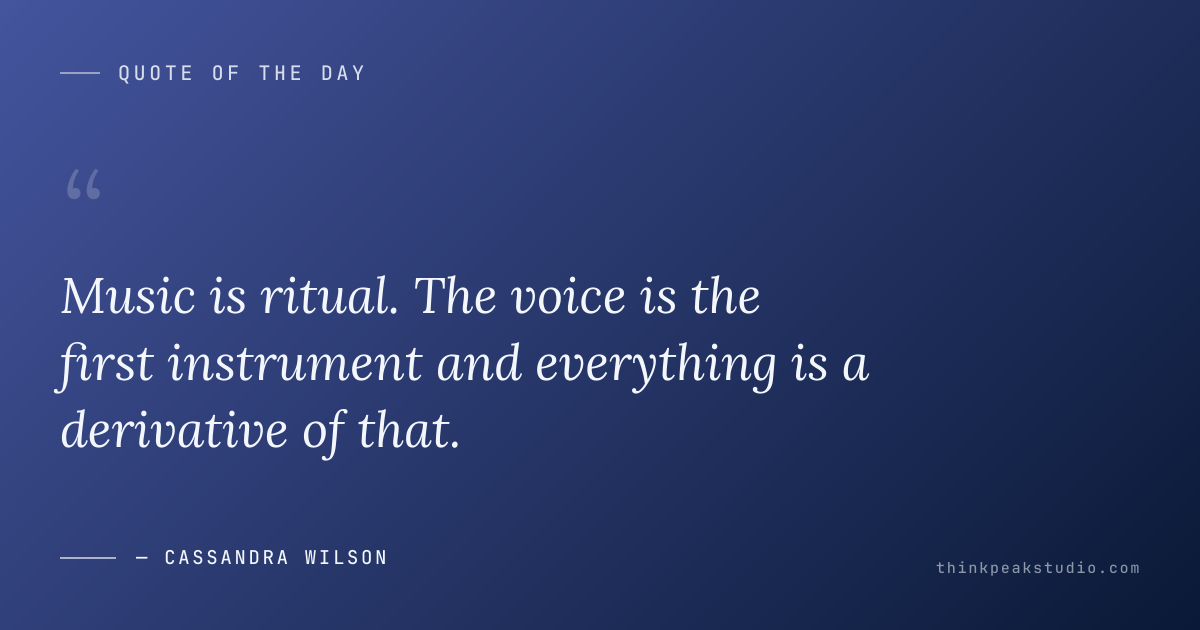
“Music is ritual. The voice is the first instrument and everything is a derivative of that.”
What this quote means
Cassandra Wilson said these words in a 1996 interview, at the height of the extraordinary run that produced Blue Light ’Til Dawn and New Moon Daughter — the albums that made her the most celebrated jazz vocalist of her generation. She was not explaining a technique. She was stating a cosmology. Music is ritual: not decoration, not background, not entertainment to be consumed, but a ceremony with a purpose, an act of attention that connects a singer to a tradition, a community and something larger than herself. And at the center of that ritual stands the voice — the first instrument, the one that predates the drum, the horn and the string, the instrument every other instrument was invented to imitate.
The second half of the sentence is the radical half. Wilson grew up hearing that the voice, unlike a horn or a piano, was not a real instrument — that jazz singers were merely interpreters, background figures who rode the band’s improvisation. She spent her career rebelling against that stereotype. Her point was the reverse of it: the voice came first, and everything else is a derivative. The saxophone aspires to sing. The violin tries to weep and laugh the way a voice can. When an instrumentalist plays a melody, they are trying to sound like a person breathing, bending, and feeling. Wilson, who described her own work as mining “the emotional content of a song,” understood that this put the vocalist at the center of the ritual rather than its margins — and that her instrument, the one she carried inside her body, could do things no man-made instrument ever could.
That idea is also why she could take a Hank Williams song, a Joni Mitchell song, a Robert Johnson blues or a Billie Holiday standard, and make it unmistakably hers. If music is ritual and the voice is the instrument, then the song is not a museum piece to be reproduced but a ceremony to be entered. Wilson would get inside a lyric, turn it and twist it, strip it down to a slide guitar and some percussion, and rebuild it around her voice. “I don’t choose the material, it chooses me,” she liked to say. It was a phrase that sounded mysterious, but it described the same conviction: a song that has a story and a truth in it is a call, and the voice that answers it makes it new. The way you honor a tradition, she believed, is not to imitate it but to keep it alive by adding your own voice to it. That is what the ritual is for — and it is why her versions of other people’s songs feel like originals.
There is also a more personal layer to the sentence. Wilson was born in Mississippi, a state where singing is as ordinary as breathing — “Everyone sings here,” she said. She never thought her own voice was extraordinary until she began writing her own music as a teenager, and then she understood it was something she was supposed to work with. For her, the voice was not a gift she was handed but a relationship she built — a relationship that required discipline, patience and trust. “The voice has so many more facets than an instrument has,” she said. Reading the line today, in the days after her death, it reads like an epitaph written decades early: she spent forty years treating music as a ritual and her voice as the altar, and the reverence never wavered.
About Cassandra Wilson
Cassandra Wilson was born on December 4, 1955, in Jackson, Mississippi, to Mary Fowlkes, a teacher, and Herman B. Fowlkes, a musician. Music was everywhere in her childhood home — her father played bass and guitar, her grandmother sang — and she began piano lessons at six. She grew up on Motown, Miles Davis and Thelonious Monk, played clarinet in marching bands, and sang in coffeehouses and cover bands while studying at Millsaps College and then Jackson State University, where she majored in mass communications. Her parents, reaching for a middle-class life, kept the blues out of the house because of the stigma attached to it; Wilson discovered it, and her own roots, later — and it became the soil of her sound.
In the early 1980s she moved to New Orleans and then to New York, where in 1982 she met saxophonist Steve Coleman and became a founding member of the M-Base Collective, a loose group of Black musicians devoted to building a new language in jazz — “interpreting the music through the lens of your own experiences,” as she described it, “creating your own voice, which is ultimately what jazz has always been about.” Her debut as a leader, Point of View (1986), was, in her words, “a point of departure, a point of awakening.” She followed it with Blue Skies (1988), which Billboard named album of the year, and then in 1993 signed to Blue Note and released Blue Light ’Til Dawn — the album that changed the course of contemporary vocal jazz. Backed by a stripped-down acoustic band, she turned songs by Joni Mitchell, Van Morrison, Robert Johnson and the Monkees into something entirely her own.
The follow-up, New Moon Daughter (1995), won the Grammy for Best Jazz Vocal Performance, the first of two she would receive — the second came in 2009 for Loverly. Time magazine named her “America’s best singer” in 2001. She recorded across blues, folk, country, pop and R&B, collaborated with the Roots, Terence Blanchard, Charlie Haden, Angelique Kidjo, John Legend, Elvis Costello and Luther Vandross, and was a principal voice in Wynton Marsalis’s Blood on the Fields, the first jazz work to win the Pulitzer Prize for Music in 1997. In 2015 she released Coming Forth by Day, an homage to Billie Holiday recorded for the centenary of Holiday’s birth, and gave a concert at the Apollo Theater in her honor. In 2022 she received the NEA Jazz Masters Fellowship, one of the highest honors a jazz musician can receive.
Her philosophy of making music was as distinctive as her voice. “You cannot be a good improviser if you’re not listening to the people around you,” she told an audience at Harvard in 2017. “It’s very much a democratic process, even though you’re standing alone.” She described herself as a “laissez-faire” producer who believed everything would work out if you brought the right people together and trusted them — “bring your voice to the party,” she would say. To younger musicians her advice was the same thing she had been saying her whole life: “Be yourself, always. Don’t try to imitate the next player who seems to be getting all the attention. You’re here to maximize your potential, not someone else’s.”
Cassandra Wilson died at home in Jackson on the morning of September 1, 2026, at the age of 70. Her manager Robert Torre said she “transitioned peacefully at home, surrounded by family, close friends, and her manager.” Tributes came from Jon Batiste, the mayor of Jackson and the National Endowment for the Arts, which said she “used her distinctive voice and fascinating arrangements of standards — in not just jazz, but blues, country and folk — to create a body of work that expanded the definition of jazz.” Her Wikipedia page, which usually drew a few thousand views a day, surged past 70,000 on September 3 as the world returned to her records. What they found there was a woman who spent four decades proving her own best line: that music is a ritual, that the voice is the first instrument, and that every other instrument on earth is just trying, as best it can, to sound like a human being.
Create your own quote graphic with this quote
This line deserves a frame as warm and smoke-toned as the voice that spoke it. A deep midnight-to-amber gradient, a serif italic set generous with whitespace, and a clean centered layout can turn these words into a graphic people save and share — a small reminder that the truest instrument you own is the one you were born with. If you want to make a quote card from this — or any quote — Quotes Creator gives you the fonts, gradients, backgrounds, and export sizes to do it in minutes, ready for Instagram, Stories, Pinterest, and everywhere else.
Editor’s note
Cassandra Wilson was one of the most-read people on Wikipedia this week. Her page entered the daily top-forty most-viewed articles on September 3, 2026 — two days after her death at 70, four decades after she began reinventing what a jazz singer could do, and years after Time called her “America’s best singer.” We are featuring this quote because it is the quiet thesis of her entire career: that music is not performance but ritual, and that the voice — the first instrument — is the one everything else imitates. It is a sentence that flips the usual hierarchy — singer as background, band as substance — on its head, and it came from a woman who spent her life proving it. As you listen to New Moon Daughter this week, remember what she taught: do not imitate the voice that gets the attention; find your own, because it is the only one that is yours. Your voice is a ritual too — and it has been waiting for you to pick it up.
— ThinkPeak Studio Editorial Team
Tips for designing this quote
- ✓ Use a dusk gradient of deep indigo through violet into warm amber to echo the smoky, Mississippi-born warmth of Wilson’s contralto
- ✓ Keep the text centered and italic in a serif font so it reads like the sung line it is — a voice, not a headline
- ✓ Break the quote so that the turn — “the voice is the first instrument” — lands on its own line with full weight
- ✓ Add a subtle gradient background rather than a flat color to suggest the low light of a late-night club and the ritual of performance
- ✓ Export in square format for Instagram feed and portrait for Stories or Pinterest
Create your own quote graphic with this quote
Turn this line into a shareable graphic in seconds — free, no signup needed. For video quotes and 100+ templates, try the Android app.
Advertisement
Enjoyed this article? Get more like it in your inbox.


