Quote of the Day: Charles Spencer on Why Goodness Draws Fire
Charles Spencer, the historian and brother of Diana, Princess of Wales, wrote these words for her funeral at Westminster Abbey in 1997 — a single sentence offered, in front of two billion viewers, as his only explanation for the campaign waged against her. As his memoir Swan Song: Diana, My Sister reaches shelves and his Wikipedia page drew more than 126,000 views in a single day, the line still reads as a defence of his sister — and of anyone whose decency makes them a target.
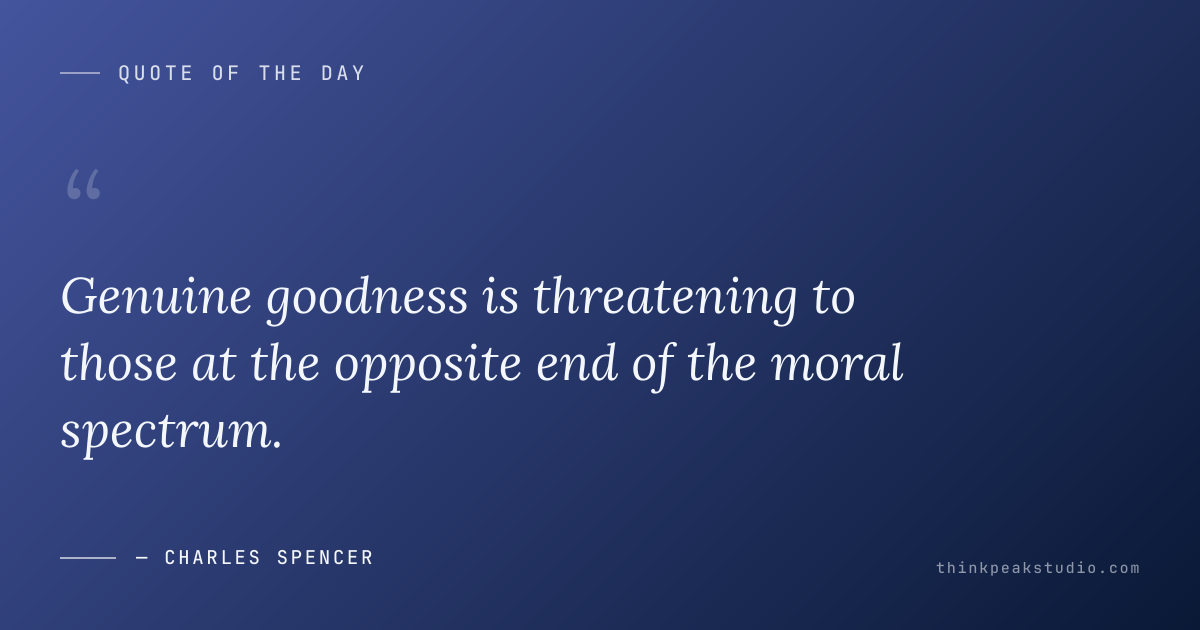
“Genuine goodness is threatening to those at the opposite end of the moral spectrum.”
What this quote means
Charles Spencer did not offer this sentence as an aphorism. He offered it as an answer to a question that had been circling the world for a week — why her? Why the relentless pursuit of a woman whose public work was charity, whose instinct was compassion, whose most famous quality was that she touched people everyone else had overlooked? The press had spent the last years of Diana’s life trying to bring her down, and Spencer, standing in the pulpit six days after her death, gave the only explanation he could honestly give: that her goodness itself was the offence. He had watched her good intentions sneered at, watched what he called “a permanent quest on their behalf to bring her down,” and concluded that the two things could not be separated. Genuine goodness is not neutral. It is a mirror, and the people it embarrasses will attack it rather than look.
The phrase “opposite end of the moral spectrum” does the real work. Spencer is not saying that good people are disliked because they are naive, or because they make others feel small in a vague psychological sense. He is describing a polarity — two ends of a single scale. Goodness is threatening precisely because it cannot be bought, flattered, or frightened into joining the other end. A person who does the right thing without needing the reward is a person the cynical cannot reach with the usual levers of status and fear, and that unreachability reads as an insult. Diana’s crime, in this telling, was not that she was flawed. It was that her care for the rejected was real enough to expose the counterfeit in everyone who calculated their kindness.
There is ancient company for the thought. It is the old observation that the just man is inconvenient to the unjust, that honest speech draws anger less for being wrong than for being true. But Spencer’s version is unusually personal: it comes from a brother who had to compose it in public, with the Queen in the front pew, while the very newspapers he was describing sat in the press gallery. To say it there was itself an act at that end of the spectrum. He must have known it would be resented, and he said it anyway. That is the difference between a proverb and a testimony.
For anyone carrying the sentence out of the post, the meaning cuts two ways. The consoling half is that being opposed is not proof you are wrong. If your honesty, your standards, or your kindness keep drawing contempt from people whose business is winning, that contempt may be evidence of the thing rather than an argument against it. The cautioning half is that the line is easy to misuse. Not every critic stands at the opposite end of the moral spectrum, and not everyone who is disliked is a martyr. The sentence is not a licence to dismiss all criticism as the envy of the wicked. It is a reminder to keep asking which end of the scale you are actually standing on — and to keep choosing goodness even when it costs, precisely because it is the only thing that costs something.
About Charles Spencer
Charles Edward Maurice Spencer was born on May 20, 1964, in London, the youngest of five children of John Spencer, the 8th Earl Spencer, and Frances Shand Kydd. He arrived into one of England’s oldest aristocratic families — the Spencers had held Althorp, their Northamptonshire estate, since the sixteenth century — and into proximity with the modern royal family: Queen Elizabeth II was one of his godmothers, and he was baptised at Westminster Abbey. He grew up at Althorp with three elder sisters, Sarah, Jane, and Diana, the last of whom was two years older and his closest companion among the siblings. An elder brother, John, had died within hours of birth four years before Charles arrived, which left him, unexpectedly, the eventual heir.
He was educated at Eton College and then read Modern History at Magdalen College, Oxford, taking his MA. His first career was in journalism and television, not writing: from 1986 to 1995 he worked as an on-air correspondent for the American network NBC News, chiefly for the Today programme and NBC Nightly News, and he reported for Granada Television in Britain from 1991 to 1993. His life changed direction in March 1992, when his father died and he became the 9th Earl Spencer at twenty-seven, inheriting Althorp and a seat in the House of Lords. He sat in the upper house until the 1999 reforms removed most hereditary peers, and he has spent the decades since restoring the estate and, increasingly, writing its history and his own.
His most widely read words remain the eulogy he delivered for Diana at Westminster Abbey on September 6, 1997. Diana had died on August 31, at thirty-six, in a car crash in Paris while being pursued by paparazzi; six days later her brother stood before a global television audience and spoke with a bluntness that startled the country, rebuking both the press and, in measured terms, the royal family, and pledging that her sons would not suffer a similar fate. The address includes the line most people remember — the “girl given the name of the ancient goddess of hunting” who became “the most hunted person of the modern age” — and it includes the quieter sentence quoted above, the diagnosis underneath the grief. The speech drew spontaneous applause inside the abbey, a breach of funeral convention, because it said aloud what much of the country had been feeling.
From biography he turned to history. Althorp: The Story of an English House (1998) and The Spencer Family (1999) began the run, followed by Blenheim: Battle for Europe (2004) and Killers of the King: The Men Who Dared to Execute Charles I (2014), both Sunday Times best-sellers, along with Prince Rupert: The Last Cavalier (2007), To Catch a King (2017), and The White Ship (2020). He founded the Althorp Literary Festival in 2003, turning the family home into a venue for writers, and in 2023 began co-hosting the history podcast The Rabbit Hole Detectives. His memoir A Very Private School (2024) described with unusual candour the abuse he suffered at boarding school. On September 22, 2026, Penguin’s Michael Joseph imprint published Swan Song: Diana, My Sister, his account of growing up beside Diana and of the week of her death — a book that has drawn intense attention and a rare public response from Buckingham Palace. His Wikipedia page, which normally draws a few thousand views a day, climbed past 126,000 views on September 20, 2026 as readers went looking for the man behind the memoir. They found, as they always do, that his most quoted sentence is not about a princess at all. It is about the price of being good in a room full of people who are not.
Create your own quote graphic with this quote
This sentence deserves a frame with some weight to it. A deep slate-to-amber gradient, a serif italic set centered with generous whitespace, and a clean attribution line can turn it into a graphic people save and share — a reminder that decency is not weakness and that being opposed is not the same as being wrong. If you want to make a quote card from this — or any quote — Quotes Creator gives you the fonts, gradients, backgrounds, and export sizes to do it in minutes, ready for Instagram, Stories, Pinterest, and everywhere else.
Editor’s note
Charles Spencer is one of the most-read people on Wikipedia this week. His page, which usually draws a few thousand views a day, surged past 126,000 views on September 20, 2026 — the weekend before his memoir about Diana was published — and entered the daily top twenty articles on the site. We are featuring this quote because it is the one line from his eulogy that is not really about Diana. It is about a pattern almost everyone meets eventually: the moment you discover that doing the right thing can make you a target rather than a hero, and the temptation that follows to soften, hedge, or join the other side. Spencer’s answer, delivered in the hardest possible setting, was to name the pattern and refuse it. As you go into your week, take the sentence as a question rather than a compliment: if your honesty and your care are drawing fire, is it because you are wrong — or because something at the opposite end of the moral spectrum has noticed you? Keep your goodness. It is the one thing that is threatening precisely because it is real.
— ThinkPeak Studio Editorial Team
Tips for designing this quote
- ✓ Use a deep slate-to-amber gradient to echo the abbey stone and the candlelight of the setting where the line was first spoken
- ✓ Keep the text centered and italic in a serif font so it reads like the testimony it is — a diagnosis, not a slogan
- ✓ Break the quote so that “opposite end of the moral spectrum” lands on its own line, letting the mirror-image land last
- ✓ Add a subtle gradient background rather than a flat color to suggest two ends of a single scale
- ✓ Export in square format for Instagram feed and portrait for Stories or Pinterest
Create your own quote graphic with this quote
Turn this line into a shareable graphic in seconds — free, no signup needed. For video quotes and 100+ templates, try the Android app.
Advertisement
Enjoyed this article? Get more like it in your inbox.


