Quote of the Day: Countee Cullen on Art and Identity
The Harlem Renaissance poet on the impossible paradox of making art in a world that denies your humanity.
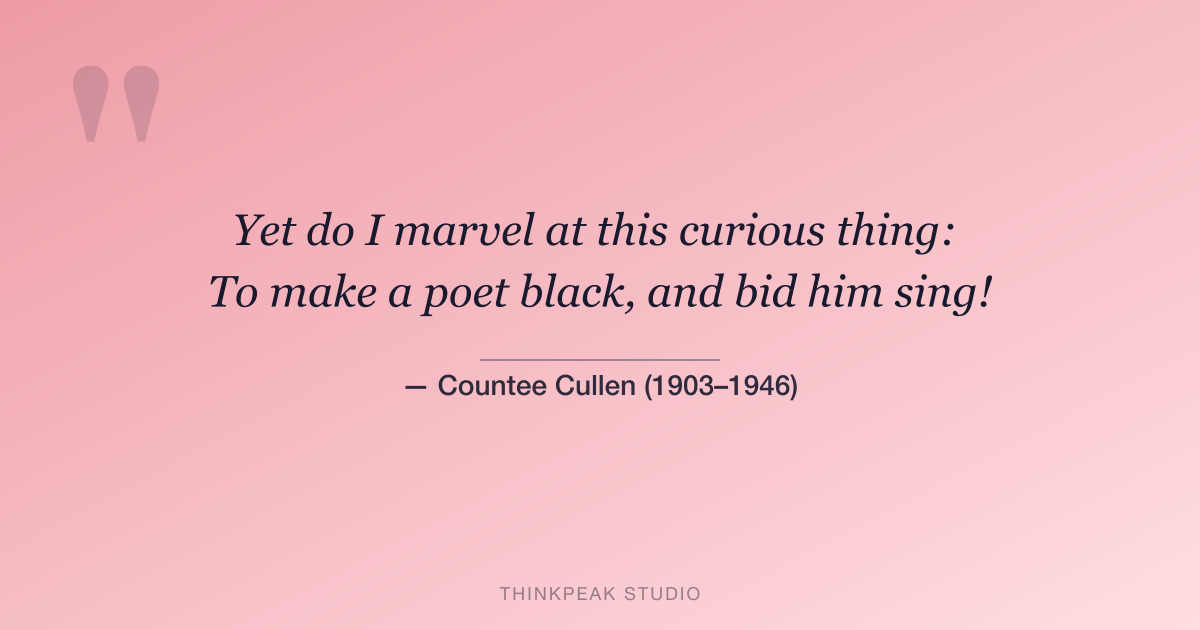
“Yet do I marvel at this curious thing: To make a poet black, and bid him sing!”
Editor’s note
Born in 1903, Countee Cullen’s couplet captures the impossible demand placed on the marginalized artist: to create beauty in conditions designed to deny one’s humanity. It reminds us that creation under constraint is one of the most profound acts of defiance and hope. If this resonates, try a ten-minute, unfiltered freewrite about the line and what it brings up.
— ThinkPeak Studio Editorial Team
What this quote means
On the surface, these two lines — the closing couplet of Cullen’s sonnet “Yet Do I Marvel” — express a feeling of bewilderment at a divine paradox. Cullen has spent the poem cataloguing the mysteries of God: why the mole is blind, why Sisyphus must roll his boulder forever, why Tantalus is tormented by fruit he cannot reach. Then he arrives at the greatest mystery of all: that God would create a Black person and give him the soul of a poet, and then expect him to sing.
The deeper truth here is about the impossible demand placed on the Black artist. To sing — to create, to celebrate, to express joy and beauty — requires a certain freedom of spirit. Yet in 1925 America, being Black meant living under the crushing weight of Jim Crow, systemic racism, and daily indignity. Cullen is not simply lamenting his own hardship; he is naming the extraordinary act of courage it takes for any marginalized artist to create beauty in conditions designed to deny their humanity. The word “marvel” is key — this is not bitterness alone, but genuine astonishment at the resilience of the creative spirit.
When Cullen wrote these words, the Harlem Renaissance was in full flower. Black artists, writers, and musicians were asserting their cultural identity with a force and sophistication that stunned the world. Yet this recognition came alongside the ever-present reality of racial violence, legal segregation, and a mainstream white literary world that could admire Black art while denying Black humanity. Cullen himself had been steeped in classical European poetry — Homer, Keats, Edna St. Vincent Millay — and felt the tension between that tradition and his lived experience deeply and personally.
More than a century later, this couplet continues to resonate. Artists from every marginalized community still navigate the same paradox: the world asks them to produce work of beauty and truth, while erecting barriers against their full participation in the world that consumes that work. The quote reminds us that creation under constraint is not a lesser form of art — it is one of the most profound acts of defiance and hope available to the human spirit.
About Countee Cullen
Countee Cullen was born on May 30, 1903, and grew up in Harlem, New York, after being adopted by the Reverend Frederick Asbury Cullen, a prominent minister, and his wife Carolyn. His upbringing in a household of faith and learning gave him access to books, ideas, and a strong sense of civic responsibility from an early age. A prodigious talent, he graduated from DeWitt Clinton High School in the Bronx as class poet and valedictorian, then went on to study at New York University — where he was elected to Phi Beta Kappa — before earning a Master of Arts from Harvard University.
Cullen published his debut collection, Color, in 1925 while still completing his undergraduate degree. The book was an instant sensation and established him as one of the leading voices of the Harlem Renaissance alongside Langston Hughes and Zora Neale Hurston. Where Hughes embraced jazz rhythms and vernacular speech, Cullen wrote in the formal meters of classical European poetry — sonnets, odes, ballads — a choice that was both celebrated and debated. He followed Color with Copper Sun (1927), The Ballad of the Brown Girl (1927), and the novel One Way to Heaven (1932). He also collaborated on a musical adaptation of St. Louis Woman with Arna Bontemps, which premiered on Broadway the year before his death.
Though Cullen died young at 42 in 1946, his influence on American poetry and the Black literary tradition has never faded. After his years of literary celebrity, he spent the last decade of his life quietly teaching French at DeWitt Clinton High School — the same school where his gifts had first been recognized. His commitment to education and to nurturing young minds was as much a part of his legacy as his verse. He once said that he wanted to be known simply as a poet, not a Black poet — a distinction that itself encapsulates the tension at the heart of his most famous couplet.
Create your own quote graphic with this quote
This is the kind of quote that resonates when it is presented visually. A clean typographic layout, a fitting color palette, and readable font sizing can transform these words into a graphic that people save and share. If you want to turn this quote into an Instagram post, WhatsApp status, Pinterest pin, or reel cover, Quotes Creator gives you all the tools to do it in minutes — custom fonts, gradients, backgrounds, and export sizes ready for every major platform.
Tips for designing this quote
- ✓ Use a serif font (Georgia, Playfair Display) to honour the literary feel of the quote
- ✓ Keep the quote on one or two lines — shorter display text reads better on mobile
- ✓ Pair the quote with a soft gradient that matches the emotional tone: soft rose for compassion and humanity
- ✓ Add the author name in a smaller, lighter weight below the quote
- ✓ Export in square format for Instagram feed and portrait for Stories or Pinterest
Turn this quote into a stunning graphic
Download Quotes Creator and design a shareable image from this quote in under a minute. Choose from dozens of templates, custom fonts, and backgrounds.
Create your own quote graphic with this quote
Turn this line into a shareable graphic in seconds — free, no signup needed. For video quotes and 100+ templates, try the Android app.
Advertisement
Enjoyed this article? Get more like it in your inbox.