Quote of the Day: Doris Miller on the Ordinary Face of Courage
One morning in December 1941, a 22-year-old cook named Doris Miller picked up a weapon he had never fired and changed history. When he finally told the story, he didn’t reach for grand words. He said the truest thing he could think of — it wasn’t hard.
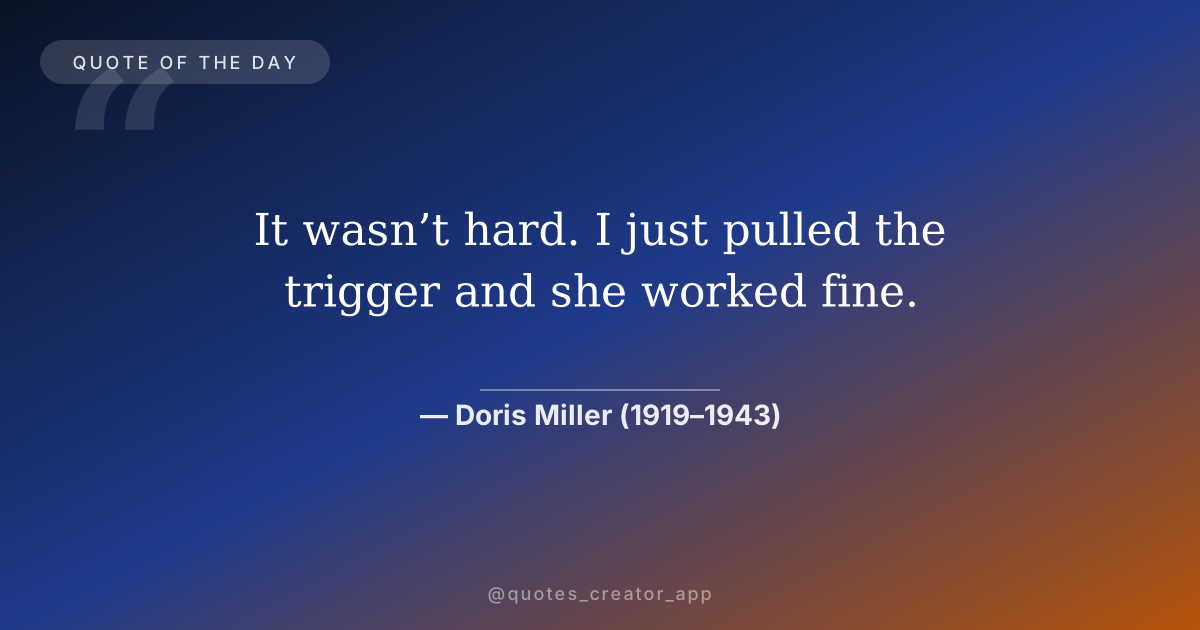
“It wasn’t hard. I just pulled the trigger and she worked fine.”
What this quote means
On December 7, 1941, Miller was a mess attendant second class aboard the battleship West Virginia, collecting laundry on the mess deck when the first Japanese torpedoes hit. He headed for his battle station only to find it destroyed, then reported for other duty and began carrying wounded sailors to safety. When an officer ordered him to the bridge, he helped lift the mortally wounded Captain Mervyn Bennion to shelter. Then, at the muzzle of an anti-aircraft gun he had never been trained to operate, he fired at the incoming planes for roughly fifteen minutes — officially credited with downing at least one attacker, though he and other witnesses believed he hit as many as four to six.
Given that backdrop, the quiet of these words is staggering. No bravado, no embroidery, no claim to have done anything extraordinary. Miller described operating a .50 caliber Browning machine gun — a weapon he had watched others use but had never touched — as though it were the most ordinary task in the world: It wasn’t hard. I just pulled the trigger and she worked fine. That understatement is the heart of the quote. Courage, in his telling, is not a heroic performance. It is simply doing the next thing that needs doing, without letting the enormity of the moment stop you.
There is a deep humility in the way Miller talks about the gun itself — he refers to it as she, the way a craftsman speaks of a trusted tool, and credits it rather than himself for doing the work. He doesn’t say, I brought down enemy planes. He says the weapon worked fine, as if the remarkable part of the story was that the machine didn’t jam. In that offhand phrasing lies a profound idea: that heroism is often just competence arriving at exactly the moment it is needed, dressed in work clothes and refusing to make a fuss.
Miller’s words also carry the weight of a man who knew precisely what his place in the Navy was supposed to be. As a Black sailor in 1941, he was confined to the mess branch — barred from combat roles and from commanding officers despite his 6-foot-3, 200-pound frame and his ship’s heavyweight boxing title. The system had told him in a hundred small ways that he was not meant to fight. And when the moment came, he fought anyway, then shrugged it off in a single sentence. The quote is therefore not just a statement about one battle. It is a refusal to let anyone else define what he was capable of.
About Doris Miller
Doris “Dorie” Miller was born on October 12, 1919, in Waco, Texas, the third of four sons, and was named Doris because the midwife attending his birth was convinced he would be a girl. He grew up on his father’s farm, played fullback on the football team at Moore High School, and dropped out after repeating the eighth grade. In September 1939 he enlisted in the U.S. Navy as a mess attendant — one of the only ratings open to Black sailors at the time — and was assigned to the battleship West Virginia, where he also became the ship’s heavyweight boxing champion.
When Pearl Harbor came under attack, Miller was a 22-year-old mess attendant second class. His heroism that morning — carrying the wounded to safety, aiding his dying captain, and manning a machine gun without any training — made him one of the first American heroes of World War II, celebrated by the Black press as part of the “Double V” campaign for victory over fascism abroad and racism at home. On May 27, 1942, Admiral Chester W. Nimitz personally presented Miller with the Navy Cross aboard the carrier Enterprise, making him the first Black American ever to receive the award.
Many argued the decoration should have been the Medal of Honor. Congressman John Dingell and Senator James Mead both introduced legislation to award it, and the Black press campaigned relentlessly on Miller’s behalf, but Secretary of the Navy Frank Knox, who opposed Black sailors in combat roles, recommended against it. No Black American would receive the Medal of Honor for service in World War II until Vernon Baker was belatedly honored in 1996. Miller, for his part, never publicly complained — he spent late 1942 and early 1943 on a war bond tour, speaking in Oakland, his hometown of Waco, Dallas, and at the Great Lakes Naval Training Station, and appearing on a Navy recruiting poster as the face of “above and beyond the call of duty.”
In the spring of 1943 he reported to the newly built escort carrier Liscome Bay. On November 24, 1943, during the Battle of Makin, the ship was struck just before dawn by a torpedo from a Japanese submarine; her own bombs and torpedoes detonated, and she sank in 23 minutes with the loss of 702 officers and sailors. Miller was among those listed as presumed dead. He was 24 years old. In the decades since, his name has been carried by a frigate, a VA medical center in Waco, schools, parks, and in 2020 the USS Doris Miller (CVN-81) — the first aircraft carrier ever named for an enlisted sailor and the first named for a Black American.
Create your own quote graphic with this quote
This is the kind of quote that resonates most when it is presented visually. A clean typographic layout, a fitting color palette, and readable font sizing can transform these words into a graphic that people save and share. If you want to turn this quote into an Instagram post, WhatsApp status, Pinterest pin, or reel cover, Quotes Creator gives you all the tools to do it in minutes — custom fonts, gradients, backgrounds, and export sizes ready for every major platform.
Editor’s note
Doris Miller became one of the most-read figures on the internet this week. His Wikipedia page drew roughly 67,000 views on August 21, 2026 — up from a typical daily readership of a few hundred — after news broke that the Trump administration and acting Navy Secretary Hung Cao were reportedly weighing whether to rename the aircraft carrier USS Doris Miller (CVN-81), potentially after President Donald Trump. The controversy returned the ship’s namesake to the national spotlight and reminded a new generation why he matters. Miller did not merely survive the worst morning of his life; in the middle of it, he discovered he was capable of more than the Navy — or anyone — had ever told him he could be. His words are a reminder that courage does not always announce itself. Sometimes it just pulls the trigger and, in the most matter-of-fact voice you have ever heard, tells you it wasn’t hard.
— ThinkPeak Studio Editorial Team
Tips for designing this quote
- ✓ Use deep navy and gold tones to echo the sea, the battleship, and the Navy Cross
- ✓ Keep the text centered and italic in a serif font for a timeless, weighty feel
- ✓ Let the words breathe with generous spacing between lines so they land with weight
- ✓ Add a subtle gradient background rather than a flat color for depth and dimension
- ✓ Export in square format for Instagram feed and portrait for Stories or Pinterest
Create your own quote graphic with this quote
Turn this line into a shareable graphic in seconds — free, no signup needed. For video quotes and 100+ templates, try the Android app.
Advertisement
Enjoyed this article? Get more like it in your inbox.