Quote of the Day: Duncan Sheik on Four Decades of Making Music — and the Happiness He Kept Chasing
Duncan Sheik was one of the most-read people on Wikipedia this weekend. His page surged to 319,023 views on September 18, 2026 — more than a thousand times its ordinary traffic — after the news that he had died in Manhattan the night before, at 56. He was the man behind Barely Breathing and the Tony-winning score of Spring Awakening. But the line worth returning to is a quiet one from a 2017 interview, when he was asked who he was: I’ve been writing and making music since I was 6 years old. So for four decades, that’s my craft.
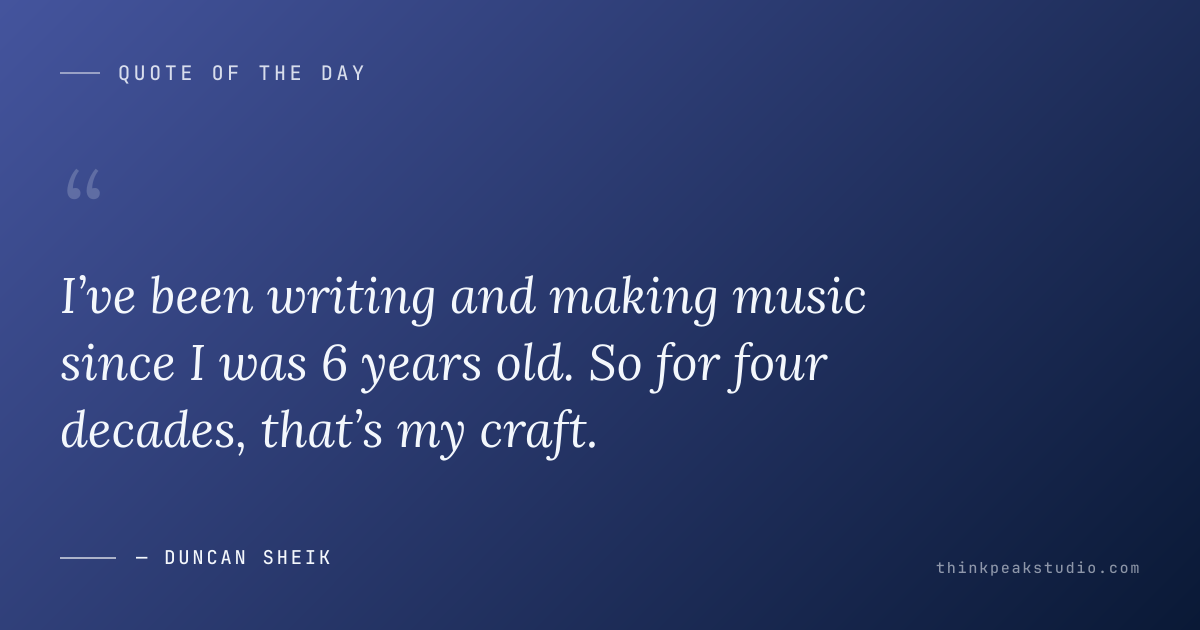
“I’ve been writing and making music since I was 6 years old. So for four decades, that’s my craft.”
What this quote means
He was asked the biggest question in the interview — not “What do you do?” but “Who are you?” — and he answered with arithmetic. Not the hit, not the gold record, not the two Tonys sitting somewhere in his apartment. He started at six years old, when his Juilliard-trained grandmother first put him at a piano, and counted forward. “For four decades, that’s my craft.” Craft is the chosen word, and it is doing a lot of work: it means something you practise rather than something you are praised for, something measured by the hours you put in rather than the noise that comes back. The numbers are worth sitting with. When he said it, in a LOCAL Life SC profile published in October 2017, he was 47, living in Manhattan, with eight albums and nine musicals behind him. When he died nine years later at 56, he had been at it for close to five decades. He never actually stopped.
The sentence also reads as a quiet rebuttal. Sheik is usually introduced as a one-hit wonder, because “Barely Breathing” was the only time he cracked the Billboard Hot 100 — and the label clearly stung. “It’s not really in my personality to say, ‘Hey, I’m up on stage; it’s great,’” he told the Los Angeles Times in 1997. “I’m very uncomfortable in that situation.” Rather than keep performing the role of the sensitive pop star, he walked toward the medium that let the music do the talking while he stayed out of the light: the theatre, where Spring Awakening made him a two-time Tony winner in 2007. “The theatre in some ways was a bit of a savior for me,” he told Songfacts in 2016. Read his answer to “Who are you?” against that biography and the logic is clean. If your identity lives in the making, a hit cannot anoint you and its absence cannot exile you. You are not one song. You are the thing you keep doing.
And he carried the idea one step further in the same conversation, when he was asked whether he was a happy man. He said there were “two kinds of happiness” — the surface kind that comes from money or an award, which is fine, and then the deeper kind, “that’s about creating value, doing something that moves other people and being part of a community.” He credited his Buddhist practice for the outlook, and he was clear that the deeper kind “takes work.” Put the two answers side by side and they are the same answer. The craft is not a means to the happiness; the craft is where the happiness lives. That is the part that travels far beyond music. Most of us are handed a scoreboard before we are handed a thing we actually love, and then we spend years mistaking the scoreboard for the point. Sheik did the harder, better thing: he kept choosing the work, from six years old until the very end, and let the applause land wherever it happened to land.
About Duncan Sheik
Duncan Scott Sheik was born on November 18, 1969, in New Jersey, and his first teacher was his grandmother, a Juilliard-trained pianist who introduced him to the instrument before he could have known it would become his life. After his parents divorced, he split his childhood between New Jersey and Hilton Head Island, South Carolina, where he got his first electric guitar and, by 12, was playing with high-school students in a cover band. He graduated from Phillips Academy in Andover, Massachusetts, in 1988 and went on to Brown University, where he studied semiotics and graduated in 1992 — and where he played guitar in a band with a fellow student named Lisa Loeb. Then he moved to Los Angeles with a demo tape.
He signed to Atlantic Records and released his self-titled debut in May 1996, produced by Rupert Hine. Its lead single, “Barely Breathing,” turned out to be one of the most durable songs of the decade: it peaked at No. 16 on the Billboard Hot 100 on May 10, 1997, and stayed on the chart for 55 weeks, at the time the fourth-longest run in the chart’s history. It earned him a Grammy nomination for Best Male Pop Vocal Performance, and the album was certified gold by the RIAA in August 1997. But the fame never quite fit. He followed it with Humming in 1998 and the Nick Drake-influenced Phantom Moon in 2001, the latter a collaboration with the poet and playwright Steven Sater, and grew steadily more certain that the pop machinery of that era was not where his music belonged.
He had met Sater through the Buddhist association Soka Gakkai, and in 1999 Sater suggested they adapt Frank Wedekind’s 1891 play Spring Awakening into a musical. It opened on Broadway at the Eugene O’Neill Theatre on December 10, 2006, and at the 2007 Tony Awards it won eight prizes, including Best Musical; Sheik took home Best Original Score, shared with Sater, and Best Orchestrations. The original cast album won the 2008 Grammy for Best Musical Show Album. More musicals followed — Whisper House, Alice by Heart, American Psycho, The Secret Life of Bees — alongside his own records, the last of them Claptrap in 2022. He died on September 17, 2026, in Manhattan, at 56; his mother told The New York Times the cause was organ failure. Two works he had written were still ahead of him: Memoirs of Amorous Gentlemen, due to begin previews on September 25, 2026, and a new Spring Awakening revival set to open off-Broadway in November. The millions who found his page that week were measuring the reach of a man who, by his own account, had simply never stopped making music.
Create your own quote graphic with this quote
This is a quote about patience and devotion, so the graphic should feel steady rather than loud. A deep indigo-to-slate gradient, an italic serif, and generous margins let forty years of work register without decoration. If you want to make a quote card from this — or any quote — our free online quote maker turns it into a shareable image in seconds, with no signup. For advanced features like video quotes and 100+ templates, try the Quotes Creator Android app.
Editor’s note
Duncan Sheik was one of the most-read people on Wikipedia this week. His page, which normally draws only a few hundred views a day, jumped to 16,198 on September 17, 2026, and then to 319,023 on September 18, after his death. He was 56. We are featuring this quote because it is the one that best explains a career the obituaries found hard to summarise: a Gen X radio staple who recoiled from pop stardom, pivoted to Broadway almost on a whim, and won two Tony Awards for a musical about teenagers. The headline writers called him a one-hit wonder. He called himself a craftsman who had been at the work since he was six years old, and who was still searching, as he put it in the same interview, for “a deeper happiness that’s about creating value, doing something that moves other people and being part of a community.” The two statements belong together. Before you measure your own year by what it produced and who noticed, borrow his question instead: is the craft still there, and are you still making it? He was, for nearly five decades, right up to the end.
— ThinkPeak Studio Editorial Team
Tips for designing this quote
- ✓ Use a deep indigo-to-slate gradient — the Quote of the Day palette, kept dark and calm to match a line about steady work rather than sudden fame
- ✓ Set the quote in an italic serif and leave the margins wide; the sentence is an admission, not a headline
- ✓ Break the quote between the two sentences so “so for four decades, that’s my craft” lands on its own line
- ✓ Resist adding a guitar, a piano or a theatre mask — the line is about a life, not an instrument
- ✓ Keep the attribution in small letterspaced caps so the author’s name reads as a signature rather than a boast
- ✓ Export in square format for Instagram feed and portrait for Stories or Pinterest
Create your own quote graphic with this quote
Turn this line into a shareable graphic in seconds — free, no signup needed. For video quotes and 100+ templates, try the Android app.
Advertisement
Enjoyed this article? Get more like it in your inbox.


