Quote of the Day: Elizabeth Holmes on Living a Life of Purpose
Elizabeth Holmes is, once again, the most-read person on Wikipedia. On September 7 her page shot to the top of the daily rankings as A24 surprised the Telluride Film Festival with You Can See Everything — Nathan Fielder and Lance Oppenheim’s secret, three-hour documentary shot in the weeks before Holmes reported to a federal prison in Texas. The line readers keep circling back to is one she gave The New Yorker in 2014, at the height of Theranos’s $9 billion peak: I would much rather live a life of purpose than one in which I might have other things but not that.
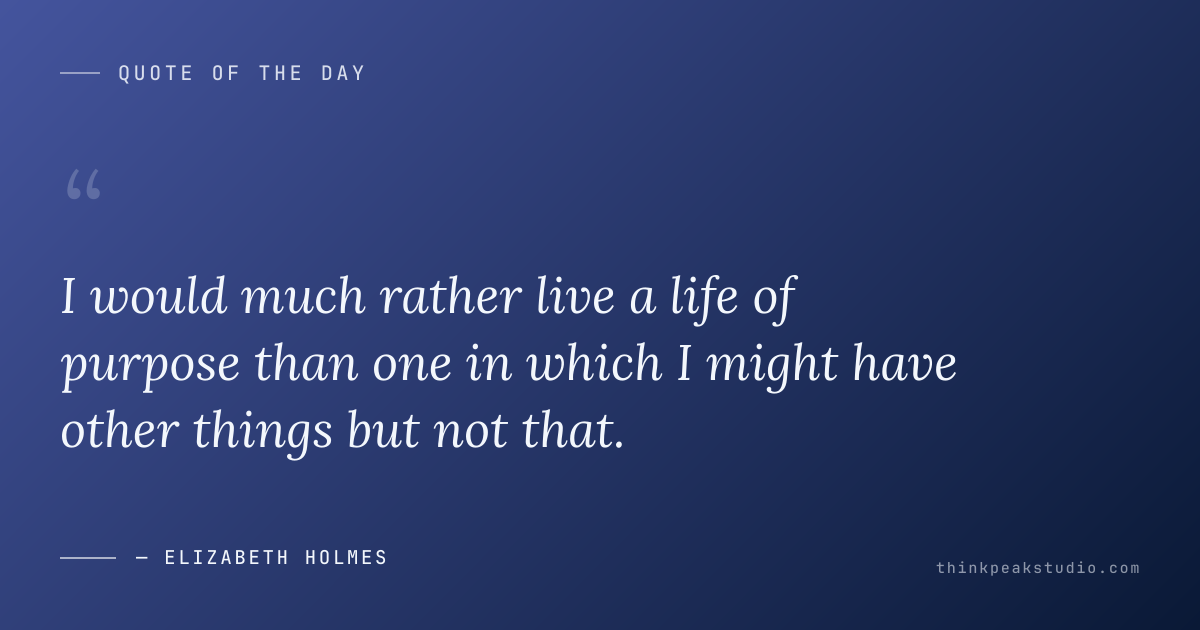
“I would much rather live a life of purpose than one in which I might have other things but not that.”
What this quote means
The sentence is nearly a decade old now, and it has aged into something stranger than the person who said it intended. Read plainly, it is an almost devotional statement of priorities: that a meaningful life matters more than a comfortable one, that a person should be willing to trade security and ease for the sense that their days are pointed at something real. Purpose is the word we reach for when we want to say that a life should add up to more than the sum of its possessions. In 2014, spoken by a woman who had just been named the youngest self-made female billionaire in America, it sounded like a creed — the motto of someone who had given up everything ordinary to chase a mission that would change healthcare for everyone.
That is the trap the sentence sets, and it is why the quote is worth sitting with rather than sharing quickly. A life of purpose is not measured by how loudly you claim to have one. It is measured by what you actually do — by whether the thing you build works, whether the people who trust you are protected, whether the words you speak match the facts you know. Purpose is not a feeling you announce; it is a discipline you keep, and it is tested precisely at the moments when announcing it is easiest and honoring it is hardest. Theranos offered a purpose so sweeping that it invited belief — a drop of blood, a pinprick, healthcare democratized for every person in every corner of the world. And for years, that purpose was the cover under which the truth quietly went missing.
The most useful reading of the line is as a question we can turn on ourselves. What would it take for us to discover that the thing we call purpose was actually something thinner — ambition, status, the thrill of being believed? The difference between the two is not always visible from the inside. It shows up in the small, unglamorous choices: whether you correct the record when a small lie would be easier, whether you admit what you don’t know to the people who depend on you, whether you are willing to be less impressive in order to be more honest. A life of purpose, properly understood, cannot be built on a foundation that collapses the moment it is examined. The people who get the sentence right are not the ones who say it loudest — they are the ones whose years quietly prove it true.
None of this is a reason to dismiss the aspiration. Wanting a life of purpose is good and human and hard. But the quote is a reminder that purpose and truth are not rivals to be weighed against each other — they are the same thing seen from two angles. The moment one is sacrificed for the other, both are lost. That is the lesson Elizabeth Holmes’s story leaves behind, and it is why her most famous sentence, read against her life, becomes a caution rather than a creed: the words we use to describe our purpose matter far less than what we do when no one is watching to applaud.
About Elizabeth Holmes
Elizabeth Anne Holmes was born on February 3, 1984, in Washington, D.C., into a family steeped in achievement and acutely aware of its own history. Her father, Christian Holmes IV, worked at a subsidiary of Enron before moving through government agencies like USAID and the EPA; her mother, Noel, was a staffer on Congressional committees. On her father’s side she is descended from Charles Louis Fleischmann, the immigrant who founded Fleischmann’s Yeast, and her family was, by the account of a longtime friend, “very proud of its yeast empire” history — and eager to recapture some of that old fortune. At nine, she wrote to her father that what she really wanted out of life was “to discover something new, something that mankind didn’t know was possible to do.”
She grew up in Houston, where she studied Mandarin and computer programming, and enrolled at Stanford University in 2002 to study chemical engineering. As a freshman she worked in a lab at the Genome Institute of Singapore, collecting blood samples for SARS research and filing her first patent for a wearable drug-delivery patch. In 2004 she dropped out of Stanford at nineteen, using her tuition money as seed funding to found the company that became Theranos, a portmanteau of “therapy” and “diagnosis.” Her pitch was genuinely ambitious: a small device, the Edison, that could run hundreds of blood tests from a single fingerprick, making lab testing cheap, fast, and available everywhere — an end to the fear of needles she herself admitted to feeling.
Expert after expert told her it could not be done the way she claimed. Phyllis Gardner, a Stanford clinical pharmacologist, remembered Holmes “staring through” her, unmoved by the objection. But Holmes persisted, assembled a dazzling board that included Henry Kissinger, George Shultz, and James Mattis, and raised more than $700 million from investors including Rupert Murdoch and Larry Ellison. In 2014, at thirty, Forbes named her the youngest self-made female billionaire in America on the strength of a $9 billion valuation. The problem, as The Wall Street Journal’s John Carreyrou reported beginning in 2015, was that the technology at the center of it all did not work — that most of Theranos’s tests were being run on ordinary machines made by other companies, and that the results it produced could be dangerously inaccurate. The company was dissolved by 2018.
Holmes was indicted alongside her former boyfriend and Theranos COO Ramesh “Sunny” Balwani on federal fraud charges. In January 2022 a jury found her guilty of one count of conspiracy to defraud investors and three counts of wire fraud, acquitting her on charges related to patients; in November she was sentenced to eleven years and three months in prison. She reported to the federal prison camp in Bryan, Texas, on May 30, 2023, a few weeks after giving birth to her second child. Her rise and fall has been chronicled in Carreyrou’s book Bad Blood, the podcast and Emmy-winning Hulu series The Dropout, and now You Can See Everything — the A24 documentary, filmed over three years with astonishing access, that premiered in secret at Telluride on September 6, 2026, and sent her Wikipedia page to the top of the daily rankings the next day. Few public lives have asked so pointedly how far a person’s stated purpose can drift from the truth of what they did.
Create your own quote graphic with this quote
This line deserves a frame that lets it sit with you rather than shout. A cool, clinical gradient, a clean centered serif set, and generous whitespace can turn these words into a graphic people save and share — a small reminder that a life of purpose is only ever as real as the truth it is built on. If you want to make a quote card from this — or any quote — Quotes Creator gives you the fonts, gradients, backgrounds, and export sizes to do it in minutes, ready for Instagram, Stories, Pinterest, and everywhere else.
Editor’s note
Elizabeth Holmes was the most-read person on Wikipedia this week. Her page jumped to the top of the daily rankings on September 7, 2026 — more than three years after she reported to a federal prison in Texas — as Nathan Fielder and Lance Oppenheim’s surprise documentary You Can See Everything premiered at Telluride before a theatrical release in October. We are featuring this quote because it has become a remarkable test of what “purpose” means — and because the line, read against her life, turns into one of the most instructive cautionary sentences of the decade. Purpose is not a promise you make to the world; it is a set of choices you keep in private. Theranos offered a purpose so vast it invited belief, and it became the thing under which the truth was hidden. The people who get to live a real life of purpose are not the ones who announce it loudest — they are the ones whose work can bear being looked at closely. Before your next ordinary Tuesday, ask yourself what you have called purpose, and whether it would survive being fully seen.
— ThinkPeak Studio Editorial Team
Tips for designing this quote
- ✓ Use a cool gradient of deep slate through teal to echo the clinical, lab-lit atmosphere of the Theranos story and the moody restraint of the documentary
- ✓ Keep the text centered and italic in a serif font so it reads like a confession set down plainly — a question, not a slogan
- ✓ Break the quote so that the turn — “but not that” — lands on its own line with full weight
- ✓ Add a subtle gradient background rather than a flat color to suggest the quiet, ambiguous space between a stated purpose and the truth
- ✓ Export in square format for Instagram feed and portrait for Stories or Pinterest
Create your own quote graphic with this quote
Turn this line into a shareable graphic in seconds — free, no signup needed. For video quotes and 100+ templates, try the Android app.
Advertisement
Enjoyed this article? Get more like it in your inbox.


