Quote of the Day: Esther Rantzen on Finding Strength When Things Are at Their Roughest
Dame Esther Rantzen died on 30 September 2026, aged 86, at her home in the New Forest. Two days on, the sentence that best explains the life she led comes from a letter she wrote to her younger self in 2021 — five years before the illness that killed her, and two years before she was even diagnosed. It is not really about hardship at all. It is about knowing when strength is actually required.
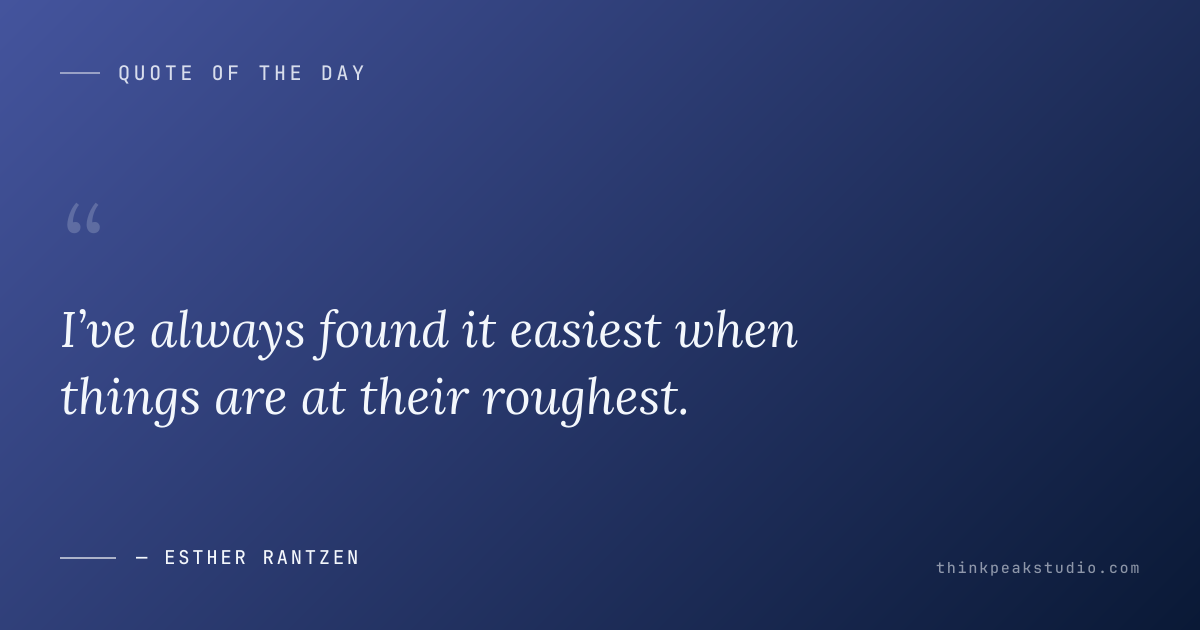
“I’ve always found it easiest when things are at their roughest.”
What this quote means
Read it twice, because it says the opposite of what we are usually told. The familiar instruction is that hard times call for strength, and that when life calms down we can finally rest. Rantzen reverses it. Crises, she found, are the easy part. They hand you a task. There is a decision to make, a call to place, a person to sit with, and the sheer momentum of having something to do carries you through. It is afterwards — in the quiet, when the visitors have gone and nothing further is being asked of you — that the real work begins. That is the moment she is describing, and she is warning you not to spend your reserves before it arrives.
The line is not a fragment floating on its own. It sits in a passage she wrote for The Big Issue’s “Letter to My Younger Self” series, and the surrounding sentences make the argument plain. “Then I just try and concentrate on surviving,” she wrote. “It’s when the bullets stop flying, when you’re no longer battling the elements, when hope is flagging; that’s when you really need your strength.” The metaphor is military, but the psychology is exact: danger organises the mind, and peace leaves it exposed. Fortitude, in her account, is not a burst of adrenaline. It is what you keep in reserve for the stillness, when there is no longer any emergency to hide behind.
Her own advice to the girl she had been was, in the same breath, blunter and more tender: “I’d tell my younger self, strap your tin helmet on and keep going.” The image is telling. Rantzen was born in June 1940, at the height of the Blitz, and her family moved out of London to escape the German bombing. The tin helmet is not borrowed rhetoric; it is the furniture of her childhood. But notice what the advice is not. It is not “be brave” or “stay positive.” It is keep going — a smaller, more durable instruction, available to people who do not feel brave at all.
She wrote the passage with a particular loss in view. Her husband, the documentary maker Desmond Wilcox, had died in 2000, and she described how grief arrives first as administration — forms, decisions, arrangements occupying the whole front of the mind — and only later as absence. The busiest, worst weeks were survivable because they had a shape. It was the flat, undemanding time that followed, with no obvious task and no visible enemy, that asked the most. That is the distinction the quote draws, and it is why the line travels so well beyond bereavement. A diagnosis, a redundancy, a slow disappointment, the end of something you had built your days around: none of them is a battlefield, and all of them reach the quiet part eventually. Rantzen’s instruction is to keep a little strength back for then. Don’t wait for calm to feel strong. The calm is precisely when you will need to be.
About Esther Rantzen
Esther Louise Rantzen was born in Berkhamsted, Hertfordshire, on 22 June 1940, into a Jewish family whose paternal line traced back to Poland; her father, Henry, was an engineer. With London under German bombing, the family moved away from the capital for her earliest years, and she later said she hated the grey streets when they returned. She was educated at North London Collegiate School in Edgware and then at Somerville College, Oxford, where she read English, performed with the Oxford University Dramatic Society and joined the Experimental Theatre Group.
She entered the BBC behind the camera, working as a researcher on Ned Sherrin’s late-night satire BBC-3 and then on current-affairs programmes. Her break came when the producer of the consumer show Braden’s Week put his researchers on screen; when the programme was replaced, it was rebuilt as That’s Life!, and in 1973 Rantzen was made its main presenter. It ran on BBC1 for 21 years, until 1994, and became one of the most popular programmes on British television. What began as a consumer show — faulty goods, dodgy traders, the Jobsworth award — widened into campaigning journalism: a drive for organ donors after the appearance of the toddler Ben Hardwick, safer playground surfaces, and the law requiring children to wear seat belts in the back of cars.
The most enduring of those campaigns produced Childline. After an edition that dealt with the death of a toddler, Rantzen persuaded the BBC to open a helpline; it was overwhelmed with calls, and she spent the next months raising the money and talking BT into premises and a free phone line. Childline launched in 1986 as a national helpline for children suffering abuse or neglect, and later merged with the NSPCC. She devised other programmes too, including The Big Time, which launched the singer Sheena Easton, and Hearts of Gold. After That’s Life! ended she presented her own BBC Two talk show, Esther, from 1994 to 2002. In 2010, in the wake of the MPs’ expenses scandal, she stood as an independent parliamentary candidate in Luton South; she came fourth with just over four per cent of the vote and lost her deposit. Later she founded The Silver Line, a helpline against loneliness in older people, which went on to become part of Age UK. She remained President of Childline until her death.
Her honours tracked the work: an OBE in 1991 for services to broadcasting, a CBE in 2006 for services to children and young people, and appointment as a Dame Commander in the 2015 New Year Honours for services to children and older people through Childline and The Silver Line. She married the documentary maker Desmond Wilcox in 1977; they had three children and five grandchildren, and she was widowed when he died in 2000. In January 2023 she disclosed that she had lung cancer, and by that May it had reached stage four. She joined the Dignitas clinic in Switzerland in December 2023 and became a prominent campaigner for assisted dying, describing the law in England and Wales as “messy and cruel.” In September 2026, too frail to make the journey, she called the defeat of the Assisted Dying Bill in the Commons “a tragic day.” She died at home in the New Forest on 30 September 2026, aged 86. Her family said her “legacy of compassion and understanding will live on in her charities” and called her “our sunshine.”
Create your own quote graphic with this quote
A line about steady, unshowy resilience should look steady too. A calm slate-and-teal gradient, a clear italic serif for the words, and a small, unadorned attribution let it read the way she spoke on television for fifty years — plainly, warmly, to the person in front of her. If you want to turn this quote, or any line you keep returning to, into something you can post, Quotes Creator gives you the fonts, gradients, backgrounds and export sizes to do it in minutes, ready for Instagram, Stories, Pinterest and everywhere else.
Editor’s note
Dame Esther Rantzen was one of the most-read people on Wikipedia this week, and the reason was her death. Her page had been drawing roughly 300 to 850 views a day through late September — 360 on 29 September — then jumped to 157,605 on 30 September 2026, the day she died at her home in the New Forest. The traffic came from readers looking up a broadcaster who had been a fixture of British life for half a century and who, in her last years, had become the country’s most recognisable advocate for assisted dying. We are featuring this quote because it is the most useful thing she left behind. It contains no advice about winning or enduring in the heroic sense; it simply notices that the moment you think you are least equipped to cope is often not the crisis but the quiet after it. Rantzen spent her career — and, by her own account, her whole temperament — in the service of being needed, and she wrote this line at 80, before the illness that killed her, when she could still talk about survival from the far side of grief. Two days after her death, in a week when many people are grieving her, it seems worth passing on as she said it: strap your tin helmet on, and keep going. Keep a little strength back for the stillness.
— ThinkPeak Studio Editorial Team
Tips for designing this quote
- ✓ Use a calm slate-and-teal gradient rather than a bright or fiery one — the quote is about quiet endurance, not adrenaline
- ✓ Set the words in a clear italic serif and give them room; the sentence is short and should feel unhurried
- ✓ Break after “easiest” so the turn in the sentence — “when things are at their roughest” — lands on its own line
- ✓ Keep the attribution small and plain in the lower corner; this is an ordinary, generous sentence, not a monument
- ✓ Export square for the Instagram feed and portrait for Stories or Pinterest, where quote cards travel furthest
Create your own quote graphic with this quote
Turn this line into a shareable graphic in seconds — free, no signup needed. For video quotes and 100+ templates, try the Android app.
Advertisement
Enjoyed this article? Get more like it in your inbox.


