Quote of the Day: Filip Hrgović on the Importance of the Chin
For eight rounds at the O2 Arena, everyone watching the fight saw the same thing: the 21-year-old prodigy Moses Itauma was faster, sharper, better. He dropped the Croatian veteran, out-landed him, and won every round on every card. Then Filip Hrgović, the 34-year-old underdog who was losing exactly as the oddsmakers expected him to lose, found the energy to finish the fight in the ninth round and became the first world heavyweight champion in Croatian history. His first words into the microphone were a question — “Let me ask my young friend something: is the chin important?” — and the sentence everyone is sharing this week is the answer he gave to it.
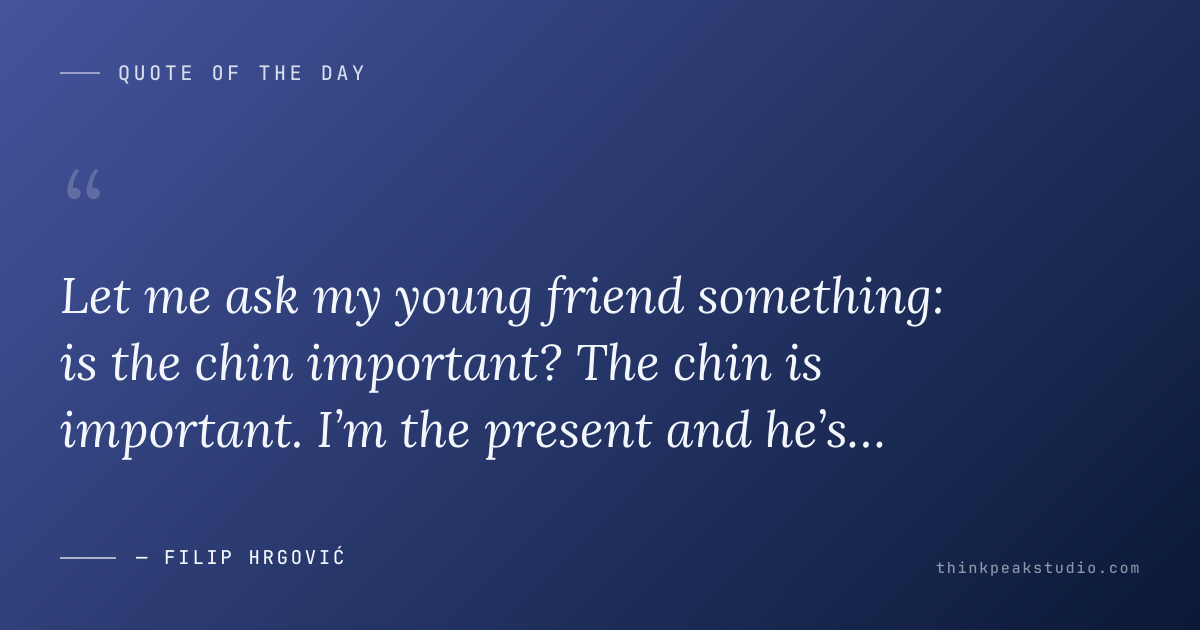
“Let me ask my young friend something: is the chin important? The chin is important. I’m the present and he’s definitely the future.”
What this quote means
The sentence is a setup and a punchline, and the punchline had been delivered forty-five minutes earlier in front of eighteen thousand people. Throughout the build-up to the fight, Itauma — the young man who had been walking through opponents in seconds and had dismissed the chin as an overrated attribute — never thought he would need to take a real punch. Hrgović, who has been dropped and cut and stopped and written off across a decade in the hardest division in sport, spent the fight proving the opposite. “Let me ask my young friend something: is the chin important?” he asked into the microphone. Then he answered it, with the evidence still visible on his face: “The chin is important.” It is the rare quote where the speaker has just demonstrated his thesis in real time.
What makes the line land is that the fight itself was the argument. For eight rounds Hrgović was beaten to the punch, outboxed, dropped in the second round, and — by his own admission afterwards — losing every round. None of that decided the outcome. In the end it was not Itauma’s speed or his combinations that settled the night; it was whether he could keep producing them once his body ran out of fuel, and whether the man absorbing all of them could keep coming forward. The chin, in boxing, is shorthand for something far larger than anatomy: the capacity to take hits and keep going, to be hurt and not stop, to be behind on every scorecard and still believe the fight is not over. Hrgović is not talking about jawbones. He is talking about endurance under pressure — about the value of being the person who can absorb a beating and still be standing when the other side runs out of strength.
And then comes the second half of the sentence, which is what stops the quote from being a boast. Hrgović had spent the promotion needling Itauma, promising to send the “delusional” prodigy back to school; the two had scuffled at the weigh-in when Itauma shoved him off the stage. Yet in the moment of victory, after taking everything the young man had, he called him “one of a kind” and “the best I’ve been in the ring with,” and closed with a sentence of extraordinary grace: “I’m the present, and he’s definitely the future.” The present versus the future — the older champion who bought his title with years of damage and patience, acknowledging the younger man who will one day come for it. There is a lesson in it about winning without needing to shrink your defeated opponent to feel the size of your own achievement.
The quote translates far beyond the ring, which is why it has travelled so fast. Everyone has a version of this dynamic: the brilliant, gifted young person who seems destined to win everything, and the older, slower one who keeps showing up, keeps absorbing the hits, keeps refusing to quit. Most of those contests are decided the way this fight was — not by who started better, but by who could still be standing at the end. “Is the chin important?” is a question about the most unglamorous virtue there is: durability. Hrgović’s answer, and his entire career, is that it is the most important thing of all. And his closing line adds the humility: being the present is not the same as being immortal. The future always arrives. The question is whether you will have been ready to hold the present while you had it.
About Filip Hrgović
Filip Hrgović was born on June 4, 1992, in Zagreb, the capital of Croatia, to Petar and Iva Hrgović. His father, born in Livno, Bosnia and Herzegovina, worked for Croatian Motorways; his mother, a native of Zagreb and a graduate in kinesiology, raised Filip and his four siblings. He grew up overweight — he has admitted to earning the nickname “fatty” as a child and getting into trouble at school — and took up basketball at eight to lose weight, winning a national championship with his club Dubrava before back and knee injuries forced him to stop. He tried swimming next, and then at thirteen he walked into the boxing club Leonardo in his home district of Sesvete, under coach Leonardo Pijetraj. His mother was not happy about her son choosing boxing as a profession. His mind was already made up.
As an amateur he became one of the best super-heavyweights in the world. In 2010 he won the AIBA Youth World Championships in Baku, beating a young Joseph Parker on the way. In 2013 he entered the sparring folklore of the division: he was the man who cut David Haye so badly in a session that the Haye–Tyson Fury fight was cancelled. In 2015 he won the European Championships in Samokov, the first Croatian to reach a European final in eleven years, and was named AIBA’s Boxer of the Month. At the 2016 Rio Olympics he stopped Lenier Peró by TKO before losing a razor-thin split decision to Tony Yoka in the semifinals to take the bronze medal — a result that earned him the Order of Danica Hrvatska and the Franjo Bučar State Award for Sport. The sport gave him a reputation as one of the hardest chins and most dangerous punchers in the heavyweight division, and nicknames to match: Hrga, El Animal, Stoneman — and, in time, the one that would make his quote iconic: The Iron Chin.
He turned professional in September 2017, and the road to the top was long and crooked. He collected titles — IBF International, WBC International, a knockout of Éric Molina in 2019, a disputed decision over Zhilei Zhang in 2022 — while the division’s biggest names repeatedly refused to fight him. He became the mandatory challenger for Oleksandr Usyk’s IBF title and waited through the Fury–Usyk trilogy while the belt stayed tied up, then took an interim fight with Daniel Dubois in June 2024 and lost on a doctor’s stoppage after deep cuts, despite being ahead on the scorecards. There was grief in the middle of it all: his father died weeks before his scheduled fight with Zhang in May 2022. He has spoken about the faith that carried him through, and after the Itauma fight he credited the Holy Spirit and his coach Abel Sánchez for the strength to endure what he called the best camp of his life. He beat Joe Joyce in April 2025, David Adeleye in August 2025, and David Allen in May 2026 — biding his time as a new generation of heavyweights arrived.
And so to August 29, 2026, at the O2 Arena in London, for the vacant IBF heavyweight title. Moses Itauma, 21, unbeaten in fourteen fights, was chasing Mike Tyson’s record as the youngest heavyweight champion in history; Hrgović, 34, was the biggest underdog of his career. Itauma won the early rounds, dropped Hrgović in the second, and the fight seemed to be following the oddsmakers’ script. But the man nicknamed The Iron Chin absorbed everything, kept the pace in his favour, and in the ninth round — when the younger man finally emptied his tank — the Croatian finished the fight, sending Itauma to hospital and becoming the first Croatian world heavyweight champion in history. His Wikipedia page, which had been drawing a few thousand views a day through most of August, climbed to 17,400 on August 28 as fight week peaked, jumped to 75,763 on the night of the fight, and surged past 108,000 the day after as the world looked up the man who had just rewritten the heavyweight script. “I was losing every round, I was outboxed,” he said. “I don’t know from where I got energy in that round.” The answer, to hear him tell it, was the chin — the same answer he gave the world in the sentence everyone is quoting now.
Create your own quote graphic with this quote
A quote this theatrical and this earned is built to be seen, not just read. A clean typographic layout, a bold gradient, and strong contrast can turn these three sentences into a graphic that people save, share, and come back to the next time they are behind on every scorecard. If you want to make a quote card from this — or any quote — Quotes Creator gives you the fonts, gradients, backgrounds, and export sizes to do it in minutes, ready for Instagram, Stories, Pinterest, and everywhere else.
Editor’s note
Filip Hrgović is one of the most-read people on Wikipedia this week. His page, which normally draws a small fraction of the traffic it received over the weekend, jumped from 17,400 views on August 28 to 75,763 on the night of the fight and more than 108,000 the day after — the morning the world woke up to the news that Croatia had its first world heavyweight champion. We are featuring this quote because it is the rarest kind of victory speech: a sentence about endurance that was proven in the same breath it was spoken. For eight rounds the faster, younger man looked unbeatable; the man with the iron chin simply refused to stop coming forward until the fight turned. “Is the chin important?” is a question for anyone who has ever felt outboxed by life — outclassed by a rival, outrun by a deadline, outmatched by a diagnosis. Hrgović’s answer is that the most important thing you can have is not the fastest start, but the ability to keep standing when everything is landing. And his last line — “I’m the present, and he’s definitely the future” — is the reminder that you can win hard, and still be generous. Keep coming forward. Your round is coming.
— ThinkPeak Studio Editorial Team
Tips for designing this quote
- ✓ Use deep crimson and gold tones to echo the IBF title belt and the red-and-white of a Croatian champion’s night
- ✓ Keep the question and the answer on separate lines so the setup and the punchline land with full effect
- ✓ Set the quote in an italic serif so it reads like a voice from the ring, not a headline
- ✓ Let the words breathe with generous whitespace around each line, like the calm after nine rounds
- ✓ Export square for Instagram feed, portrait for Stories and Pinterest, and wide for a desktop wallpaper
Create your own quote graphic with this quote
Turn this line into a shareable graphic in seconds — free, no signup needed. For video quotes and 100+ templates, try the Android app.
Advertisement
Enjoyed this article? Get more like it in your inbox.


