Quote of the Day: Franco Baresi on Refusing Easy Consolation
The legendary AC Milan captain who died this week spent a lifetime being praised — and still insisted, when it came to the 1994 World Cup final, on telling the truth: he missed the penalty, and he lost the final.
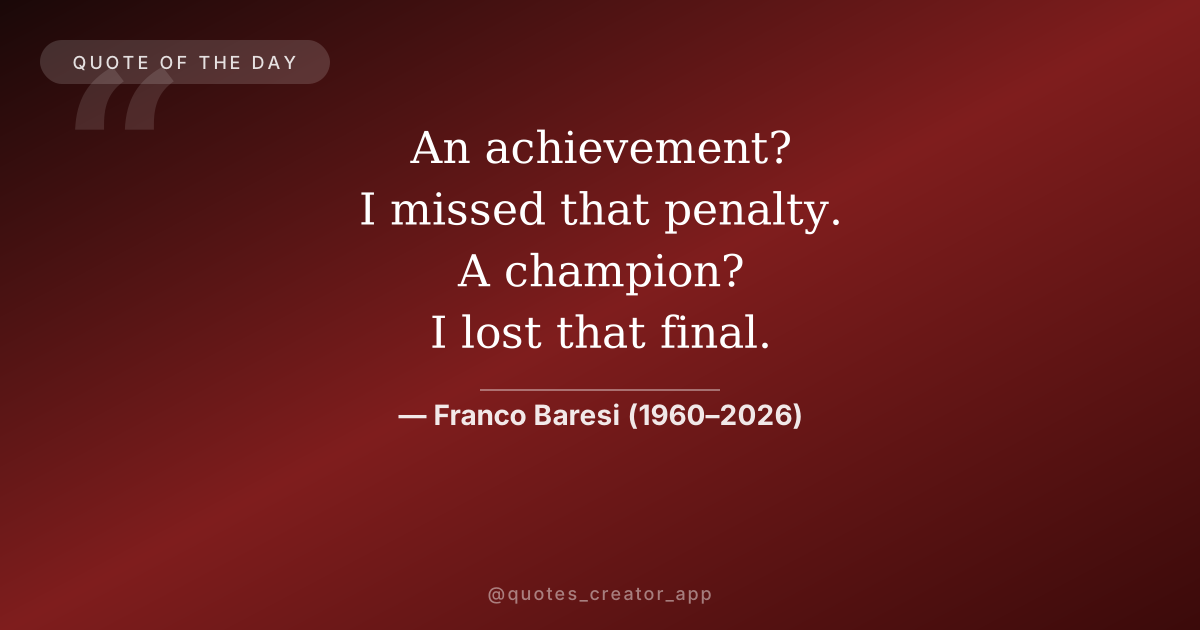
“An achievement? I missed that penalty. A champion? I lost that final.”
What this quote means
There is a question we all learn to expect after a painful defeat, and it usually begins with comfort. Someone leans in and says the kind words: but what an achievement; but what a champion you are. Most of us take the balm. It is soothing, it is polite, and it asks nothing of us. Franco Baresi is one of the few people in the history of sport who heard those words at the very summit of his career and refused them — line by line. “An achievement? I missed that penalty. A champion? I lost that final.” Two rhetorical questions, two honest answers, and not a single concession to the compliment.
The context makes the quote unbearable to read and impossible to forget. In the summer of 1994, at the age of 34 — ancient for a defender — Baresi tore a cartilage in his knee in Italy’s second match of the World Cup in the United States. He had surgery and was given no realistic chance of playing again in the tournament. Twenty-five days later, he was back, captain of Italy, walking out for the final against Brazil at the Rose Bowl. He delivered one of the greatest defensive performances of his life, marshalling a makeshift back line to a clean sheet. After 120 goalless minutes, the trophy would be decided on penalties — and Baresi, who had scored 21 of 31 career goals from the spot, stepped up first. The ball sailed over the bar. Roberto Baggio missed too, and Brazil lifted the World Cup. In the aftermath, the world wanted to comfort him: you came back from surgery; you reached the final; you were courageous. The story writes itself. Baresi’s answer, written years later in his autobiography Libero di sognare, refuses the story entirely.
That refusal is the whole point, and it is why the quote travels beyond football. There is a quiet dignity in not accepting a better narrative than the one that happened. The phrase “moral victory” exists precisely so that losing can be made to feel like winning, and Baresi’s instinct — almost thirty years after the event — was still to say no to it. He did not deny the achievement of returning from surgery; he simply declined to let it erase the scoreline. An achievement and a failure can be true at the same time, and a champion can lose the biggest game of his life. Naming the failure does not diminish the greatness — it is what makes the greatness trustworthy. Nobody believes a legend who has to protect himself from the truth.
Translated into daily life, the lesson is a bracing one. When a project collapses, a relationship ends, a race is lost or a deal falls through, the instinct is to reach for the story that softens it. “We learned so much.” “The journey mattered more.” Sometimes that is genuine wisdom, but sometimes it is a dodge — a way of avoiding the painful, clarifying work of admitting what we got wrong and what we lost. Baresi’s model is different. Own the result. Say the sentence that hurts. Miss the penalty, lose the final, and then go on. His honesty is not self-flagellation; it is the precondition for real growth, because you cannot improve at something you refuse to admit you failed at. The man who captained one club for twenty years understood that integrity — on and off the pitch — is built one honest admission at a time.
About Franco Baresi
Franco Baresi was born on May 8, 1960, on a farm in Travagliato, near Brescia in northern Italy, into a family that would lose both parents early — his mother when he was 13, his father four years later. Football became the Baresi brothers’ family. Giuseppe, two years older, joined Inter Milan; when Inter judged the younger Franco “too frail” and rejected him, he signed instead with their city rivals, AC Milan, at 14. It was the most consequential rejection in the history of the transfer market. He made his Serie A debut two weeks before his 18th birthday in 1978, and in his second season Milan won the scudetto. Then came the dark years: the match-fixing scandal of 1980, relegation to Serie B, promotion, and relegation again. Where stars fled, Baresi stayed — he was made captain at 22 and led Milan back to Serie A, choosing loyalty over the exits that were always open to him.
With Silvio Berlusconi’s takeover and Arrigo Sacchi’s revolution in the late 1980s, Baresi became the heart of arguably the greatest defensive unit ever assembled — himself alongside Paolo Maldini, Alessandro Costacurta and Mauro Tassotti. He won six Serie A titles, including the unbeaten 1991–92 campaign that stretched to a record 58 matches without defeat, and three European Cups, and he captained Milan for 15 of his 20 seasons at the club, making 719 appearances. Runner-up in the 1989 Ballon d’Or to teammate Marco van Basten, he was nicknamed “Kaiser Franz” in honour of Franz Beckenbauer, the only other sweeper of his class. In 1999 he was voted Milan’s Player of the Century, and upon his retirement in 1997 the club retired his number 6 shirt — the first such honour in Italian football. He was also named one of Pelé’s 125 greatest living footballers in 2004 and inducted into the Italian Football Hall of Fame in 2013.
For Italy, Baresi won 81 caps and one of the most unusual medal collections in football history — gold at the 1982 World Cup, bronze at Italia ’90, and silver at USA ’94, the final he spent the rest of his life being asked about. On February 4, 2026, he carried the Olympic torch through the San Siro with Giuseppe Bergomi at the Milan–Cortina Winter Games opening ceremony — his last public appearance. After a long illness that followed surgery to remove a lung nodule, Baresi died on July 31, 2026, in Rozzano, Milan, aged 66, days after a false death report had sent his country searching for news. His Wikipedia page was viewed more than 300,000 times in a single day — and in the grief, his own words did the rounds again: a champion, telling the truth about the final he lost.
Create your own quote graphic with this quote
This is the kind of quote that resonates most when it is presented visually. A clean typographic layout, a fitting color palette, and readable font sizing can transform these words into a graphic that people save and share. If you want to turn this quote into an Instagram post, WhatsApp status, Pinterest pin, or reel cover, Quotes Creator gives you all the tools to do it in minutes — custom fonts, gradients, backgrounds, and export sizes ready for every major platform.
Editor’s note
Franco Baresi was among the most-read figures on the internet this past week — his Wikipedia page drew more than 300,000 views on July 31, the day he died, and his name has barely left the trending lists since. Two years after carrying the Olympic torch through the San Siro, one of the greatest defenders who ever lived is being remembered the way he would have wanted: not with a comforted myth, but with his own clear-eyed words about the night he missed a penalty and lost a final. Before you share this, ask yourself what comfortable story you have been telling yourself about a defeat — and whether you are brave enough to name the result the way he did.
— ThinkPeak Studio Editorial Team
Tips for designing this quote
- ✓ Use deep rosso-nero crimson and near-black to echo AC Milan’s iconic colours and Baresi’s commanding presence
- ✓ Let the two rhetorical questions and two answers breathe as four short centered lines for maximum impact
- ✓ Keep the serif italic typography elegant and timeless — the quote deserves the gravitas of a statue
- ✓ Add a subtle gradient background rather than a flat color for depth and dimension
- ✓ Export in square format for Instagram feed and portrait for Stories or Pinterest
Create your own quote graphic with this quote
Turn this line into a shareable graphic in seconds — free, no signup needed. For video quotes and 100+ templates, try the Android app.
Advertisement
Enjoyed this article? Get more like it in your inbox.