Quote of the Day: G. K. Chesterton on Curiosity and Wonder
Born on this day in 1874, Gilbert Keith Chesterton — philosopher, essayist, and the “Prince of Paradox” — left us words that challenge how we see the world around us.
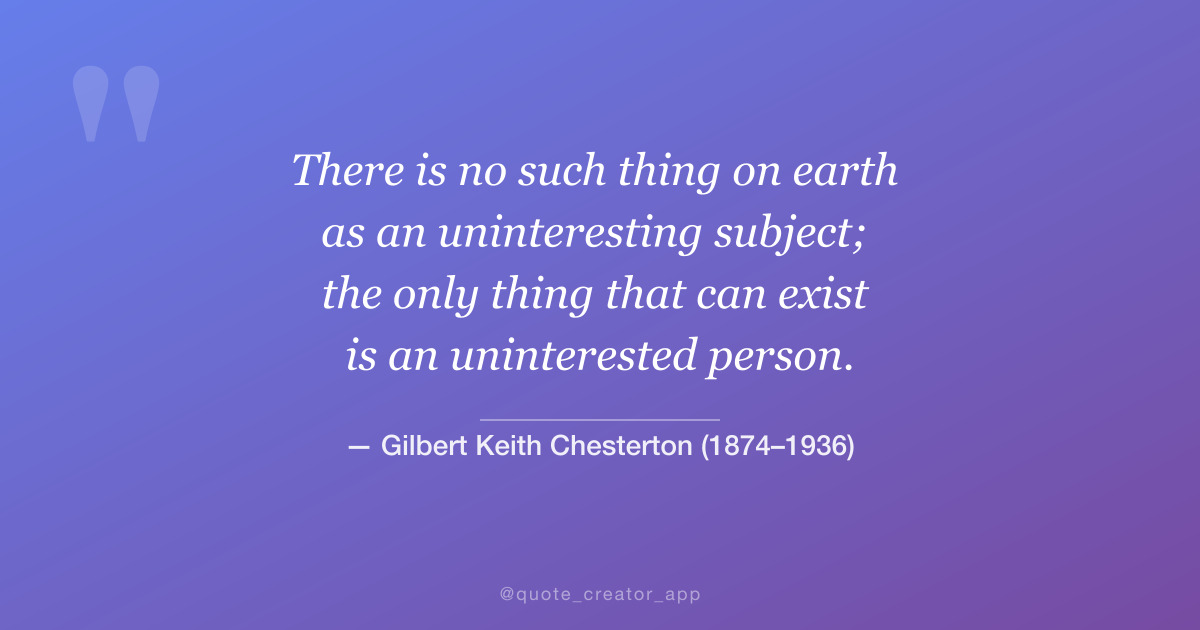
“There is no such thing on earth as an uninteresting subject; the only thing that can exist is an uninterested person.”
Editor’s note
Born in 1874, G. K. Chesterton’s line — “There is no such thing on earth as an uninteresting subject; the only thing that can exist is an uninterested person” — is a reminder that curiosity is not something you find but something you bring. The cure for boredom is not more stimulation, but more wonder. If this resonates, try a ten-minute, unfiltered freewrite about the line and what it brings up.
— ThinkPeak Studio Editorial Team
What this quote means
Chesterton’s words make a bold and disarming claim: that boredom is never a property of the world around us, but always a property of the person looking at it. There is no topic — no profession, no rock, no insect, no historical period, no obscure technical field — that is inherently dull. When we find something boring, we are not discovering a truth about that subject; we are revealing something about our own attention.
The deeper insight is about the nature of curiosity itself. Interest is not something you find; it is something you bring. Every subject, however mundane it appears on the surface, contains within it layer upon layer of complexity, history, and mystery. The person who can find wonder in the ordinary has an infinite well to draw from, while the person who meets every new thing with indifference will be bored regardless of what they encounter. In this sense, curiosity is not merely a pleasant trait — it is a form of wisdom, even a form of gratitude.
Chesterton wrote this in Heretics (1905), a sparkling collection of essays in which he challenged the leading intellectuals of his day — H. G. Wells, Rudyard Kipling, George Bernard Shaw — whom he accused not of religious heresy but of philosophical shallowness. He believed the modern tendency toward narrow specialization and cynical detachment was slowly killing the human capacity for wonder. He himself was famously, almost comically, curious about everything: he wrote brilliant essays about cheese, about walking, about chalk, about the philosophy hidden inside a detective story. His very life was a demonstration of the principle he articulated here.
In an era of infinite scroll, shrinking attention spans, and algorithmically engineered distraction, this quote carries more weight than ever. We have access to more information than any generation in human history — yet disengagement and boredom are epidemic. Chesterton’s challenge to us is both simple and demanding: the cure for boredom is not more stimulation, but more curiosity. The world has not become less interesting. We have simply stopped looking properly at it.
About G. K. Chesterton
Gilbert Keith Chesterton was born on May 29, 1874, in Kensington, London. He studied at the Slade School of Fine Art before gravitating inevitably toward writing — a vocation that would consume him entirely for the next four decades. His output was staggering: over 80 books, several hundred poems, more than 200 short stories, and an estimated 4,000 essays written for newspapers and magazines. He wrote quickly, prolifically, and with an effortless wit that masked the seriousness of his thought.
Known as the “Prince of Paradox,” Chesterton had a rare gift for turning conventional wisdom upside down and revealing a deeper truth beneath it. His Father Brown detective series remains beloved more than a century after its first publication; his works of Christian apologetics — Orthodoxy (1908) and The Everlasting Man (1925) — directly influenced C. S. Lewis, who credited Chesterton with beginning his journey toward faith. He engaged in famous public debates with Shaw, H. G. Wells, and Bertrand Russell, winning the admiration even of those who disagreed with him entirely. He died on June 14, 1936, and was eulogized by Pope Pius XI as a “defender of the Catholic Faith.”
Despite his formidable intellect, Chesterton was famously — almost legendarily — absent-minded in daily life. One story, probably true, holds that he once telegraphed his wife during a speaking tour with the message: “I am at Market Harborough. Where ought I to be?” She replied simply: “Home.” It is a fitting image for a man whose mind was always somewhere larger and more interesting than wherever his body happened to find itself.
Create your own quote graphic with this quote
This is the kind of quote that resonates most when it is presented visually. A clean typographic layout, a fitting color palette, and readable font sizing can transform these words into a graphic that people save and share. If you want to turn this quote into an Instagram post, WhatsApp status, Pinterest pin, or reel cover, Quotes Creator gives you all the tools to do it in minutes — custom fonts, gradients, backgrounds, and export sizes ready for every major platform.
Tips for designing this quote
- ✓ Use a serif font (Georgia, Playfair Display) to honour the literary and philosophical feel of the quote
- ✓ Keep the quote on two or three lines — shorter display text reads better on mobile
- ✓ Pair the quote with a rich indigo or purple gradient to convey intellectual depth and wisdom
- ✓ Add the author name in a smaller, lighter weight below the quote
- ✓ Export in square format for Instagram feed and portrait for Stories or Pinterest
Related Posts
Create your own quote graphic with this quote
Turn this line into a shareable graphic in seconds — free, no signup needed. For video quotes and 100+ templates, try the Android app.
Advertisement
Enjoyed this article? Get more like it in your inbox.