Quote of the Day: George Ezra on Music and Memory
Born on this day in 1993, George Ezra reminds us that a song’s true value isn’t in its technical perfection but in the moments it witnesses and the memories it comes to hold.
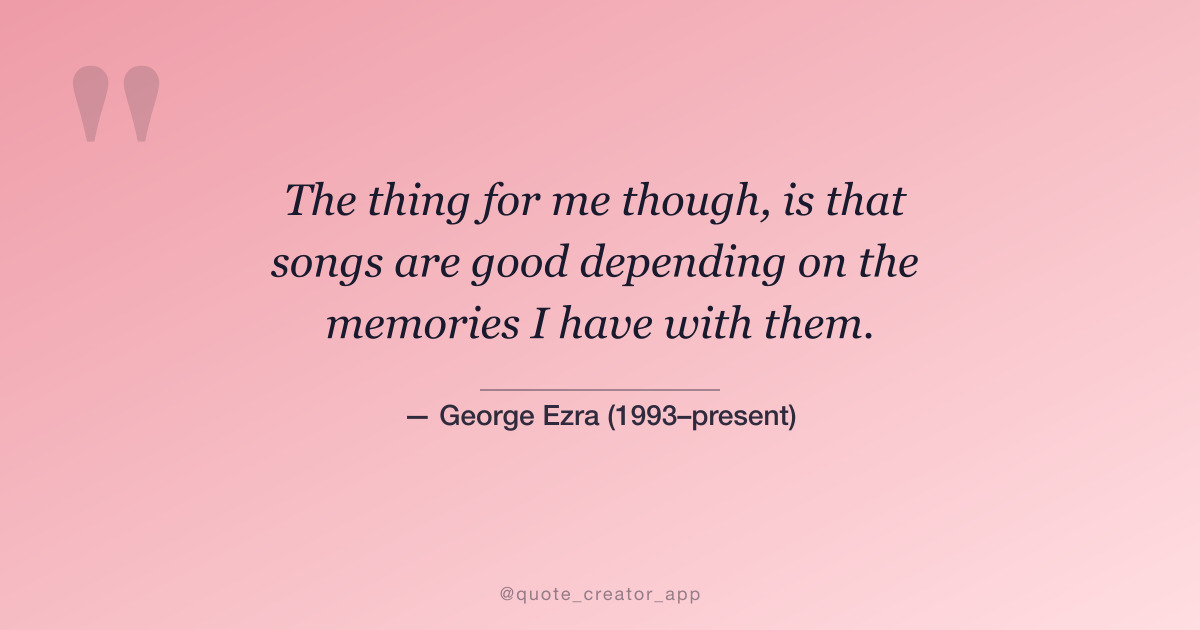
“The thing for me though, is that songs are good depending on the memories I have with them.”
Editor’s note
George Ezra’s observation that songs become good through the memories attached to them is a reminder that art is never finished — it is completed by the listener. We often underestimate how much our own experiences shape what we love. If this resonates, put on the song that soundtracked your favourite moment and let yourself remember why it mattered.
— ThinkPeak Studio Editorial Team
What this quote means
On the surface, George Ezra is making a simple, almost humble observation about his own craft: a song’s quality is subjective, measured not by music critics or chart positions but by the personal history it accumulates. If a “naff” song played during a perfect summer evening becomes the soundtrack to that memory, then for that listener, it is a great song.
The deeper insight is about how art and life intertwine. We don’t experience music in a vacuum — we experience it alongside heartbreaks, road trips, quiet mornings, celebrations, and ordinary Tuesdays. The melody becomes a vessel; the lyric, a timestamp. A song “becomes good” because it was there when something mattered. This reframes the relationship between creator and listener: the artist provides the raw material, but the listener completes the work by living with it.
Ezra arrived at this understanding through his own journey. Growing up in Hertford, England, he traveled Europe as a teenager — missing trains, getting lost, hearing “Budapest” take on a life of its own in hostels and bars. His breakthrough hit wasn’t written as a calculated pop masterpiece; it was a playful list of things he didn’t own but would gladly give up. Yet millions heard it during first dates, long drives, and moments of homesickness, and the song became inseparable from those memories. The artist’s intent and the listener’s experience diverged, and in that gap, meaning was made.
Today, in the streaming era where songs are often reduced to data points — skip rates, playlist adds, algorithmic recommendations — Ezra’s perspective is a quietly radical reminder. The metrics don’t capture why a song matters. The three-minute track that carried you through a breakup, the album that defined a summer, the chorus you sang at a wedding — these are the true measures. The song doesn’t change; your life does, and the song changes with it.
About George Ezra
George Ezra Barnett was born on June 7, 1993, in Hertford, Hertfordshire, England. The son of a teacher, he grew up listening to his parents’ record collection — Bob Dylan, Paul Simon, Woody Guthrie — and taught himself guitar as a teenager. After finishing school, he chose not to go to university and instead spent time traveling across Europe, busking and writing songs in hostels, on trains, and in borrowed rooms.
His debut album, Wanted on Voyage (2014), named for the travel documents he carried, became a phenomenon. Led by the single “Budapest” — a whimsical, acoustic-driven track about giving up things he didn’t own — the album reached number one in the UK and sold over a million copies. His follow-up, Staying at Tamara’s (2018), produced the chart-topping “Shotgun” and “Paradise” and cemented his status as one of Britain’s most successful contemporary singer-songwriters. His third album, Gold Rush Kid (2022), debuted at number one as well, making him one of the few artists to achieve three consecutive UK number-one albums in the streaming era.
Despite his commercial success, Ezra has retained a grounded, self-deprecating charm. He hosts a podcast, George Ezra & Friends, where he interviews fellow musicians about their creative processes. He has spoken openly about anxiety and the pressures of fame, and his lyrics often return to themes of home, movement, and the small moments that define a life. He continues to write, tour, and — true to his own philosophy — make songs that people will one day remember their lives by.
Create your own quote graphic with this quote
This is the kind of quote that resonates most when it is presented visually. A clean typographic layout, a fitting color palette, and readable font sizing can transform these words into a graphic that people save and share. If you want to turn this quote into an Instagram post, WhatsApp status, Pinterest pin, or reel cover, Quotes Creator gives you all the tools to do it in minutes — custom fonts, gradients, backgrounds, and export sizes ready for every major platform.
Tips for designing this quote
- ✓ Use a serif font (Georgia, Playfair Display) to honour the reflective, personal tone of the quote
- ✓ Keep the quote on two or three lines — let the words breathe so the sentiment lands
- ✓ Pair the quote with a soft rose-to-pink gradient that evokes warmth, nostalgia, and the emotional resonance of memory
- ✓ Add the author name in a smaller, lighter weight below the quote
- ✓ Export in square format for Instagram feed and portrait for Stories or Pinterest
Create your own quote graphic with this quote
Turn this line into a shareable graphic in seconds — free, no signup needed. For video quotes and 100+ templates, try the Android app.
Advertisement
Enjoyed this article? Get more like it in your inbox.