Quote of the Day: George Michael on What Faith Really Means
Ten years after his death on Christmas Day, George Michael was back in the spotlight this week: an all-star tribute at the MTV Video Music Awards, and a trailer for George Michael: The Faith Tour, a concert film built from 1988 footage that was thought lost for nearly four decades. The film returns him to the word that named his biggest album — and to an archival interview in which he explains it. His answer is not religious. It is much plainer, and much braver.
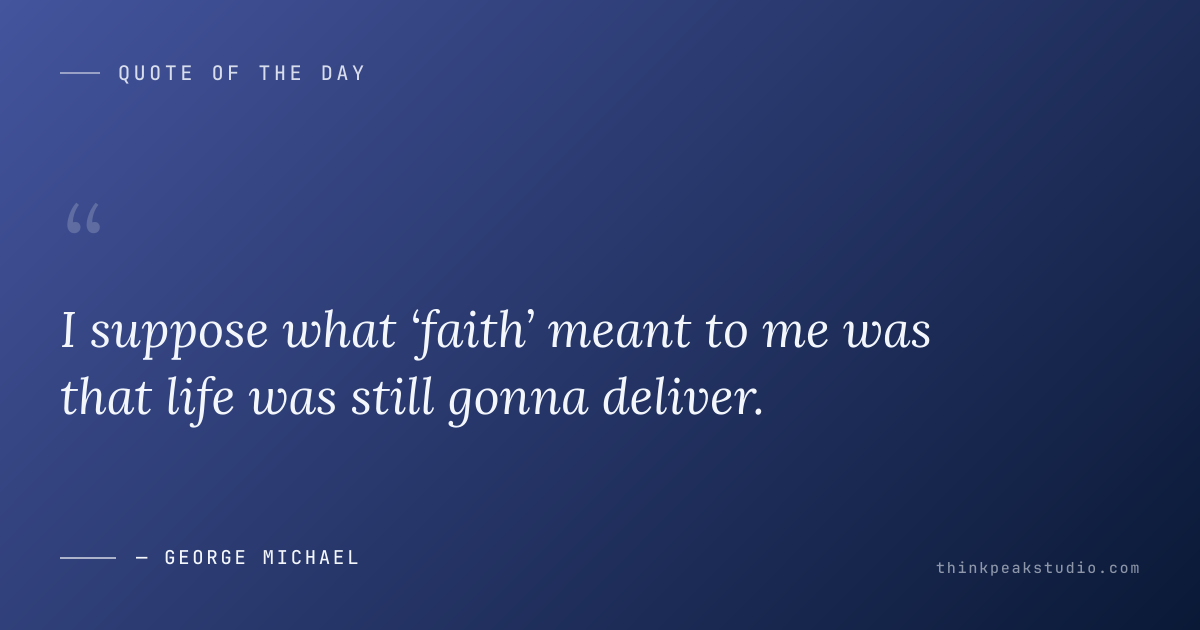
“I suppose what ‘faith’ meant to me was that life was still gonna deliver.”
What this quote means
Start with the tentativeness. “I suppose” is not how a man states a doctrine; it is how he offers a working definition he is still testing. George Michael had no church to answer to, and he said so plainly. In a 1988 interview he put it this way: “I do not have a religion, but I believe that one can influence one’s life, one’s future, through faith and decency towards others.” That is the frame for this sentence. Faith, for him, was not the certainty of things unseen. It was a wager that the world would keep its side of the bargain — that even now, with everything already won, there was still something ahead worth expecting.
Then listen to the tense. Not “life has delivered,” which looks back over the evidence, and not “life will deliver everything,” which is the fantasy that makes people resent reality. He says life was still gonna deliver — still, as in despite everything; gonna, as in spoken aloud, unfinished, unpolished. It is the grammar of a person facing forward. He is not claiming that the best has already happened or that it will be painless. He is claiming that the story is not over, and that waiting for what comes next is not naive but reasonable. Faith, in this sentence, is simply the decision to keep expecting something from the future.
The line gains its weight from the year it was said. In 1988 Michael was 24, midway through the Faith Tour, selling millions and lonely enough, by his own account, that he spent almost the entire year in sunglasses because he could not make eye contact with strangers. He had reached the summit and discovered it was cold, and this sentence is what he had left to hold: not a guarantee of happiness, just life was still gonna deliver. It turned out to be the most useful thing he ever said about himself. Five years later his partner, Anselmo Feleppa, died of an AIDS-related illness, and Michael spent eighteen months unable to write. The sentence survived even that. “Once you’ve seen the worst of things you can then see the best of things,” he told The Big Issue afterwards. Faith was not the denial of the worst. It was the refusal to let the worst have the last word.
That is why the line is portable. Most of us are not handed a number-one album at 24, but all of us are handed a moment when the future looks closed — a diagnosis, a bereavement, a career that has quietly stopped moving. The instruction here is small enough to follow: do not demand that life prove itself today. Keep a little room in the account for what has not arrived yet. Say it as he said it, softly and without ceremony, and let the believing be in the waiting.
About George Michael
George Michael was born Georgios Kyriacos Panayiotou in East Finchley, north London, on 25 June 1963, the son of a Greek Cypriot restaurateur and an English dancer. He met Andrew Ridgeley at Bushey Meads School in Hertfordshire, and the two formed Wham! in 1981. Their second album, Make It Big (1984), topped the Billboard 200 and produced three US number-one singles — “Wake Me Up Before You Go-Go,” “Careless Whisper,” and “Everything She Wants.” “Careless Whisper,” released as his first solo single in the UK, reached number one in roughly 25 countries. In 1984 he sang on Band Aid’s “Do They Know It’s Christmas?”; in 1985 he performed at Live Aid, and Wham! became the first Western pop act to tour China. The duo split in 1986, after a sell-out farewell at Wembley Stadium.
His solo debut arrived with little in the way of hesitation. “I Knew You Were Waiting (For Me),” his 1987 duet with Aretha Franklin, went to number one in both the UK and the US and won the Grammy for Best R&B Performance by a Duo or Group with Vocal. Faith, released on 30 October 1987, spent twelve weeks at number one on the Billboard 200, produced four US number-one singles, has sold more than 25 million copies worldwide, and won the Grammy for Album of the Year in 1989. The Faith Tour that followed ran for nine months and 109 shows; two nights at the Palais Omnisports de Paris-Bercy on 30 and 31 May 1988 were captured on 35mm film by fourteen cameras and then lost for nearly four decades. In September 1989 he received MTV’s Video Vanguard Award.
The second act of his life was quieter and harder. Listen Without Prejudice Vol. 1 (1990) traded the pop-machine for songs about faith, war, and grief, and he stepped back from the promotional circus that had exhausted him. He met the Brazilian designer Anselmo Feleppa in Rio de Janeiro in 1991; Feleppa died in March 1993 of an AIDS-related brain haemorrhage, and Michael later said he could not write for eighteen months. The song that finally came, “Jesus to a Child” (1996), was a tribute to him, and the album it opened, Older, was dedicated to his memory. Michael came out publicly in 1998 and spent the rest of his life as an LGBTQ rights campaigner and a fundraiser for HIV and AIDS charities. The Radio Academy named him the most played artist on British radio for the two decades from 1984 to 2004.
He nearly died of pneumonia in 2011 and gave his final concert at London’s Earls Court in 2012. He was found dead at his home in Goring-on-Thames, Oxfordshire, on Christmas Day 2016, aged 53; a coroner later confirmed a natural cause of death, dilated cardiomyopathy with myocarditis and fatty liver. He had sold more than 100 million records and won two Grammy Awards from eight nominations, and in 2023 he was inducted into the Rock and Roll Hall of Fame. A decade after his death, the archive has caught up with him: an 18-track live album, George Michael: The Faith Tour, arrives on 6 November 2026, and the restored concert film reaches cinemas on 11 December.
Create your own quote graphic with this quote
This is a line to set quietly. A deep indigo or midnight gradient, a clean italic serif, and a great deal of space let it read the way it was spoken — as a thought offered, not a slogan delivered. If you want to make a quote card from this sentence, or from anything else you have been carrying around, Quotes Creator gives you the fonts, gradients, backgrounds and export sizes to do it in minutes, ready for Instagram, Stories, Pinterest and everywhere else.
Editor’s note
George Michael is one of the most-read people on Wikipedia this week. His page jumped past 110,000 views on 28 September, the day after an all-star tribute to him at the MTV Video Music Awards, where Sombr, RAYE, Teddy Swims and a surprise Adam Lambert performed a medley of his songs. The tribute was tied to two events still ahead: the live album George Michael: The Faith Tour, out on 6 November, and the restored concert film of the same name, in cinemas on 11 December, assembled from 1988 footage that had been considered lost for nearly forty years. It also comes as his 1987 album Faith approaches its fortieth anniversary. We are featuring this quote because it is the clearest definition of faith he ever gave, and because it asks nothing supernatural of the reader. He said it at 24, at the top of the world and already lonely, and it stayed true through the losses that followed — the death of the partner he wrote “Jesus to a Child” for, the long silences, the illnesses. Faith, for him, was never the absence of doubt. It was the decision to keep expecting something from a future he could not see. Before your next closed-looking morning, borrow his wager: life might still deliver.
— ThinkPeak Studio Editorial Team
Tips for designing this quote
- ✓ Use a deep indigo or midnight-blue gradient — the quote is about the future, and night is when we decide whether tomorrow is worth expecting
- ✓ Set the line in a clean italic serif and leave the type fairly large; the sentence is short enough to fill the frame without crowding it
- ✓ Break the line so that “life was still gonna deliver” lands as a single unit — the quiet promise is the whole point
- ✓ Keep the attribution small and understated in the lower corner, and resist adding a second line of decoration
- ✓ Export in square format for the Instagram feed and portrait for Stories or Pinterest
Create your own quote graphic with this quote
Turn this line into a shareable graphic in seconds — free, no signup needed. For video quotes and 100+ templates, try the Android app.
Advertisement
Enjoyed this article? Get more like it in your inbox.


