Quote of the Day: Giancarlo Esposito on Letting Go and Listening
Giancarlo Esposito, the award-winning actor who brought Gus Fring to unforgettable life, shares a profound insight about releasing expectations and opening yourself to new possibilities.
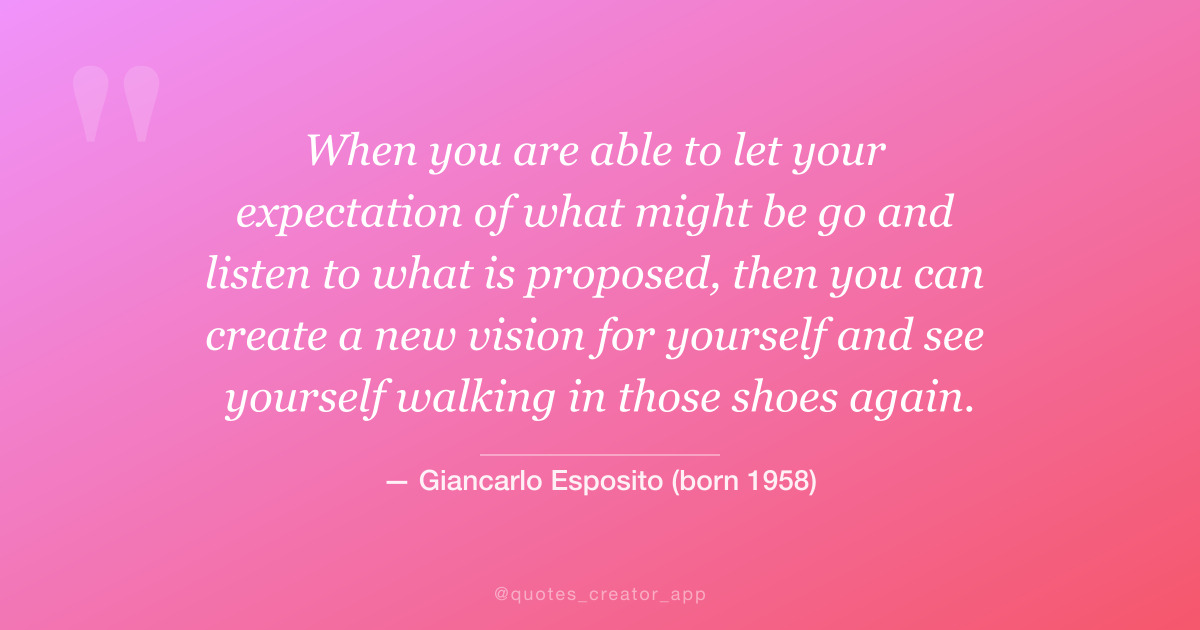
“When you are able to let your expectation of what might be go and listen to what is proposed, then you can create a new vision for yourself and see yourself walking in those shoes again.”
Editor’s note
In a world that rewards certainty, Esposito’s invitation to release expectation is quietly radical. Whether you are navigating a career shift, a creative block, or a relationship challenge, the instinct to control outcomes often backfires. This quote reminds us that the most rewarding paths are sometimes the ones we never planned for. If this resonates, try this today: pick one area where you have a fixed outcome in mind, and simply ask yourself what you might see if you let it go.
— ThinkPeak Studio Editorial Team
What this quote means
This quote from Giancarlo Esposito speaks to the power of releasing our preconceived notions about how things should be. On the surface, he is telling us that when we let go of our rigid expectations and instead truly listen to what life presents, we open ourselves to new possibilities. The act of “listening” here goes beyond hearing words — it means being receptive to circumstances, feedback, and even the quiet voice within ourselves. Esposito is describing a mindset of openness that is essential for growth, whether in creative work, relationships, or personal development.
The deeper insight is about the relationship between expectation and vision. Esposito suggests that our fixed expectations often blind us to the opportunities right in front of us. By releasing the need for things to look a certain way, we create space for a “new vision” to emerge. This is not about giving up on goals, but about being flexible in how we reach them. The phrase “see yourself walking in those shoes again” suggests a process of reimagining — you have the ability to adapt, grow, and step into unfamiliar roles with confidence. It is a reminder that identity is not fixed, and that we can always reinvent ourselves.
Esposito shared these thoughts during an interview about his approach to acting, specifically his preparation for playing Gus Fring across twelve years of Breaking Bad and Better Call Saul. As an actor who has portrayed some of television’s most memorable and complex villains, he has had to constantly reinvent himself and find new layers in characters over long stretches of time. Rather than arriving on set with rigid ideas about who Gus was, Esposito practiced deep listening — to the script, to his fellow actors, and to his own intuition. This philosophy of openness became the foundation of one of the most acclaimed performances in modern television history.
In everyday life, this quote invites us to examine where we might be holding too tightly to expectations. Whether it is in our careers, relationships, or personal goals, the habit of imagining exactly how things “should” unfold can prevent us from seeing better paths. Esposito’s words encourage us to shift from a fixed mindset to a growth mindset — to listen before we decide, and to trust that new visions can emerge when we release our grip on the old ones. The next time you feel stuck, ask yourself: what expectation am I holding that might be blocking my view?
About Giancarlo Esposito
Giancarlo Giuseppe Alessandro Esposito was born on April 26, 1958, in Copenhagen, Denmark, to an Italian father, Giovanni Esposito, and an African-American mother, Elizabeth Foster. The family moved to the United States when he was a young child, settling in New York City. Esposito discovered his passion for performing early, and by the age of twelve, he was appearing in stage productions in Harlem. He attended Elizabeth Seton College and later studied at the Actors’ Studio under the legendary Lee Strasberg, where he developed the craft that would sustain a career spanning five decades.
Esposito is best known for his portrayal of Gustavo “Gus” Fring, the calm, calculating drug kingpin in AMC’s Breaking Bad (2009–2011), a role he reprised in the prequel Better Call Saul (2017–2022). The performance earned him two Critics’ Choice Television Awards for Best Supporting Actor in a Drama Series and multiple Primetime Emmy nominations. Beyond Breaking Bad, Esposito played Moff Gideon in Disney+‘s The Mandalorian, a role that made him a fan favorite in the Star Wars universe, and Stan Edgar in Amazon’s The Boys. His film credits include Spike Lee’s Do the Right Thing and Malcolm X, The Usual Suspects, and Okja. In 2025, news broke that Esposito would star in a major television adaptation of The Count of Monte Cristo, further cementing his reputation as one of the most versatile actors of his generation.
Beyond his on-screen work, Esposito is also an accomplished director. He has directed episodes of Better Call Saul, The Mandalorian, and The Boys, and has spoken openly about his desire to helm projects that “uplift and change the way we think about the world we live in.” He is also a dedicated advocate for mindfulness and meditation, practices he credits with helping him navigate the demands of his career and stay creatively grounded. A father of six, Esposito continues to live and work primarily in New York, approaching each new role with the same philosophy he shared in the quote above — by letting expectation go and listening deeply to what is proposed.
Create your own quote graphic with this quote
This is the kind of quote that resonates most when it is presented visually. A clean typographic layout, a fitting color palette, and readable font sizing can transform these words into a graphic that people save and share. If you want to turn this quote into an Instagram post, WhatsApp status, Pinterest pin, or reel cover, Quotes Creator gives you all the tools to do it in minutes — custom fonts, gradients, backgrounds, and export sizes ready for every major platform.
Tips for designing this quote
- ✓ Use a serif font (Georgia, Playfair Display) to honour the reflective tone of the quote
- ✓ Keep the quote on no more than three lines — shorter display text reads better on mobile
- ✓ Pair the quote with a fuchsia-to-coral gradient that matches its emotional tone: warm fuchsia tones for creativity and openness
- ✓ Add the author name in a smaller, lighter weight below the quote
- ✓ Export in square format for Instagram feed and portrait for Stories or Pinterest
Create your own quote graphic with this quote
Turn this line into a shareable graphic in seconds — free, no signup needed. For video quotes and 100+ templates, try the Android app.
Advertisement
Enjoyed this article? Get more like it in your inbox.