Quote of the Day: Hannah Fry on the Secret to Being Happy
She is the mathematician who became Cambridge’s first Professor of the Public Understanding of Mathematics, the broadcaster who has spent a decade making numbers feel human, and — as of this week — one of the most-searched names on the internet after walking into a Scottish castle for the second series of The Celebrity Traitors. But the line new readers keep coming back to is the one she arrived at the hard way, after cancer at 36 taught her to stop waiting for the good days and start naming them.
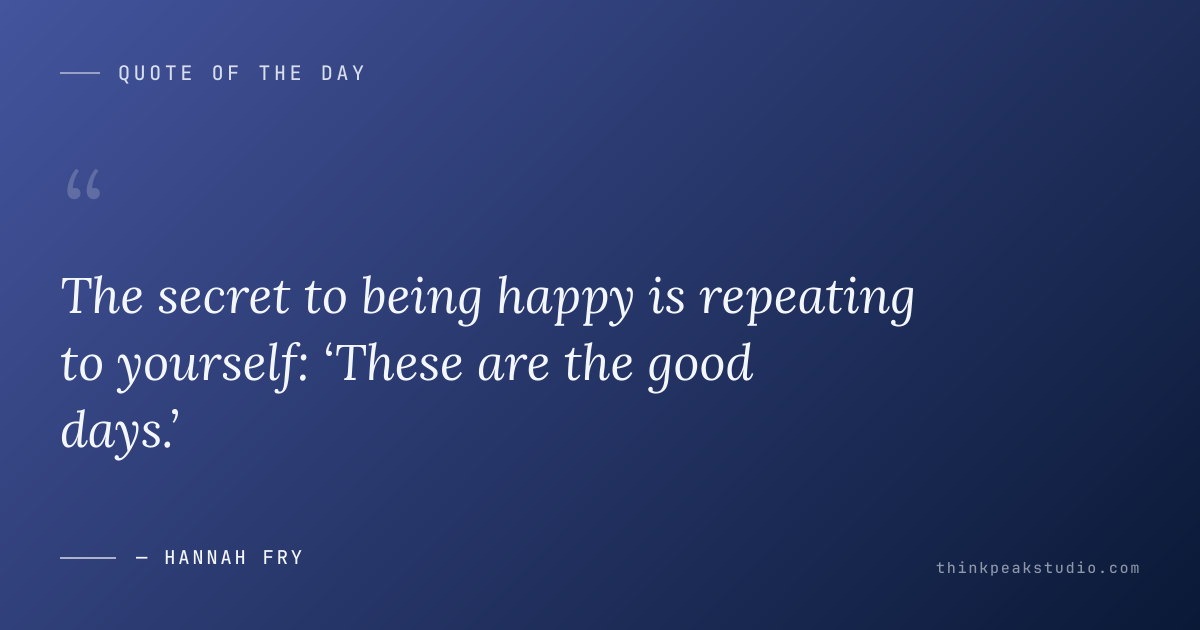
“The secret to being happy is repeating to yourself: ‘These are the good days.’”
What this quote means
Most advice about happiness is set in the future tense. Be grateful for what you will have, work toward the life you want, and happiness will arrive when the conditions are right. Hannah Fry’s sentence does the opposite. It plants happiness squarely in the present, and it makes it a practice rather than a prize. The secret, she says, is not to wait for the good days but to say that these are the good days — to narrate your own life in the present tense, out loud if necessary, until the ordinary moment you are standing in registers as the thing you would one day be nostalgic for.
The word that gives the line its power is “repeating.” This is not a one-off realisation; it is a discipline. Fry frames happiness as something closer to exercise than to luck — a sentence you return to, again and again, until it changes the way a day feels. The instruction is almost childishly simple, which is exactly what makes it usable. When you are in the middle of a hard season, the mind has a natural talent for rehearsing what is missing. This quote interrupts that reflex with a smaller, stranger, harder claim: that right now, with all its mess, is a version of the life you once wanted. Naming it is the whole technique. Attention becomes gratitude, and gratitude becomes, if not happiness exactly, then its most reliable raw material.
What makes the line land so much harder than the average inspirational maxim is where Fry got it. She was diagnosed with cervical cancer in 2020, at 36, and underwent a radical hysterectomy; the treatment left her with lymphoedema, a chronic swelling condition, and the certainty that she would not have the third child she had always wanted. It was during that period — when her children were small, when she was too ill to work — that she found the sentence. “When I look back at when I was sick, I think: ‘My babies were small, I didn’t have to work, I got to sit with them on the sofa all day,’” she told The Guardian. “Even in the darkest moments, there are things you can feel good about.” That is the crucial context: she is not prescribing positivity to people whose lives are easy. She is describing what she actually did inside one of the hardest years of her life, and finding that it worked.
The quote also explains why Fry is such an unusual kind of public intellectual. A mathematician by training, she is professionally suspicious of tidy answers — her forthcoming book is titled No One Knows What They’re Doing — yet this is a claim she makes without hedging. Happiness, in her telling, is not a theorem to be proved once, but an experiment you run every day. And the direction of the experiment matters. She has said that as she has aged she has become happier and more optimistic, not despite the bad things but because of what she learned watching herself survive them: “No matter how bad things get, we adapt.” “These are the good days” is the daily version of that larger belief. It is a way of refusing to let the present be demoted to a waiting room for some better future — and of keeping, in plain sight, the evidence that you have been happy all along.
About Hannah Fry
Hannah Mary Fry was born on 21 February 1984 in Harlow, Essex, the middle of three sisters, and grew up in Hertfordshire. She has described a childhood that was academically serious and socially narrow: while her classmates were out having a wild time in their twenties, she was at home reading mathematics textbooks, and she has called herself a lifelong “goody two shoes” who never got a detention. She studied at University College London, earning a degree and then a doctorate, which she completed in 2011 under the supervisor Frank T. Smith with a thesis on fluid dynamics and droplet deformation. She stayed at UCL as a lecturer, rising to professor of the mathematics of cities, a role in which she worked with physicists, computer scientists, architects and geographers to study patterns in human behaviour — the mathematics of transport, shopping, crime and cities.
What changed her from a researcher into one of Britain’s best-known scientists was a gift for translation. In 2015 she published The Mathematics of Love, which used the “37% rule” of optimal stopping to think about dating, and followed it with Hello World (2018), a clear-eyed look at the algorithms that increasingly make decisions for us. Alongside the books came radio and television: The Curious Cases of Rutherford & Fry on BBC Radio 4, documentaries such as The Joy of Data and The Secret Genius of Modern Life on BBC Two, and, in 2019, the Royal Institution Christmas Lectures — delivered on the hidden numbers, rules and patterns that govern daily life, making her only the fourth mathematician ever to give them. In 2024 the Royal Society gave her the David Attenborough Award for her science communication, citing her as “the foremost populariser of maths in the country”; in 2026 she added the Leelavati Prize, awarded by the International Mathematical Union for outstanding contributions to public awareness of mathematics. Her rise has been, in the most literal sense, measurable.
In January 2025 she became the University of Cambridge’s first Professor of the Public Understanding of Mathematics, following in the tradition of communicators such as Stephen Hawking and David Spiegelhalter. The title says as much about her beliefs as her achievements. Fry has argued that communication “is not an optional extra” — that if you build something which affects the public, engaging those people is a moral duty, not a marketing afterthought. That conviction runs through everything she makes, from the podcast The Rest Is Science, which she began in November 2025 with Michael Stevens, to her YouTube channel and her role as chief number-cruncher for Channel 4’s 2024 general-election coverage. She is, by temperament, less interested in being the cleverest person in the room than in making the room feel cleverer.
The other half of her public story is what she has called being “a celebrity… only if you like niche maths videos on the internet” — and the very un-niche health crisis that reshaped her. In summer 2020, at 36, she was diagnosed with cervical cancer and underwent a radical hysterectomy; she made a BBC Two Horizon documentary, Making Sense of Cancer with Hannah Fry, about the treatment, the statistics and the long-term effects, including the lymphoedema she still manages. She has been candid about the cost — the regret of not having a third child, the fear she had to sit with, the fact that living without cancer has not meant living without uncertainty — and equally candid about the perspective it gave her. She co-parents two daughters with her ex-husband and now lives in Greenwich, south London.
Which brings us to the castle. On 1 October 2026, the second series of The Celebrity Traitors premiered on BBC One — twenty-one celebrities, hosted by Claudia Winkleman, competing to win up to £100,000 for their chosen charities. Fry is among them, listed by the BBC simply as “British mathematician, author and broadcaster.” The effect on her Wikipedia readership was immediate: from a baseline of roughly three to four thousand views a day, her page jumped to 36,563 on 1 October and 51,854 the next day, according to the Wikimedia Pageviews API. A game show made her briefly one of the most-read people on the English internet. But the reason her name rewards a deeper look is the thing she has been doing all along: taking something most of us find abstract or intimidating — mathematics, algorithms, mortality, probability — and showing, in plain language, how to live well alongside it. The quote about the good days is the shortest version of that project, and the most useful.
Create your own quote graphic with this quote
Some quotes shout; this one settles. “These are the good days” is a sentence that belongs somewhere you will see it on an ordinary morning — calm, uncluttered, and set in a quiet serif that lets the words do the work. If you want to turn this quote, or any quote, into a design people keep and share, Quotes Creator gives you the fonts, gradients, backgrounds and export sizes to do it in minutes, ready for Instagram, Stories, Pinterest and everywhere else.
Editor’s note
Hannah Fry was one of the most-read people on English Wikipedia this week. When the second series of The Celebrity Traitors began on BBC One on 1 October 2026, her page jumped from a typical three to four thousand views a day to 36,563 that day and 51,854 the next, according to the Wikimedia Pageviews API. We are featuring this quote because it is the opposite of what a mathematician is supposed to say. Fry does not offer a formula for happiness; she offers a rehearsal, a sentence you repeat until the present tense finally feels like enough. She arrived at it the hard way — cancer at 36, a radical hysterectomy, a chronic condition she lives with still — and says it anyway. Before your next ordinary day, try saying it to yourself, out loud: these are the good days. It sounds like a small thing. It is not.
— ThinkPeak Studio Editorial Team
Tips for designing this quote
- ✓ Keep the composition calm — a soft slate-to-indigo gradient or a plain warm background, not a busy texture
- ✓ Set the sentence in italic serif so it reads like a thought you are borrowing, not a slogan you are shouting
- ✓ Give the phrase “These are the good days” its own line so the turn of the quote lands with full weight
- ✓ Leave generous margin around the text; the quietness of the layout is part of the message
- ✓ Export square for the feed and portrait for Stories or Pinterest
Create your own quote graphic with this quote
Turn this line into a shareable graphic in seconds — free, no signup needed. For video quotes and 100+ templates, try the Android app.
Advertisement
Enjoyed this article? Get more like it in your inbox.


