Quote of the Day: Homer on Finding Joy in Struggle
The ancient Greek poet who shaped Western literature reminds us that even our hardest trials can become treasured memories.
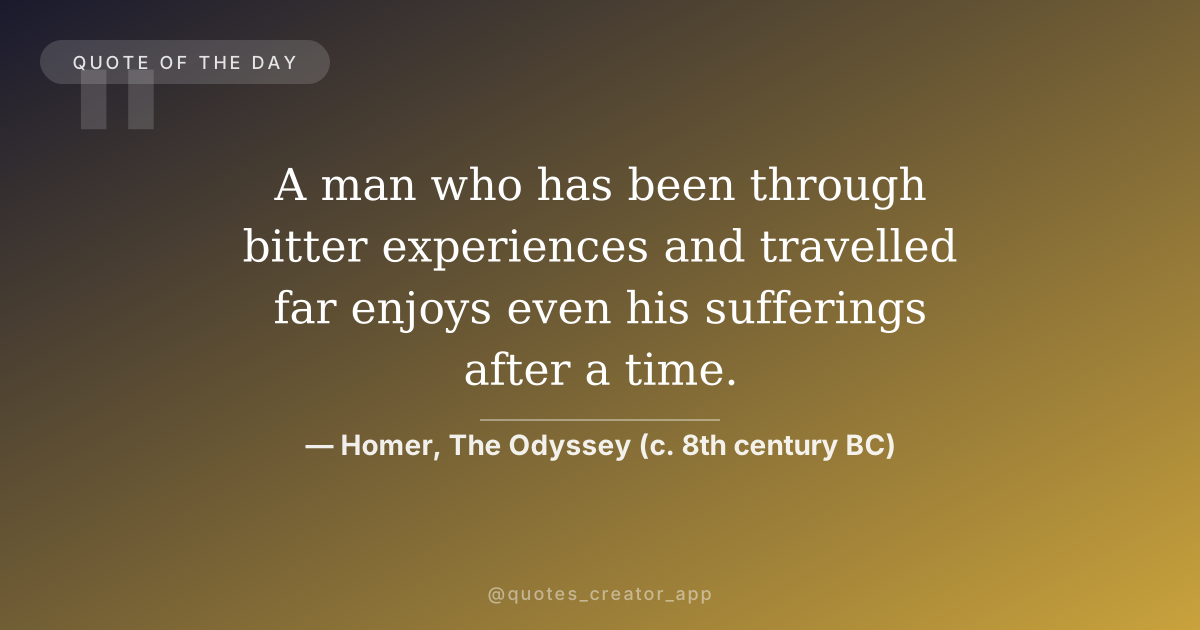
“A man who has been through bitter experiences and travelled far enjoys even his sufferings after a time.”
What this quote means
On its surface, Homer offers a strange and almost paradoxical idea: that suffering, once endured, can become a source of enjoyment. It seems counterintuitive. No one welcomes pain in the moment. Yet anyone who has lived long enough knows the truth buried in this line. The hardships we survive become the stories we treasure, the proof of our resilience, the texture of a life fully lived.
Homer places these words in the mouth of Eumaeus, the loyal swineherd of Odysseus, who speaks them while hosting a stranger who is secretly his king in disguise. Eumaeus himself was once a prince, kidnapped by Phoenician traders and sold into slavery. His “bitter experiences” are not abstract philosophy—they are the scars of a stolen life. And yet here he is, a slave, offering hospitality and finding warmth in the memory of his journey. The quote suggests that meaning is not found in the absence of suffering, but in what we make of it after the fact.
This is a deeply Stoic sentiment centuries before Stoicism was formalized. It anticipates the idea that we do not control what happens to us, but we do control our relationship to it. Time has the power to transform anguish into wisdom. The man who has travelled far—literally and figuratively—returns home with a perspective no one who stayed behind can claim. The suffering becomes a kind of wealth.
Today, this ancient insight feels urgently relevant. In an era of curated highlight reels and filtered photos, Homer reminds us that the uncomfortable, unglamorous chapters of our lives are not to be hidden but honoured. They are not wasted years. They are the very material from which a meaningful life is built.
About Homer
Homer is the legendary ancient Greek poet credited with composing the Iliad and the Odyssey, the twin epics that stand as the foundation stones of Western literature. He is believed to have lived around the 8th century BC, most likely in Ionia, the central coastal region of what is now Turkey. Nothing certain is known about his life—ancient traditions describe him as a blind bard who wandered from town to town reciting his verses—and scholars continue to debate whether Homer was a single person or a tradition of oral poets whose works were compiled and written down centuries later.
The Iliad recounts a few weeks in the final year of the Trojan War, centred on the rage of Achilles. The Odyssey follows the ten-year homeward journey of Odysseus, a king struggling against monsters, gods, and his own pride to return to his wife and son. Together, these poems shaped ancient Greek education and identity. Plato called Homer “the poet who has educated Greece,” and for more than two millennia, his works have been translated, adapted, and studied in virtually every language.
Homer’s enduring power lies in his psychological realism. His heroes are not perfect paragons—they are proud, flawed, fearful, and brave in equal measure. They weep, they doubt, they make terrible decisions. And in their struggles, readers across three thousand years have recognized their own. When Odysseus steels himself before a new trial or Achilles rages against his fate, they feel as real and immediate as any character in a modern novel. That is why Homer is not merely read but lived. His words, as this quote demonstrates, remain startlingly relevant to anyone navigating the hardships of being human.
Create your own quote graphic with this quote
This is the kind of quote that resonates most when it is presented visually. A clean typographic layout, a fitting color palette, and readable font sizing can transform these words into a graphic that people save and share. Use our free online quote maker to turn this exact quote into a shareable image in seconds — no signup, no app install. For advanced features like video quotes, 100+ templates, and direct social sharing, try the Quotes Creator Android app.
Editor’s note
On this July day in 2026, as the long-awaited film adaptation of The Odyssey draws audiences worldwide, Homer is having a cultural moment. His epic of wandering and homecoming speaks to something deep in us—the hope that after every trial, there is a return. Whether you are navigating a personal loss, a career setback, or simply the exhaustion of daily life, let these words remind you that the suffering will not last forever. And one day, you may look back and find it was worth every step.
— ThinkPeak Studio Editorial Team
Tips for designing this quote
- ✓ Use a classic serif font (Georgia, Playfair Display) to match the ancient, timeless feel of the quote
- ✓ Keep the quote on three or four lines — shorter display text reads better on mobile
- ✓ Pair the quote with a warm gold and navy palette that evokes ancient Greek pottery and architecture
- ✓ Add the author name and work title below the quote for credibility and context
- ✓ Export in square format for Instagram feed and portrait for Stories or Pinterest
Create your own quote graphic with this quote
Turn this line into a shareable graphic in seconds — free, no signup needed. For video quotes and 100+ templates, try the Android app.
Advertisement
Enjoyed this article? Get more like it in your inbox.