Quote of the Day: Jason Arday on What Silence Teaches
The Cambridge sociologist who couldn’t speak until he was 11 spent twelve years watching the world without words — and turned that silence into the sharpest tool he had. Today his memoir reaches American readers; this is the insight at the heart of it.
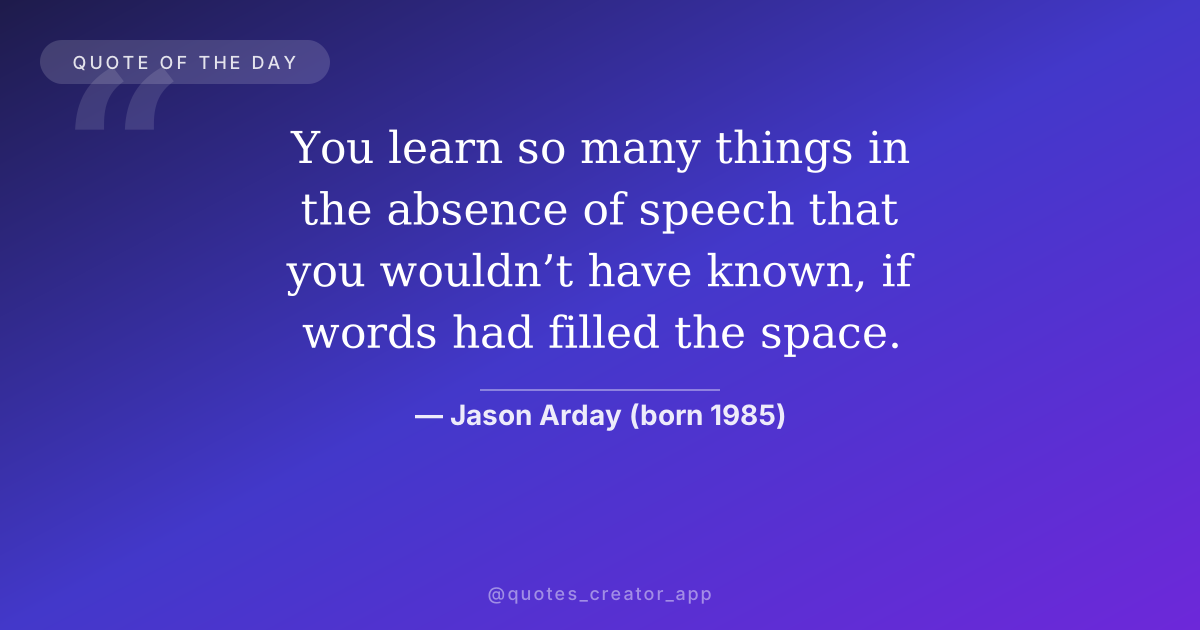
“You learn so many things in the absence of speech that you wouldn’t have known, if words had filled the space.”
What this quote means
Most of us treat language the way we treat oxygen — as something so constant we never notice it is there. Speech narrates our mornings, fills the silences in lifts, softens the awkward gaps in conversations. So it takes someone who lived without it to point out what we are missing, and Jason Arday is exactly that person. He did not speak until he was eleven years old. The sentence he offers here is not a metaphor about mindfulness or a trendy case for being quiet now and then; it is a report from twelve years of lived experience. “You learn so many things in the absence of speech that you wouldn’t have known, if words had filled the space.”
The claim is almost counter-intuitive, because we think of words as the way we gather information. We ask questions, we read reports, we listen to lectures. Arday’s point is that speech also fills the space where observation happens. When you are composing your next sentence, planning your comeback, or simply narrating the moment aloud, you are not fully watching. He had none of that. For twelve years he watched faces, studied gestures, and learned what a look could carry and what a touch could mean — the entire grammar of human connection that words often flatten. “It was a privilege, it was beautiful, to observe human interaction in the stillness of your own mind without words,” he later said. What sounds like a deficit became, in his telling, a rare and rigorous education.
There is a quieter lesson underneath, and it applies to all of us whether or not we have ever been without speech: attention is a scarce resource, and talking is how we spend it. Every time we reach for words, we surrender a little observation. The most perceptive people in any room are often not the loudest ones; they are the ones listening closely enough that they do not feel the need to fill the space. Arday’s sentence reframes silence not as emptiness but as capacity — a space cleared for the things that only reveal themselves when nothing is being said. It is an argument for building pauses into our lives: the pause before answering, the pause before judging, the pause before speaking at all.
And the line lands hardest when you remember what the silence produced. Arday left it carrying an ability to read people that he calls the only thing he is really good at — and he went on to earn a PhD, hold professorships, and in 2023 become the youngest Black professor in Cambridge’s history, a man who could not read or write until he was eighteen. The point is not that suffering is good or that adversity is a blessing. It is that the space words leave behind is not empty. What fills it is up to you — and if you can learn to be present in that space, you may end up seeing things, and people, that everyone else talked right past.
About Jason Arday
Jason Atta Kwei Arday was born on May 9, 1985, in South London, the third of four brothers of Ghanaian parents — his mother a mental health nurse, his father a chef. He grew up in Clapham, and at age three he was diagnosed with autism, global developmental delay, deafness and dyscalculia. He was non-verbal until the age of eleven, could not read or write until he was eighteen, and was diagnosed with dyslexia in his first year of university. He has described learning to read as a slow accumulation of incremental steps — a sentence, then a paragraph, then different tenses — and credits a tutor at Merton College in South London for instilling his sense of self-belief, alongside voice-recognition software that helped him catch grammatical errors.
He earned a BA and MA from St Mary’s University, Twickenham, a PGCE at the Institute of Education, and a PhD in education from Liverpool John Moores University in 2015. Before academia he was a teacher — “the best job I ever had,” he has said — and his life story includes running marathons for charity, including a run of 30 marathons in 35 days in 2010 to raise money for Shelter and Shooting Star Children’s Hospices, and carrying the Olympic torch in 2012. He worked at Leeds Beckett University, the University of Roehampton, Durham University and the University of Glasgow before his appointment in March 2023 as Professor of Sociology of Education at the University of Cambridge — making him the youngest Black professor ever appointed in the university’s history.
His research focused on race, inequality and education, drawing on critical race theory, and his books include Dismantling Race in Higher Education (2018, co-edited with Heidi Safia Mirza), Cool Britannia and Multi-Ethnic Britain (2020) and We See Things They’ll Never See: Love, Hope and Neurodiversity (2025, co-written with Chantelle Jessica Lewis). He was awarded honorary doctorates by several universities, named among the UK’s most influential disabled people, and served as a trustee of the Runnymede Trust and the British Sociological Association. His memoir, Great and Unfortunate Things, is published in the United States on August 11, 2026, and in the United Kingdom on August 27 — the same week his Wikipedia page surged to more than 66,000 daily views as readers raced to understand the man behind the headlines.
Create your own quote graphic with this quote
This is the kind of quote that resonates most when it is presented visually. A clean typographic layout, a fitting color palette, and readable font sizing can transform these words into a graphic that people save and share. If you want to turn this quote into an Instagram post, WhatsApp status, Pinterest pin, or reel cover, Quotes Creator gives you all the tools to do it in minutes — custom fonts, gradients, backgrounds, and export sizes ready for every major platform.
Editor’s note
Jason Arday is one of the most-read people on the internet this week — his Wikipedia page drew more than 66,000 views on August 9, 2026, on the eve of his memoir’s American release. That traffic comes at a complicated moment: in recent weeks he has faced detailed media allegations about plagiarism in his academic work and about claims made in his public biography, and on August 5 he resigned from his Cambridge professorship, saying his departure should not be mistaken for an acceptance of the narratives around him. We are featuring this quote not as a verdict on those allegations, which remain the subject of investigation and dispute, but because the words themselves — about what silence teaches and what observation reveals — offer a genuine and moving insight into the lived experience of neurodiversity. Before you share this quote, sit with the silence for a moment, and ask yourself what you might be missing by always filling the space.
— ThinkPeak Studio Editorial Team
Tips for designing this quote
- ✓ Use deep indigo and violet tones to echo the quiet, contemplative spirit of the quote
- ✓ Let the quote breathe as four short centered lines — the pause between lines mirrors the silence it describes
- ✓ Keep the serif italic typography elegant and unhurried, giving each word room to land
- ✓ Add a subtle gradient background rather than a flat color for depth and dimension
- ✓ Export in square format for Instagram feed and portrait for Stories or Pinterest
Create your own quote graphic with this quote
Turn this line into a shareable graphic in seconds — free, no signup needed. For video quotes and 100+ templates, try the Android app.
Advertisement
Enjoyed this article? Get more like it in your inbox.