Quote of the Day: Jay Shetty on the Difference Between Reacting and Being Free
The former monk turned media mogul built a career asking millions of people to slow down, and his most quoted line is a definition of freedom that most of us have backwards. As his podcast On Purpose completes its first summer on Netflix — after the reported $100 million deal with Netflix and Spotify — his Wikipedia page has been drawing its biggest readership of the year. His books keep answering the same question: what would you do with your life if you stopped performing it for other people?
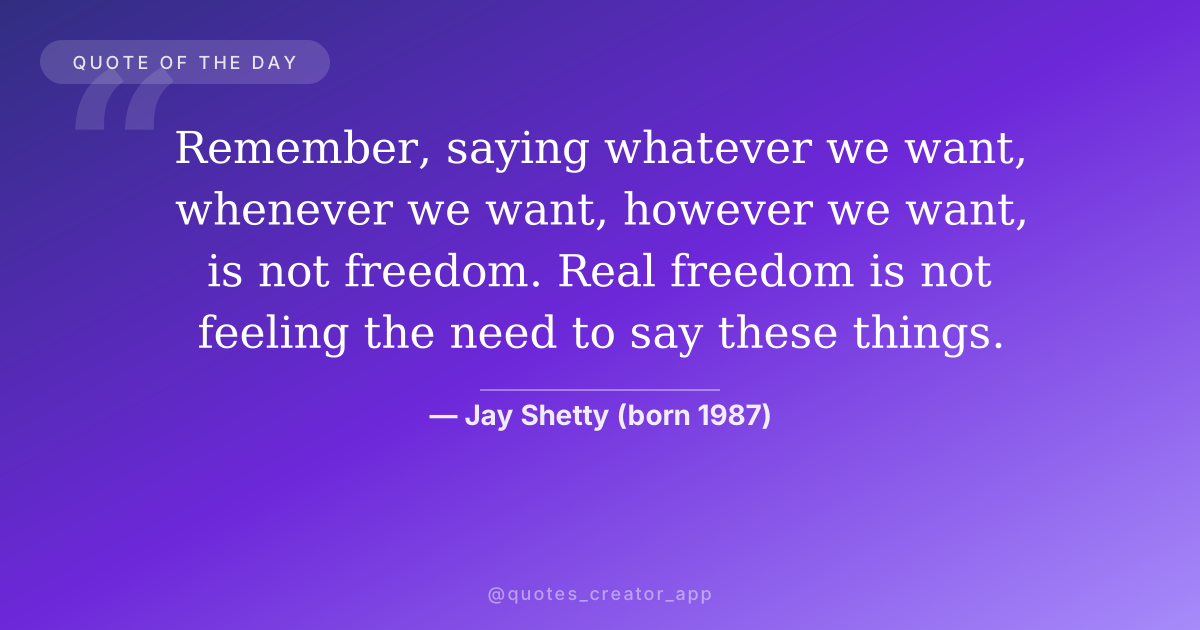
“Remember, saying whatever we want, whenever we want, however we want, is not freedom. Real freedom is not feeling the need to say these things.”
What this quote means
The line arrives midway through Think Like a Monk, in the middle of a chapter about self-mastery, and it reads at first like a paradox. We live in a culture that tells us freedom is the ability to say whatever we want, whenever we want, however we want — that the person with the loudest opinions, the most unfiltered feed, and the least hesitation is the most liberated one. Shetty, who spent three years living as a monk in India before building one of the world’s biggest podcast empires, turns that assumption on its head. Saying anything at any moment, he argues, is not freedom at all. It is the opposite: it is being a slave to impulse, to mood, to the last person who provoked you. Real freedom is not feeling the need to say these things in the first place.
To understand the quote, it helps to understand the mind it came from. A monk’s training is largely a training in response — in the pause between stimulus and reaction, in noticing the emotion before it becomes a sentence. Shetty spent years practicing precisely the skill the quote describes: watching the urge to speak, to correct, to defend, to prove a point, and letting it pass without obeying it. What he calls freedom is not the absence of constraints but the absence of compulsion — the quiet power of choosing your words because you want to say them, not because you have to. That is a very different thing from the unfiltered version of authenticity that social media rewards, and it is exactly the version he thinks we have confused ourselves about.
The deeper point is that the people who seem most free are often the least so. The person who must answer every insult, fire back at every criticism, and correct every misunderstanding is, in a very real sense, at the mercy of everyone around them — their peace depends on what other people do. The truly free person does not need the last word, because they were never fighting to begin with. Shetty often talks about this in terms of the difference between being “driven” and being “called”: the driven person is pushed around by circumstances, while the called person moves from a center of their own. The quote is an invitation to ask which one you are — and to notice, honestly, how many of your words are responses to other people rather than expressions of yourself.
It is also, quietly, a warning about the cost of constant reaction. Every time we fire back, we give away a little control of our inner state; every argument we join, we let someone else set the terms of our day. Shetty has spent a decade building a media business on the opposite premise — that peace is a practice, not a mood — and his own trajectory is the proof of concept. He does not win arguments by shouting; he built a following of tens of millions by teaching people to think before they speak, to breathe before they answer, and to notice that the compulsion to react is usually the thing that is actually imprisoning them. The quote lands with fresh force this month because the world’s attention on him keeps growing — and the more visible he becomes, the more his core message matters: the people who say everything are rarely the people who are free.
About Jay Shetty
Jay Shetty was born on September 6, 1987, in London, the son of Indian immigrants — a Gujarati mother raised in Yemen and a Tulu father from Mangalore. He grew up in Barnet, North London, attended Queen Elizabeth’s School, and graduated from the Bayes Business School at City, University of London in 2010 with a degree in management science. But the turning point came in business school, when a monk named Gauranga Das spoke to his class about selflessness and minimalist living. Shetty followed him around the UK, spent four summers in India interning and training with the International Society for Krishna Consciousness, and then, from 2010 to 2013, lived the monastic life — an experience that would later become the bedrock of his public teaching.
He came back to the secular world and worked as a digital strategist at Accenture, coaching executives on social media, before realizing his calling. In 2016 he left to become an independent content creator, producing videos about purpose and mental health. His work caught the attention of Arianna Huffington, who hired him to create videos for HuffPost; within two years he had a million YouTube subscribers and twenty million Facebook followers, appearances on The Ellen DeGeneres Show and Red Table Talk, and the unofficial role of spiritual adviser to Will Smith. In 2019 he launched the podcast On Purpose, which was downloaded 64 million times in its first year and became the number one health podcast in the world, with guests ranging from Kobe Bryant and Alicia Keys to President Joe Biden, who sat for an interview with Shetty at the White House in July 2023.
His first book, Think Like a Monk, published in 2020, was an instant New York Times bestseller that taught readers to apply monastic principles — meditation, purpose, gratitude, detachment — to modern life. His second, 8 Rules of Love (2023), also debuted at number one on the bestseller list, reframing love as a skill rather than a feeling. In 2022 he joined the meditation app Calm as its chief purpose officer, and in July 2025 TIME named him to its inaugural TIME100 Creators list. Then came the biggest validation yet: in May 2026, Netflix and Spotify jointly signed Shetty to bring On Purpose to both platforms — the first time the two streaming giants had co-signed a creator — in a deal reported at up to $100 million. The show began streaming on Netflix in July 2026 from a studio elaborate enough, per Architectural Digest, to host Oprah.
His career has not been without scrutiny — a 2024 Guardian investigation questioned claims about his background and his online coaching school — and he has been candid, including in a February 2026 New York Times interview, about the contradictions of preaching monastic calm from a glamorous Los Angeles life. But the attention itself is the measure of his reach: roughly sixty-five million people follow him online, and his Wikipedia page — which drew between about 1,300 and 1,900 views a day through most of August 2026 — spiked to more than 62,000 views on August 17, 2026 as his interview with Hayden Panettiere, recorded months earlier and now among the last she gave, resurfaced in the tributes that followed her death. Shetty’s response to that loss was characteristic of his entire philosophy: “You were the brave one,” he wrote, remembering a woman who chose to tell the truth even when it was painful. It was the sentence of a man who believes that courage is less about speaking than about having something worth saying — and knowing when it is yours to speak.
Create your own quote graphic with this quote
This is the kind of quote that resonates most when it is presented visually. A clean typographic layout, a fitting color palette, and readable font sizing can transform these words into a graphic that people save and share. If you want to turn this quote into an Instagram post, WhatsApp status, Pinterest pin, or reel cover, Quotes Creator gives you all the tools to do it in minutes — custom fonts, gradients, backgrounds, and export sizes ready for every major platform.
Editor’s note
Jay Shetty is one of the most-read people on the internet this week. His Wikipedia page surged from its usual 1,300–1,900 daily views to more than 62,000 on August 17, 2026 — a jump of well over thirty times — as his months-old interview with Hayden Panettiere resurfaced in the wave of tributes that followed her death, on top of the steady audience he has built since On Purpose arrived on Netflix and Spotify in July 2026 under the reported $100 million deal. We are featuring this quote because it captures the deepest argument of his whole public career: that the freedom our culture sells us — the freedom to react, to vent, to say whatever comes to mind — is actually a cage, and that real liberation is the capacity to choose your words. In a week of noise and grief, it is a reminder that strength often looks like restraint, and that the people who can stay quiet long enough to choose are the people who are actually free. The next time you feel the urge to fire back, try asking one question first: am I saying this because I want to, or because I have to? The gap between those two answers is where freedom lives.
— ThinkPeak Studio Editorial Team
Tips for designing this quote
- ✓ Use calm violet and indigo tones to echo the meditative, introspective spirit of the quote
- ✓ Keep the text centered and italic in a serif font for a contemplative, literary feel
- ✓ Let the quote breathe as four short centered lines — the rhythm mirrors a slow realization
- ✓ Add a subtle gradient background rather than a flat color for depth and dimension
- ✓ Export in square format for Instagram feed and portrait for Stories or Pinterest
Create your own quote graphic with this quote
Turn this line into a shareable graphic in seconds — free, no signup needed. For video quotes and 100+ templates, try the Android app.
Advertisement
Enjoyed this article? Get more like it in your inbox.