Quote of the Day: Jeff Bezos on Innovation and Critics
Jeff Bezos, the founder of Amazon and one of the most transformative entrepreneurs of our time, shares a powerful reminder about innovation, criticism, and the courage to do something different.
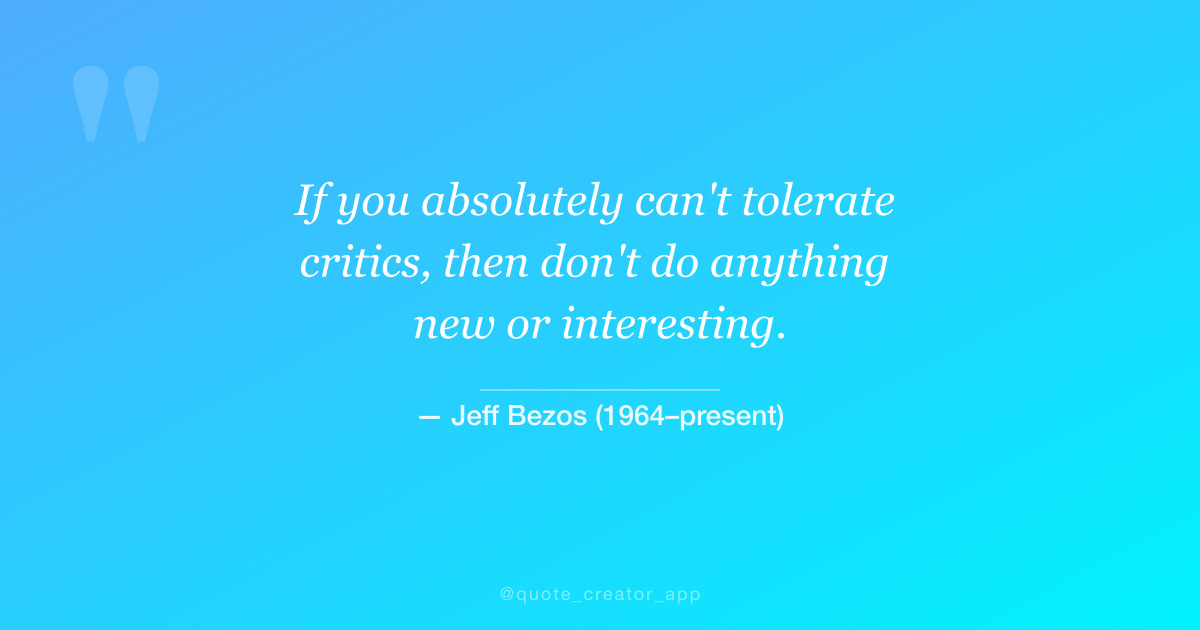
“If you absolutely can’t tolerate critics, then don’t do anything new or interesting.”
What this quote means
On the surface, this quote asserts a simple, almost mathematical truth: criticism and innovation go hand in hand — you cannot have one without the other. If you want to create something genuinely new, you must be prepared for people to question, doubt, and push back against what you are doing. The qualifier “absolutely” is deliberate. It is not enough to tolerate some criticism. The kind of criticism that accompanies real innovation can be loud, persistent, and personal. If you do not have the stomach for it, Bezos argues, you would be better off staying in safer territory.
The deeper insight is about the relationship between boldness and resilience. Any idea worth pursuing will challenge the status quo, and the status quo always resists. The quote reframes criticism not as a signal of failure but as evidence that you are doing something that matters. By this logic, a complete absence of criticism is actually a warning sign. If nobody is questioning what you are building, you have probably constructed something too familiar to provoke a reaction. Critics, in this view, are a compass — they point you toward the edges where new ground is being broken.
Bezos articulated this idea during a 2016 interview when asked about the scrutiny Amazon faced as it disrupted everything from bookstores to retailer supply chains to cloud computing. By then, Amazon had spent more than two decades weathering constant criticism — from Wall Street skeptics who called it a bubble, from publishers who resented its pricing power, from regulators concerned about its size. Each wave of criticism arrived precisely because Amazon was doing something unprecedented. The Washington Post, which Bezos purchased in 2013, had its own share of critics, and Bezos applied the same principle there: if you are not being criticized, you are probably not taking enough editorial risks.
Today, in a world of social media where criticism is immediate, public, and often harsh, Bezos’s words carry extra weight. Whether you are launching a startup, sharing creative work online, or voicing an unpopular opinion, the volume of criticism you receive is often proportional to how much your idea challenges the norm. The productive question is not “will people judge me?” but “is this worth being judged for?” If the answer is yes, then the critics are not a problem to solve — they are proof you are moving in the right direction.
About Jeff Bezos
Jeff Bezos was born in 1964 in Albuquerque, New Mexico, and raised in Houston and Miami. A gifted student from an early age, he graduated summa cum laude from Princeton University in 1986 with degrees in electrical engineering and computer science. After college, Bezos worked at several firms on Wall Street, eventually becoming the youngest senior vice president at the hedge fund D.E. Shaw. It was there, in 1994, that he noticed internet usage was growing at 2,300% per year — a statistic that made him think about what kind of business a person could build inside a growth rate like that.
He quit his job, drove cross-country to Seattle, and founded Amazon.com out of his garage — initially selling only books. Over the next three decades, Amazon expanded relentlessly into electronics, apparel, streaming entertainment, cloud computing, and artificial intelligence. Today it is one of the largest companies on Earth, and Amazon Web Services powers a significant portion of the internet. Bezos also founded Blue Origin, a rocket company pursuing reusable spaceflight, and owned The Washington Post from 2013 to 2024. His combination of long-term thinking, customer obsession, and willingness to be misunderstood made him the wealthiest person in the world for several years running.
One of Bezos’s most enduring ideas is the “regret minimization framework” — a personal decision-making tool in which he imagined himself at age 80 and asked whether he would regret not having tried something. That single mental exercise was what pushed him to leave a safe, high-paying Wall Street role to sell books on the internet in 1994. It is the same principle that drove Amazon into cloud computing when it seemed like a bizarre side project for an online bookstore, and the same principle that launched Blue Origin when reusable rockets seemed like science fiction. The thread connecting all of it is the one captured in this quote: meaningful work attracts critics. The choice is whether you let that stop you.
Create your own quote graphic with this quote
This is the kind of quote that resonates most when it is presented visually. A clean typographic layout, a fitting color palette, and readable font sizing can transform these words into a graphic that people save and share. If you want to turn this quote into an Instagram post, WhatsApp status, Pinterest pin, or reel cover, Quotes Creator gives you all the tools to do it in minutes — custom fonts, gradients, backgrounds, and export sizes ready for every major platform.
Tips for designing this quote
- ✓ Use a serif font (Georgia, Playfair Display) to honour the literary feel of the quote
- ✓ Keep the quote on one or two lines — shorter display text reads better on mobile
- ✓ Pair the quote with a soft gradient that matches the emotional tone: cool blue tones for boldness and forward-thinking
- ✓ Add the author name in a smaller, lighter weight below the quote
- ✓ Export in square format for Instagram feed and portrait for Stories or Pinterest
Create your own quote graphic with this quote
Turn this line into a shareable graphic in seconds — free, no signup needed. For video quotes and 100+ templates, try the Android app.
Advertisement
Enjoyed this article? Get more like it in your inbox.